Our Top Picks


A 28 mm miniature is an unforgiving print. The face, the weapon edge and the cloak folds all sit inside a few centimetres of plastic, so any wobble in filament diameter, extra stringing or glossy glare shows up immediately. Terrain is more forgiving, but it eats material fast, and a spool that feeds inconsistently can ruin a long print hours in. Choosing filament for a gaming table is therefore less about chasing exotic materials and more about matching a material class to the job: matte PLA for figures you plan to paint, a toughened PLA blend for pieces handled every session, PETG for scenery that must survive drops and car journeys, and a silk PLA when a display piece should shine straight off the build plate.
This guide gathers five 1.75 mm spools, each sold in a 1 kg size, that cover those jobs between them. Every specification quoted below — diameter, stated tolerance, spool weight and the maker’s recommended temperatures — is taken from the maker’s own labelling, because those are the numbers your slicer profile will be built around. Finishes are described the way the makers describe them: matte, standard or high-gloss silk.
As an Amazon Associate, we earn from qualifying purchases.
Quick Picks
- Polymaker PolyTerra PLA (Charcoal Black) — matte PLA that hides layer lines and gives primer an easy surface on painted figures.
- HATCHBOX PLA (Green) — a long-running standard PLA with a stated ±0.03 mm tolerance, well suited to bulk terrain and test prints.
- eSUN PLA+ (Red) — a toughened PLA blend for gaming pieces, tokens and bases that get handled, dropped and packed away often.
- OVERTURE PETG (Gold) — PETG with a stated ±0.02 mm tolerance for durable scenery, storage and table hardware.
- OVERTURE Silk PLA (Silk Copper) — a high-gloss metallic silk finish for trophies, display figures and unpainted centrepieces.
How to Choose
Start with the material class
PLA is the default for miniatures because it prints at modest temperatures, holds fine detail and needs no enclosure. Standard PLA is the baseline; matte PLA adds surface texture that softens the look of layer lines; PLA+ blends aim for extra toughness so thin parts flex a little instead of snapping. PETG sits a step up in durability and heat resistance, which suits terrain and functional table accessories more than delicate figures. Silk PLA is a display material: its gloss comes from the formulation, so it looks finished without paint but shows layer lines differently under light. Pick the class by the piece’s job first, then worry about brand.
Tolerance is the detail specification
Diameter consistency decides how evenly plastic flows through a small nozzle. Makers state tolerance on the listing: ±0.03 mm is common across the PLA family, while the PETG spool below states ±0.02 mm. On a miniature, uneven flow appears as alternating fat and thin layers, which roughens faces and fills in recessed detail. A tighter stated tolerance removes one variable when you print at small nozzles and thin layer heights, and it is one of the few specifications you can compare directly from the label.
Match temperatures to your machine
Every spool here is labelled with a recommended nozzle range, and they differ. HATCHBOX labels its PLA at 180–210 °C, Polymaker labels PolyTerra at 190–230 °C with a bed at 25–50 °C, and OVERTURE’s technical sheet for its silk PLA gives 200–220 °C. PETG runs hotter than the PLA family, following the range on its own label. Staying inside the maker’s window matters more for miniatures than for large parts, because small features spend longer near the nozzle and soften or string when the melt is too hot. Use the labelled range as the centre of your test prints rather than copying another brand’s profile.
Think about finish before you prime
Paint changes the equation. A matte surface, like the PolyTerra finish Polymaker describes, absorbs light, disguises layer lines and gives primer a slightly keyed surface to grip, which is why matte spools are popular with painters. Standard PLA takes primer well too, though its smoother face can show layer steps under raking light. Glossy silk finishes are the opposite choice: they are meant to be seen, suiting trophies and display pieces that will never meet a brush. If a piece will be painted, buy for print behaviour; if it will not, buy for the finish.
Spool format and storage habits
All five picks are 1 kg spools of 1.75 mm filament, the size most desktop FDM machines are built around. Polymaker winds PolyTerra on a recycled cardboard spool, while the others use conventional spools; cardboard runs fine on most holders but is worth checking against enclosed multi-material feeders that grip the spool edge. Whatever the format, filament absorbs moisture from room air over time, and damp filament strings and pops during printing — a particular nuisance on small parts. Keep spools sealed with their desiccant between sessions.
Polymaker PolyTerra PLA — Matte Finish for Painted Figures
Polymaker describes PolyTerra as a bioplastic-based PLA designed for ease of use, printing quality and reliability, and its defining trait for miniature work is the matte surface. That finish does two useful things on a 28 mm figure: it scatters light so layer lines read less harshly on camera and at the table, and it leaves a surface that primer grips readily. Polymaker labels the spool at 1.75 mm with a stated tolerance of ±0.03 mm, a nozzle range of 190–230 °C and a bed range of 25–50 °C, so it behaves like a conventional PLA in the slicer despite the different surface.
The Charcoal Black spool listed here is a sensible painter’s staple: dark undercoats, dungeon scenery and test prints all disappear into it, and the matte texture forgives minor surface banding. The recycled cardboard spool keeps plastic out of the packaging, though owners of enclosed multi-material systems should confirm their feeder handles cardboard edges. For painters who prime everything, this spool earns the first slot.
Specs
| Specification | Labelled detail |
|---|---|
| Material | Matte PLA (bioplastic-based) |
| Diameter | 1.75 mm |
| Stated tolerance | ±0.03 mm |
| Spool | 1 kg, recycled cardboard |
| Nozzle temperature | 190–230 °C |
| Bed temperature | 25–50 °C |
| Finish | Matte |
See the Polymaker PolyTerra PLA listing for the full colour range on this spool size.
HATCHBOX PLA — The Standard Spool for Terrain and Tests
HATCHBOX has sold its standard PLA for years, and the listing keeps the specification simple: 1.75 mm diameter, a stated dimensional accuracy of ±0.03 mm, a 1 kg spool, and a recommended nozzle temperature of 180–210 °C. The maker also notes that the material is plant-based, low-odour and does not require a heated bed, which makes it an easy tenant in a shared room or a small hobby space. The finish is a standard PLA surface — smoother and slightly glossier than a matte spool — so painted pieces benefit from a thorough primer coat.
For gaming tables, this is the workhorse role: ruined-city walls, hills, dungeon tiles, movement trays and the calibration prints that precede a serious miniature run. The Green spool listed here suits terrain builders who print foliage bases, alien jungle pieces or old-school flocked scenery and want the base colour working in their favour before paint. Nothing about the specification is exotic, and that is the point — predictable feeding keeps long scenery prints boring in the best way.
Specs
| Specification | Labelled detail |
|---|---|
| Material | PLA |
| Diameter | 1.75 mm |
| Stated tolerance | ±0.03 mm |
| Spool | 1 kg |
| Nozzle temperature | 180–210 °C |
| Heated bed | Not required, per maker |
| Finish | Standard |
See the HATCHBOX PLA listing for the maker’s full colour range in this spool size.
eSUN PLA+ — Toughened Blend for Pieces That Get Handled
Regular PLA is stiff, and stiffness turns into snapped spear shafts and broken banner poles once a miniature starts travelling to game nights. eSUN’s PLA+ is the maker’s toughened take on the material, sold as PLA Plus with the same 1.75 mm diameter and a stated dimensional accuracy of ±0.03 mm on a 1 kg spool. It prints within the familiar PLA family behaviour — no enclosure, no exotic hardware — while aiming for parts that tolerate knocks, drops and tight storage slots better than a standard blend.
That profile fits the objects a gaming table actually abuses: objective markers, tokens, measuring widgets, card and token holders, and bases for large monsters. The Red spool listed here is a natural fit for markers and counters you want to spot instantly across a crowded table. Painters should treat it like ordinary PLA under primer; players who leave pieces unpainted get a bright, consistent colour with a little more forgiveness built in.
Specs
| Specification | Labelled detail |
|---|---|
| Material | PLA+ (toughened PLA blend) |
| Diameter | 1.75 mm |
| Stated tolerance | ±0.03 mm |
| Spool | 1 kg |
| Colour listed | Red |
| Model | PLA+175R1KG |
See the eSUN PLA+ listing for the maker’s colour options on this spool size.
OVERTURE PETG — Durable Stock for Scenery and Hardware
Some prints earn their keep by surviving: folding terrain that rides in a backpack, clips and brackets for shelving, dice towers, card deck boxes and storage tubs. PETG is the usual answer, and OVERTURE’s spool states the specification terrain printers care about — 1.75 mm diameter with a stated dimensional accuracy of ±0.02 mm, the tightest figure in this guide, on a 1 kg spool. PETG runs hotter than the PLA family, following the range on its own label, and rewards a tuned first layer with parts that flex slightly under load instead of cracking.
The Gold spool listed here prints scenery with a warm metallic tone that can pass unpainted for treasure-room sets, temple terrain and trophy-style display pieces, while the material underneath stays table-tough. PETG can string more readily than PLA, so small, intricate miniatures are still better served by the PLA spools above; PETG’s home ground is the bigger, handled, load-bearing print. Buy it for the scenery box and the storage shelf rather than the character shelf.
Specs
| Specification | Labelled detail |
|---|---|
| Material | PETG |
| Diameter | 1.75 mm |
| Stated tolerance | ±0.02 mm |
| Spool | 1 kg |
| Colour listed | Gold |
| Finish | Gloss |
See the OVERTURE PETG listing for the maker’s colour options on this spool size.
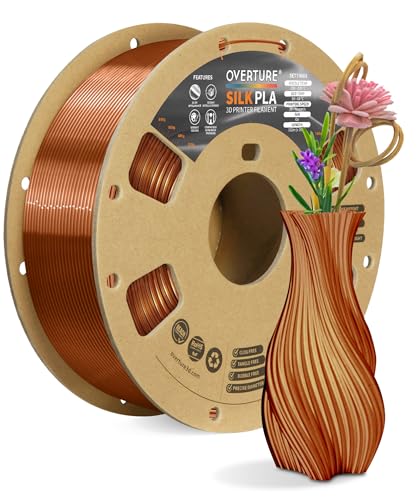
OVERTURE Silk PLA — Metallic Shine for Display Pieces
Silk PLA exists for prints that skip the paint queue entirely. OVERTURE labels this Silk Copper spool as a shiny, metallic-shine filament with a high-gloss finish, and its technical sheet recommends a nozzle range of 200–220 °C. The gloss comes from the formulation itself, so a well-tuned print comes off the plate looking polished, with layer lines visually softened by the reflective surface rather than hidden by texture. It is still PLA underneath, with the easy printing behaviour that implies.
On a gaming shelf, that finish suits award trophies for league winners, display busts, dragon figures printed large for the cabinet, and metallic-look props such as coins, relics and treasure piles for role-playing sessions. The trade-off is honest: silk blends are display materials first, so thin, fragile gaming pieces that get handled weekly belong on the PLA+ spool instead. Keep this one for prints people pick up to admire, not the ones they move across a grid.
Specs
| Specification | Labelled detail |
|---|---|
| Material | Silk PLA |
| Diameter | 1.75 mm |
| Spool | 1 kg |
| Nozzle temperature | 200–220 °C |
| Colour listed | Silk Copper |
| Finish | High-gloss metallic silk |
See the OVERTURE Silk PLA listing for the maker’s silk colour range on this spool size.
Products at a Glance
| Product | Material class | Stated tolerance | Spool | Best role |
|---|---|---|---|---|
| Polymaker PolyTerra PLA | Matte PLA | ±0.03 mm | 1 kg cardboard | Painted miniatures |
| HATCHBOX PLA | Standard PLA | ±0.03 mm | 1 kg | Terrain and test prints |
| eSUN PLA+ | Toughened PLA blend | ±0.03 mm | 1 kg | Handled gaming pieces |
| OVERTURE PETG | PETG | ±0.02 mm | 1 kg | Durable scenery and hardware |
| OVERTURE Silk PLA | Silk PLA | See maker listing | 1 kg | Unpainted display pieces |
Frequently Asked Questions
Can FDM filament really handle gaming miniatures?
Yes, within limits that filament choice helps define. Small nozzles and thin layers do the heavy lifting, but consistent diameter keeps flow even across tiny features, which is why the stated tolerance on each spool matters. Resin still wins for the finest display detail, yet a well-chosen PLA spool produces table-ready figures.
Why choose matte PLA over standard PLA for painted figures?
A matte surface scatters light, so layer lines look softer at table distance, and primer tends to grip the slightly textured face well. Standard PLA paints perfectly well too, especially under a full primer coat, but its smoother finish can show layer steps more clearly under harsh light. If every figure you print gets painted, matte is the easier starting point.
When is PETG worth choosing over PLA for a gaming table?
Choose PETG for prints that take physical abuse or mild heat: folding terrain, storage boxes, clips, dice towers and anything that travels in a bag or sits near a sunny window. Its durability and layer bonding suit bigger, handled parts. For delicate character miniatures, PLA and PLA+ remain easier to print cleanly, and PETG’s tendency to string makes tiny detail harder work.
How should spools be stored between printing sessions?
Keep filament sealed in its bag or a dry box with desiccant, away from humid rooms. Any filament that has absorbed moisture can string, pop and leave rough surfaces, which miniature prints show immediately. If a spool has sat open for weeks, dry it before an important print rather than reprinting the piece afterwards.
Conclusion
Filament decides what your printer’s detail work is worth. For painted miniatures, Polymaker’s PolyTerra brings a matte, primer-friendly surface and honest PLA manners. HATCHBOX PLA covers the terrain, tiles and test prints that consume most of a hobby spool. eSUN PLA+ adds toughness for markers, holders and bases that live a hard life, OVERTURE PETG steps in when scenery and storage hardware need real durability, and OVERTURE Silk PLA finishes display pieces in a metallic shine with no paint at all. Match the material class to the piece’s job, respect the temperatures on each label, and a 1 kg spool goes a long way across a gaming table.
FAQ
Can FDM filament really handle gaming miniatures?
Why choose matte PLA over standard PLA for painted figures?
When is PETG worth choosing over PLA for a gaming table?
How should spools be stored between printing sessions?
More from Amazon
Programs that pair well with the guide above. Offers and eligibility are set by Amazon and may change.
Free shipping on eligible items, Prime Video and more. Eligible new members can start with a free trial.
Start a Prime free trialAd-free music streaming. Eligible new subscribers can start with a free trial.
Try Music Unlimited freeA Prime membership for ages 18-24 with a trial period. Eligibility is set by Amazon.
See Prime for Young AdultsAudiobooks and podcasts to listen to on the go. Eligible new members can start with a free trial.
Try Audible freeAs an Amazon Associate we earn from qualifying purchases.