Our Top Picks
 ZOTAC Gaming GeForce RTX™ 3060 AMP White EditionPack of 19.1 x 5.6 x 1.6 inches2.2 poundsCheck on Amazon
The Radeon RX 7600 is the faster card at 1080p by a modest margin and adds AV1 encoding and lower launch-era cost, while the GeForce RTX 3060 12GB offers more video memory, a wider memory bus, stronger ray tracing and DLSS support; for most buyers the RX 7600 wins on frame rate and efficiency, and the RTX 3060 12GB wins when memory capacity or NVIDIA features matter.
Quick verdict
Reviewers who compare these two put the RX 7600 ahead in rasterized games, with margins reported anywhere from about 7 percent to around 15 to 20 percent depending on the outlet, the game selection and the resolution. That wide range is a reminder that no single number is definitive. The RTX 3060 12GB, in turn, pulls ahead when a game uses more than 8GB of memory, when ray tracing is on, or when DLSS is available and FSR is not the better option. One review summary reported by a comparison site concludes that the RTX 3060 12GB is the better buy unless it costs noticeably more than the RX 7600; that is a judgement about price, which this guide does not list.

ZOTAC Gaming GeForce RTX 3060 Twin Edge 12GB GDDR6 Gaming Graphics Card
Picked as a relevant option in this category.
View on Amazon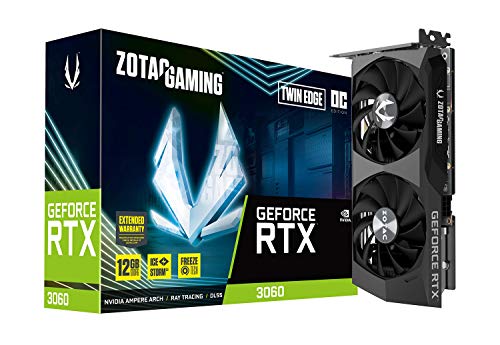
ZOTAC Gaming GeForce RTX 3060 Twin Edge OC 12GB GDDR6 192-bit 15 Gbps PCIE 4.0 Gaming Graphics Card, IceStorm 2.0 Cooling, Active Fan Control, Freeze Fan Stop ZT-A30600H-10M (Renewed)
Chosen because it specifies IceStorm 2.0 Cooling and Active Fan Control.
View on AmazonZOTAC Gaming GeForce RTX 3060 Twin Edge OC 12GB GDDR6 192-bit 15 Gbps PCIE 4.0 Gaming Graphics Card, IceStorm 2.0 Cooling, Active Fan Control, Freeze Fan Stop ZT-A30600H-10M
Chosen because it specifies IceStorm 2.0 Cooling and Active Fan Control.
View on AmazonZOTAC Gaming GeForce RTX™ 3060 AMP White Edition 12GB GDDR6 192-bit 15 Gbps PCIE 4.0 Gaming Graphics Card, IceStorm 2.0 Cooling, Active Fan Control, Freeze Fan Stop ZT-A30600F-10P
Chosen because it specifies IceStorm 2.0 Cooling and Active Fan Control.
View on AmazonSpecifications side by side
| Spec | Radeon RX 7600 | GeForce RTX 3060 12GB |
|---|---|---|
| Architecture | RDNA 3, TSMC 6nm | Ampere, Samsung 8nm |
| Shaders | 2,048 stream processors | 3,584 CUDA cores |
| Memory | 8GB GDDR6, 128-bit, 18 Gbps | 12GB GDDR6, 192-bit, 15 Gbps |
| Memory bandwidth | 288 GB/s plus Infinity Cache | 360 GB/s |
| Board power | 165W | 170W |
| PCIe interface | PCIe 4.0 x8 | PCIe 4.0 x16 |
| Upscaling | FSR (including newer versions on supported titles) | DLSS 2 upscaling; no DLSS frame generation |
| Video encoder | AV1 encode and decode | AV1 decode only; no AV1 encode |
| Ray tracing | Supported, weaker | Supported, stronger |
These numbers come from the makers’ product pages and spec databases such as TechPowerUp, and are cross-checked against comparison sites. Partner models vary in clocks and cooler design.
Why the RX 7600 is usually faster
The RX 7600 is a newer architecture with higher clocks and a large on-chip cache. The raw bandwidth figure of 288 GB/s understates its effective bandwidth because the cache absorbs many memory requests. Its theoretical compute rating, around 21.7 TFLOPS, is far above the RTX 3060’s roughly 12.7 TFLOPS, though the two vendors count shader throughput differently, so the paper gap is bigger than the real-world gap. In practice reviewers report a modest lead at 1080p that narrows at 1440p, where memory demands rise.
Why the RTX 3060 12GB still has a case
Memory capacity
Twelve gigabytes on a 192-bit bus is the card’s main strength. Games that exceed 8GB at their chosen settings can run noticeably worse on the 8GB RX 7600, with stutter or automatic texture downgrades. One comparison site claims the 12GB model holds about 12 percent higher averages in memory-bound scenes. Because that is a single-source figure, treat it as an indication, not a rule. For the same reason, anyone who mods games with high-resolution textures or edits video should lean toward the card with more memory.
Ray tracing and DLSS
Ampere has second-generation ray tracing cores and Tensor cores, which means the RTX 3060 loses less performance when ray tracing is on, and DLSS Super Resolution is available in a large catalog of games. NVIDIA’s DLSS frame generation is not supported on this generation. AMD’s FSR works on both cards, which narrows the upscaling gap in titles that offer it.
Productivity and AI
Software that uses CUDA, and local AI experiments that need memory, usually run better on the RTX 3060 12GB. A source cited by the search results calls it the better local AI card by a clear margin. The RX 7600 can run some of these workloads, but software support varies by application.
Platform, power and compatibility
Both cards fit ordinary PCIe slots and need one 8-pin power connector in most partner designs. Both list a system power recommendation in the 550W range from their makers, and neither requires a new socket or processor platform. Two details matter:
- The RX 7600 uses only eight PCIe lanes. On a PCIe 3.0 motherboard its bandwidth drops, and reviewers report a loss of a few percent in general and more when video memory fills. The RTX 3060 uses sixteen lanes and is less affected.
- Neither card has a 12VHPWR connector, so there is no special cable concern. Use the PCIe power leads that came with a quality power supply, and avoid daisy-chained splitters.
Cooling and noise depend on the specific partner model. Look at the dimensions in the product listing to be sure the card fits your case.
Which games and resolutions suit each card
| Use case | Leaning | Reason |
|---|---|---|
| 1080p, esports and older titles | RX 7600 | Higher raster speed |
| 1080p, new releases with high textures | RTX 3060 12GB | 12GB avoids memory limits |
| 1440p at medium settings | Close; RTX 3060 12GB for memory | Gap narrows at higher resolution |
| Ray tracing enabled | RTX 3060 12GB | Stronger RT hardware plus DLSS |
| Streaming with AV1 | RX 7600 | AV1 encoder present |
| CUDA apps, small AI models | RTX 3060 12GB | CUDA support and 12GB |
| PCIe 3.0 motherboard | RTX 3060 12GB | Sixteen lanes |
Neither card is designed for 4K play. Both can run older or lighter titles at 4K with reduced settings and upscaling, but that is not their target.
Upgrade logic
If you already own an RTX 3060 12GB, the RX 7600 is not an upgrade worth buying; the difference is small and you would give up memory. If you own a GTX 1060, GTX 1650 or RX 580 class card, either option is a major improvement. Buyers who can stretch to the next tier should also look at cards with 12GB or 16GB, because both of these are entry-level choices that will feel limited in a few years.
Availability is also a factor. The RTX 3060 12GB is a previous-generation product, so stock is irregular, and used cards are common. Used GPUs that were run for mining or heavy loads can carry wear, and many sellers offer no warranty; ask about the return policy. The RX 7600 is sold by several partners, and stock is more consistent.
Common mistakes
- Mixing up the two RTX 3060 versions. The 12GB model and the 8GB model are different cards; the 8GB one is slower and has a narrower bus.
- Comparing only FPS averages and ignoring memory behavior.
- Skipping the PCIe 3.0 check for the RX 7600 on an older board.
- Expecting DLSS frame generation on the RTX 3060; it is not supported.
- Choosing a card without checking the case size and power connector layout.
Frequently Asked Questions
Is the RX 7600 better than the RTX 3060 12GB?
It is faster in many rasterized games at 1080p, with reported leads ranging from single digits to about twenty percent. The RTX 3060 12GB is better in memory-heavy games, ray tracing and CUDA workloads. Which is better depends on your games and your needs.
Is 8GB enough for the RX 7600?
For 1080p gaming at medium to high settings, usually yes. A few newer games want more at their highest texture settings, and then the RTX 3060 12GB has the advantage. Publisher store pages list recommended video memory.
Does the RX 7600 support ray tracing?
Yes, but reviewers report weaker ray tracing results than from the RTX 3060 in many games. If you want ray tracing as a regular feature, the NVIDIA card handles it better.
Which has better upscaling?
The RTX 3060 supports DLSS Super Resolution, which many reviewers consider the stronger upscaler, while the RX 7600 uses AMD FSR. FSR works on both cards, so you can use it in titles that lack DLSS.
Which is better for streaming?
The RX 7600 can encode AV1 video, while the RTX 3060 cannot. The RTX 3060 has the mature NVENC encoder that most streaming software supports. Choose based on the codecs your platform and software use.
Will either card work on an older PC?
Yes, with the caveat that the RX 7600 uses fewer PCIe lanes and loses more on PCIe 3.0. Confirm the power supply has an 8-pin lead and that the case has room.
FAQ
Is the RX 7600 better than the RTX 3060 12GB?
Is 8GB enough for the RX 7600?
Does the RX 7600 support ray tracing?
Which has better upscaling?
Which is better for streaming?
Will either card work on an older PC?
More from Amazon
Programs that pair well with the guide above. Offers and eligibility are set by Amazon and may change.
Free shipping on eligible items, Prime Video and more. Eligible new members can start with a free trial.
Start a Prime free trialAd-free music streaming. Eligible new subscribers can start with a free trial.
Try Music Unlimited freeA Prime membership for ages 18-24 with a trial period. Eligibility is set by Amazon.
See Prime for Young AdultsAudiobooks and podcasts to listen to on the go. Eligible new members can start with a free trial.
Try Audible freeAs an Amazon Associate we earn from qualifying purchases.