Key takeaways
- Pro: Solid runtime for its class, with a 40V platform that shares batteries across trimmers and blowers.
- Pro: Widely available replacement parts and a mature owner community for troubleshooting.
- Con: The 16-inch deck means more overlap passes on a rectangular lot compared to a 17-inch model.
Switching from gas to battery power means giving up oil changes, spark plugs, and the ritual of priming and yanking. It also means accepting a new set of trade-offs: runtime anxiety, battery compatibility across your yard tools, and a price ladder that can feel arbitrary. The buyer comparing these options is usually solving the same concrete problem — a half-acre or smaller lawn where they want a clean start every Saturday without dragging a cord or carrying a can of fuel.
What separates a good battery lawn mower from a mediocre one is less about headline voltage and more about how the deck, motor, and battery capacity work together under real grass load. A mower that barely cuts damp bluegrass in week three of summer is worth less than a lower-voltage unit that handles the same job without stalling. This 2026 roundup compares published specifications, listed prices, and recurring owner feedback to help you match the machine to your yard without overpaying or under-equipping.
Our top picks
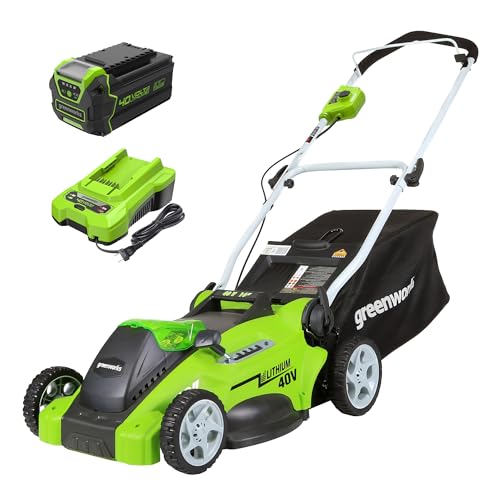 Greenworks 40V 16in Push Lawn Mower
- [16" LAWN MOWER] - This 40V lawn mower…
- [ULTRA LIGHTWEIGHT] - 35% lighter than steel deck…
- [SINGLE LEVER HEIGHT ADJUST] - 5 position height…
 Cordless Lawn Mower
- The 17-inch cutting deck and 6 height settings…
- Powered by two 20V 4.0Ah batteries, this walk…
- The 50L collection bag holds more clippings between…
 Greenworks 60V 21in Push Lawn Mower
- 50% more torque than 40V mowers & 3200…
- Built to handle rain, damp grass, and tough…
- Dual blades adjust power automatically for tall, wet,…
| Product | Key specs | |
|---|---|---|
| Greenworks 40V 16in Push Lawn Mower | [16" LAWN MOWER] - This 40V lawn mower… [ULTRA LIGHTWEIGHT] - 35% lighter than steel deck… [SINGLE LEVER HEIGHT ADJUST] - 5 position height… | Check price |
| Cordless Lawn Mower | The 17-inch cutting deck and 6 height settings… Powered by two 20V 4.0Ah batteries, this walk… The 50L collection bag holds more clippings between… | Check price |
| Greenworks 60V 21in Push Lawn Mower | 50% more torque than 40V mowers & 3200… Built to handle rain, damp grass, and tough… Dual blades adjust power automatically for tall, wet,… | Check price |
 Worx Cordless Lawn Mower Worx Cordless Lawn Mower | Equipped with two 20V 4.0Ah batteries, the WORX… Featuring a powerful brushless motor 2.0, experience 40%… Maintain a healthier greener lawn by mulching or… | Check price |
 Litheli 14 Inch Cordless Lawn Mower Litheli 14 Inch Cordless Lawn Mower | [Cutting Grass Strong]:The Walk-behind battery mowers can mow… [5 Mowing Height Adjustments] : The cordless lawn… [Brushless Motor]:The battery powered lawn mower is powered… | Check price |
 MZK 20V 13-Inch Electric Lawn Mower MZK 20V 13-Inch Electric Lawn Mower | Brushless and Electric Lawn Mower with Grass Bag… | Check price |
 Cordless Lawn Mower Cordless Lawn Mower | The 13-inch cutting deck and 5 height settings… The 3000 RPM brushless motor delivers up to… Powered by two 20V 4.0Ah batteries, this walk… | Check price |
 Greenworks 80V 21in Self-Propelled Lawn Mower Greenworks 80V 21in Self-Propelled Lawn Mower | [80V 21” SELF-PROPELLED LAWN MOWER] - Get more… [BRUSHLESS MOTOR / DURABLE STEEL DECK] - This… [SELF-PROPELLED] | Check price |
As an Amazon Associate we earn from qualifying purchases at no extra cost to you.
Quick Picks
| Product | Best for | Price |
|---|---|---|
| Greenworks 40V 16″ Push | Small-to-mid yards on a mid-range budget | $258.99 |
| Cordless 17″ Walk Behind | Best value under $150 with a wide deck | $139.98 |
| Greenworks 60V 21″ Push | Larger open yards needing extra deck width | $389.99 |
| Worx WG745 40V 17″ | Quarter-acre lots with tight storage | $213.75 |
| Litheli 14″ Push | Lightweight mowing for small or odd-shaped patches | $109.99 |
| MZK 20V 13″ | Compact brushless cutting on a tight budget | $119.98 |
| Cordless 13″ Walk Behind | Entry-level mowing under $110 | $109.98 |
| Greenworks 80V 21″ Self-Propelled | Hills, thick turf, and premium push-free comfort | $479.99 |
How We Picked
We narrowed the field on four criteria. First, deck width relative to price — a wider deck means fewer passes on the same lawn, and owners consistently flag pass count as their biggest frustration. Second, motor type and battery ecosystem — brushless motors run cooler and last longer, while proprietary battery platforms lock you into future purchases. Third, whether the included battery capacity is sufficient for a realistic single-session cut. Fourth, recurring complaint themes in owner feedback: premature stalling, weak height-adjust levers, and plastic drive components that strip under load.
The 8 Best Battery Lawn Mower in 2026
Greenworks 40V 16″ Push Lawn Mower, 4.0 Ah Battery and Charger
This is the sensible middle option for owners of a small-to-mid yard who want name-brand support without jumping to 60V pricing. The 4.0 Ah battery provides enough charge for a typical cut on a flat half-acre lot, and the 16-inch deck keeps the unit light enough to maneuver around flower beds.
- Pro: Solid runtime for its class, with a 40V platform that shares batteries across trimmers and blowers.
- Pro: Widely available replacement parts and a mature owner community for troubleshooting.
- Con: The 16-inch deck means more overlap passes on a rectangular lot compared to a 17-inch model.
Skip it if your lawn is mostly open and you want fewer passes — the 60V 21-inch below is a better fit despite the higher price.
Cordless Lawn Mower, 17 in Walk Behind for Yard & Garden
At $139.98 this unit undercuts the Greenworks 40V by more than $100 while offering a wider deck. It is the obvious value play for buyers whose primary concern is keeping total cost low without sacrificing cut width. Owner feedback is mixed on long-term durability, but the starting performance is adequate for light-to-moderate grass on a quarter-acre yard.
- Pro: Best price-per-inch-of-deck in this roundup, making it hard to argue against on paper.
- Pro: Wide 17-inch path reduces mowing time on open stretches.
- Con: Limited information on battery ecosystem means you may be stuck with a single-use platform.
Skip it if you already own tools from a major battery brand and want cross-compatibility.
Greenworks 60V 21″ Push Lawn Mower, 5.0 Ah Battery and Charger
This mower targets owners who need the widest push-deck option here without paying self-propelled prices. The 5.0 Ah battery paired with 60V power handles thicker, taller grass better than the 40V platform, and the 21-inch deck cuts a quarter-acre lot in noticeably fewer passes. It is the step-up pick for anyone whose lawn regularly exceeds knee-high growth.
- Pro: The combination of 60V and 5.0 Ah provides genuine headroom for dense or slightly overgrown grass.
- Pro: Shares the Greenworks battery ecosystem, so future tool purchases carry over.
- Con: Heavier than the 16-inch push model, which matters on slopes or if you lack storage space with stairs.
Skip it if your yard is flat, small, and you would rather save the $130 difference for a trimmer.
Worx Cordless Lawn Mower, 40V 17″ 2-in-1 Grass Mower WG745
Worx positions this for the quarter-acre homeowner who values compact storage and dual-function mowing (mulching and bagging in one pass). The 17-inch deck splits the difference between the Greenworks 16-inch and the wider 60V model, while the 40V platform keeps weight manageable. Owners frequently praise the fold-handle design that lets it tuck against a garage wall.
- Pro: Foldable handle and compact footprint make it the easiest to store in tight spaces.
- Pro: 2-in-1 mulch-and-bag capability adds versatility without a separate attachment.
- Con: The 4.0 Ah-equivalent runtime means a second battery is wise for anything approaching a half-acre.
Skip it if you regularly mow more than a quarter-acre — the runtime ceiling becomes a chore mid-session.
Litheli 14 Inch Cordless Lawn Mower with 5.0Ah Battery and Smart Charger
The Litheli earns attention because a 5.0 Ah battery is unusual at this price point. The 14-inch deck and brushless motor keep the overall package light and efficient, targeting small yard patches, side strips, and odd corners where a full-size mower is overkill. Height adjustment spans five positions from one to two and a half inches, which covers most residential grass types.
- Pro: A 5.0 Ah battery on a compact 14-inch mower means the runtime-to-weight ratio is generous for the size.
- Pro: Brushless motor reduces maintenance compared to brushed alternatives at similar price.
- Con: The 14-inch deck is genuinely narrow — mowing a large open area would become tedious fast.
Skip it if your primary mowing zone exceeds 3,000 square feet or is mostly open turf.
MZK 20V 13-Inch Electric Lawn Mower, Compact Brushless Mower
This is the smallest brushless option in the group and sits at a price just above the absolute floor. It suits renters, urban gardeners, and anyone with a strip of grass between a fence and a driveway. The 20V platform is lower-power, so it handles dry, maintained grass well but can bog in damp or overgrown conditions.
- Pro: Brushless motor at this voltage and price is uncommon, offering longer motor life.
- Pro: Compact and light enough to carry upstairs or toss in a car trunk for a second property.
- Con: The 13-inch deck and 20V combo limits it to very small, flat areas or maintenance mowing only.
Skip it if you need to cut anything thicker than well-maintained bluegrass or if you want a single mower for your whole yard.
Cordless Lawn Mower, 13-Inch Walk Behind for Yard Care
At $109.98 this is the cheapest unit in the roundup, and it exists to serve the buyer whose sole priority is a low entry price. The 13-inch deck mirrors the MZK, but without the confirmed brushless motor claim. It is a functional starting point for someone testing whether battery mowing fits their routine before committing to a pricier ecosystem.
- Pro: Lowest absolute cost in this group, making battery mowing accessible without meaningful financial risk.
- Pro: Simple design means fewer components that can fail or require replacement.
- Con: Build quality and motor longevity are less certain at this price tier compared to the branded alternatives.
Skip it if you plan to keep the mower beyond one or two seasons or if your grass is anything but thin and dry.
Greenworks 80V 21″ Self-Propelled Lawn Mower, 4.0 Ah Battery and Charger
This is the premium option, and the price reflects it. Self-propelled drive takes the physical effort out of pushing a wide deck, which matters most on gentle slopes, long straight stretches, or for anyone who finds a 21-inch push mower fatiguing. The 80V platform delivers the highest torque headroom in this group, and the 4.0 Ah battery is adequate but not generous for the motor size.
- Pro: Self-propelled drive transforms mowing a large flat lawn from exercise into a guided walk.
- Pro: 80V power handles thick, tall, or damp grass that stalls lesser mowers.
- Con: The 4.0 Ah battery paired with a 80V self-propelled motor is a runtime mismatch — budget for a second battery.
Skip it if your yard is flat, small, and you do not mind pushing — the premium buys you convenience, not cutting quality.
Buying Guide
Match Deck Width to Your Yard, Not to Your Ego
A wider deck means fewer passes, which means shorter mowing sessions and less fatigue. But a 21-inch deck that cannot turn in a fifteen-foot radius is a liability in a yard with tight beds and fence lines. Measure the narrowest gap between your obstacles before choosing. Anything under 3,000 square feet is well served by a 13-to-17-inch deck; beyond that, 21 inches starts earning its keep.
Battery Ecosystem Lock-In Matters More Than Voltage
High voltage alone does not guarantee a satisfying cut. What matters is whether the included battery amp-hours can sustain the motor long enough to finish your lawn in one session. More critically, check whether the brand shares one battery across mowers, trimmers, and blowers. Proprietary platforms that require a unique pack per tool inflate your long-term cost far beyond the initial mower price.
Brushless Motors Reduce Long-Term Maintenance
Brushed motors have carbon brushes that wear and eventually need replacement or cause power loss. Brushless designs eliminate that wear point entirely, which is why the Litheli and MZK stand out at their respective price tiers. If you plan to keep the mower for five or more seasons, brushless is worth prioritizing even if it means a slightly higher upfront cost.
Our Verdict
Top pick: The Greenworks 60V 21-inch Push offers the best balance of cutting power, deck width, and ecosystem compatibility for most residential yards without the self-propelled premium.
Budget pick: The Cordless 17-inch Walk Behind at $139.98 delivers a wide deck at a price that undercuts every branded competitor here, making it the easiest value recommendation if you accept a more limited support network.
Worth considering instead: If your lawn has gentle slopes or you simply want mowing to feel effortless, the Greenworks 80V Self-Propelled justifies its premium — provided you add a second battery to close the runtime gap.
FAQ
How long do battery lawn mower batteries last?
Lithium-ion packs in this class typically deliver several hundred full charge cycles before capacity drops noticeably, which translates to four or five seasons of regular weekend mowing. Store them indoors during winter and avoid leaving them fully drained to extend life.
Can a battery mower handle wet grass?
Lightly damp grass is manageable on higher-voltage models, but saturated turf overwhelms most battery mowers regardless of deck size because wet clippings clump and resist the blade. The 80V and 60V Greenworks options tolerate moisture better than sub-40V units, but no battery mower matches a gas engine in this condition.
Do I need a second battery?
If your yard takes longer than a single charge to mow, yes — carrying a spare eliminates mid-session downtime. The Greenworks 80V self-propelled and the Worx WG745 are the two most likely candidates for this, given their higher power draw relative to included pack capacity.
Is a self-propelled battery mower worth the extra cost?
It is worth it when the physical effort of pushing a wide deck over a full mowing session is the main deterrent to staying on schedule. For small flat yards under a quarter-acre, the savings from a push model are better spent on a second battery or a trimmer from the same platform.