Our Top Picks
 HITTITE Large Metal Chicken Coop with Run230.3"L x 118.1"W x 78.7"H230 x 118 x 79 inches113 poundsCheck on Amazon
 VAGGER 10x10x6.5 FT Metal Chicken Coop119.0"L x 119.0"W x 78.0"H119 x 119 x 78 inches62.81 poundsCheck on Amazon
 VEVOR Large Metal Chicken Coop with Run118.1"L x 236.2"W x 78.7"H118.11 x 236.22 x 78.74 inches93 poundsCheck on Amazon
Best chicken coops with run: the short answer
The best chicken coop with run is one that gives your flock enough usable space, keeps predators from reaching through or digging in, and lets you clean and inspect it without awkward work. For most backyard keepers, that means choosing a coop rated for fewer birds than its advertised maximum, then checking the run’s actual floor dimensions, mesh, roof coverage, ventilation, and access points before buying.
There is no single best model for every flock, and product dimensions and configurations can change. Treat manufacturer capacity as a starting point, not a welfare guarantee. The comparisons below focus on the features that determine whether a coop will work day to day.
HITTITE Large Metal Chicken Coop with Run, 19.19 x 9.84 x 6.56 ft Walk in Poultry Cage Chicken Run Pen, Outdoor Chicken Runs for Yard with Waterproof & Anti-UV Cover
Chosen because it specifies 19.19 x 9.84 x 6.56 ft Walk in Poultry Cage Chicken Run Pen.
View on AmazonVAGGER 10x10x6.5 FT Metal Chicken Coop, Large Chicken Run with Cover | Walk-In Chicken Run, Lockable Walk-in Door, Galvanized Steel Frame, Hexagonal Mesh, Waterproof UV Cover
Chosen because it specifies Large Chicken Run with Cover and Walk-In Chicken Run.
View on AmazonVEVOR Large Metal Chicken Coop with Run, 9.8x19.3x6.5 ft Walk-in Chicken Runs for Yard with Cover, Doom Roof Hen House with Security Lock for Outdoor and Backyard, Farm, Duck Rabbit Cage Poultry Pen
Chosen because it specifies 9.8x19.3x6.5 ft Walk-in Chicken Runs for Yard with Cover and Farm.
View on Amazon
Extra Large Chicken Coop,26x10x6.6FT Metal Chicken Run for Yard with Feeding Door,Walk-in Chicken Pen,Outdoor Poultry Cage with Anti-UV Cover
Chosen because it specifies 26x10x6.6FT Metal Chicken Run for Yard with Feeding Door and Walk-in Chicken Pen.
View on Amazon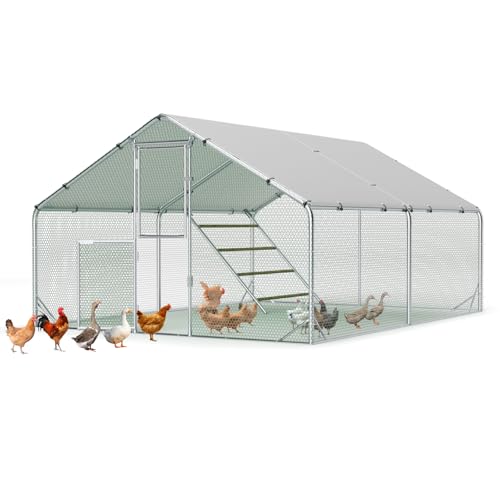
Sannwsg Large Metal Chicken Coop with Run, 10x13 FT Walk in Chicken Pen with Feeding Door, Secure Lock, Heavy Duty Poultry Cage with Waterproof Cover for Outdoor Farm Use
Chosen because it specifies 10x13 FT Walk in Chicken Pen with Feeding Door and Secure Lock.
View on Amazon
Large Walk-in Chicken Coop with Chicken Run, Galvanized Poultry Enclosure with Waterproof Anti-UV Cover and Security Lock, Ideal for Rabbit, Duck, Backyard and Farm Yard,9.8'x 6.6'x 6.6'
Chosen because it specifies Ideal for Rabbit and Duck.
View on AmazonExtra Large Chicken Coop,26x10x6.6FT Metal Chicken Run for Yard with Feeding Door,Walk-in Chicken Pen,Outdoor Poultry Cage with Anti-UV Cover
Chosen because it specifies 26x10x6.6FT Metal Chicken Run for Yard with Feeding Door and Walk-in Chicken Pen.
View on Amazon
NUGRIART Metal Chicken Coop 83"x38" Chicken Run Pen with Cover | Waterproof Cover, Portable Poultry Cage, Chicken Tractor for Chickens, Ducks, Rabbits & Small Animals, Outdoor Backyard Use.
Chosen because it specifies Waterproof Cover and Portable Poultry Cage.
View on AmazonCompare the main coop-and-run setups
| Setup | Practical starting flock | Run area to look for | Best fit | Main trade-off |
|---|---|---|---|---|
| Compact raised coop with attached run | 2–3 standard hens | At least 24 sq. ft. (2.2 sq. m.) | Small yards and short-term access to a larger fenced area | Limited room to forage; often tight to clean |
| Walk-in coop and run | 4–6 standard hens | About 40–60 sq. ft. (3.7–5.6 sq. m.) | Keepers who want easier access and a contained flock | Needs more yard space and a secure roof or cover |
| Large coop with a separate covered run | 6–10 standard hens | About 60–100 sq. ft. (5.6–9.3 sq. m.) | Long-term housing, harsh weather, or frequent predator pressure | Higher cost and more assembly; verify the structure is anchored |
These are planning ranges, not universal legal or husbandry standards. Breed size, time spent confined, local climate, and access to a secure yard all affect the space a flock needs. If the birds will remain in the run most of the day, favor the larger end of the range.
Choose by your yard, flock, and predator risk
| Your situation | What to prioritize | What to avoid |
|---|---|---|
| Two or three hens in a compact yard | A roomy run relative to the coop, a full-width cleaning door, and a rain-shedding roof | A high bird-count claim based only on roosting space |
| Four to six hens kept in the enclosure daily | Walk-in access, multiple vents, and enough run area for birds to move away from one another | A narrow attached run with no covered section or shade |
| Raccoons, dogs, foxes, or digging predators nearby | Welded wire, secure latches, a buried barrier or outward-facing apron, and a rigid frame | Chicken wire as the sole barrier or a lightweight run that can be lifted |
| Wet, windy, or snowy climate | Roofed shelter, raised dry bedding area, braced framing, and protected ventilation | Exposed nest boxes, flat roofs that collect snow, or sealed walls without airflow |
For a common four-hen flock, a useful worked check is to calculate run area rather than rely on the product’s bird rating. A run measuring 8 by 6 feet provides 48 square feet, or 12 square feet per hen. A 6-by-3-foot run provides only 18 square feet, or 4.5 square feet per hen. The smaller enclosure may function as a short-access pen, but it is a poor choice as the flock’s only daytime space. This calculation also ignores the area occupied by feeders, waterers, and shelters.
What separates a durable coop from a frustrating one
Predator resistance: inspect the weakest point
Chicken wire can contain chickens, but it is not a dependable barrier against many predators. Look for welded wire mesh with openings small enough to prevent a predator from reaching through; 1/2-inch hardware cloth is a common choice for vulnerable areas. Check whether it covers vents and the underside of the coop, not just the run walls. Doors should close flush, and latches should resist being nudged or lifted. Raccoons are capable of manipulating simple closures, so a locking carabiner or two-step latch can add security.
Predators may dig beneath an enclosure. A buried wire barrier or a wire apron extending outward along the ground can make digging harder. Secure the run to a solid frame and anchor that frame to the ground; a strong mesh panel is less useful if the whole structure can be pushed or lifted.
Ventilation without a draft across the roost
Hens need fresh air to remove moisture and ammonia, especially overnight. Choose a coop with vents high on opposing walls or under the eaves, ideally protected by mesh and a rain overhang. Air should circulate above roosting birds rather than blow directly across them. A coop that is completely sealed to “keep heat in” can trap damp air, while large unprotected openings can expose birds to driving rain and wind.
Cleaning access that matches the interior
A pull-out tray is convenient only if it reaches the areas where droppings collect and can be removed without tipping bedding across the yard. For a larger flock, a full-height door is often more useful: it lets you scrape the floor, replace litter, check corners, and retrieve a bird. Before choosing, compare door width and tray depth with the coop’s interior dimensions. Small pop doors make daily flock movement easy but do not replace a cleaning door.
Weather protection and useful run cover
Check that the roof sheds water away from the entrance and nesting boxes, with no exposed seams likely to leak. A raised floor can help in damp yards, but look for a stable ramp and a design that does not leave a cold, wet gap underneath. In hot climates, prioritize shade and cross-ventilation; in snowy regions, check roof support, pitch, and the manufacturer’s stated load guidance rather than assuming a lightweight cover will hold snow.
A covered run reduces mud and gives birds shelter, but a small roof over only one end is not all-weather protection. If the run is open-topped, consider local aerial predators and whether the flock can reach a secure covered area.
Assembly: count the steps after the box is opened
Assembly complexity depends on more than the number of panels. A large run may require two people, a level base, and time to square the frame before tightening it. Check whether the kit includes all fasteners, whether replacement parts are available, and whether the instructions show the mesh and latch details clearly. Plan the site first: leave access around the coop for cleaning, and ensure doors can swing fully open without hitting a fence.
How to make the final choice
- Start with adult flock size: Choose a capacity that leaves room for all birds after they reach full size, rather than using the maximum headcount as your target.
- Measure the run: Multiply its length by width, then divide by the number of hens. Compare the result with how many hours they will be confined.
- Trace the predator path: Inspect the floor, corners, vents, roof edge, door seams, and latch. Any unprotected opening can undermine stronger mesh elsewhere.
- Check the daily routine: Confirm that you can collect eggs, refill water, remove waste, and reach an ill or injured bird without dismantling anything.
- Match materials to weather: Favor braced construction and dependable drainage in exposed locations, with shade and high-level airflow in hot ones.
- Plan for growth: If you may add hens later, buy more run area now or confirm that the design can connect to a secure extension.
In practice, the best chicken coops with run are not necessarily the biggest or most feature-heavy. A modest enclosure with secure mesh, good airflow, dry shelter, and genuinely usable cleaning access is a better buy than a larger-looking kit with a cramped run or vulnerable latches. For a flock kept inside its enclosure most of the day, prioritize run area first, predator-proofing second, and easy maintenance third.
More from Amazon
Programs that pair well with the guide above. Offers and eligibility are set by Amazon and may change.
Free shipping on eligible items, Prime Video and more. Eligible new members can start with a free trial.
Start a Prime free trialAd-free music streaming. Eligible new subscribers can start with a free trial.
Try Music Unlimited freeA Prime membership for ages 18-24 with a trial period. Eligibility is set by Amazon.
See Prime for Young AdultsAudiobooks and podcasts to listen to on the go. Eligible new members can start with a free trial.
Try Audible freeAs an Amazon Associate we earn from qualifying purchases.