Our Top Picks


A good trivia game does something most board games cannot: it lets a history buff, a sports fan, and a casual player who mostly guesses all stay in the running until the final round. The five games below cover the main styles worth owning, from the traditional race around a question board to betting games where a smart wager beats a perfect memory, and a timeline game where you only need a rough sense of when things happened.
Every pick here is a boxed game with physical cards and components, so there is no app to install and no screen competing for attention. They differ mainly in group size, question style, and how much luck softens the gap between experts and beginners.
As an Amazon Associate, we earn from qualifying purchases.
Quick Picks
- Trivial Pursuit Classic Edition — the traditional board, 2,400 questions, and the six classic categories for purists.
- Wits & Wagers Vegas Edition — a betting twist where everyone answers every question and the best guess wins chips.
- Half Truth — designed by Ken Jennings and Richard Garfield, built so partial knowledge still scores.
- …I Should Have Known That! — a compact card game of everyday questions that fit in a small box.
- Chronology — a timeline game where you slot historical events into order instead of reciting dates.
How to Choose
Start with your group size. Two-player households need a game that works head to head, while party groups of eight or more need team play or a format where everyone answers at once, so nobody sits idle waiting for a turn.
Next, think about the knowledge gap at your table. Straight question-and-answer games reward the strongest generalist, which can frustrate everyone else. Betting and multiple-answer formats narrow that gap: a player who can eliminate two wrong options, or judge which guess at the table is closest, can score without knowing the exact fact.
Question volume matters for replay value. A few hundred cards repeat quickly if you play weekly, while a pool of several thousand questions lasts for years. Card-only games are also easier to store or take on a trip than full boards.
Finally, consider the style of question. Classic category trivia suits players who enjoy school-style recall. Timeline games suit people who think in stories and eras. Everyday-knowledge card games suit mixed family groups, because the questions cover daily life rather than specialist subjects.
Trivial Pursuit Classic Edition
This is the format most people picture when they hear the words trivia game. Players move a token around a circular board, land on category spaces, and answer questions across six classic categories: Geography, Entertainment, History, Arts and Literature, Science and Nature, and Sports and Leisure. A correct answer on a headquarters space earns a wedge, and collecting all six earns a trip to the centre for a final question.
The Classic Edition leans into the original look and feel, with a retro-style board and 2,400 questions spread across 400 cards. That question pool is the main reason to choose it over smaller games: a group that plays monthly can go a long time before hearing a repeat. The wedge system also gives the game structure, because a player strong in three categories still has to survive the other three.
It suits two to six players, and it works well in teams when the group is larger, which turns arguments about answers into part of the fun. Sessions run longer than the card games in this guide, so it fits an evening built around one main game. For households that want the definitive, traditional trivia board, this remains the benchmark.
Specs
| Detail | Value |
|---|---|
| Publisher | Hasbro Gaming |
| Players | 2 to 6, or teams |
| Recommended age | 16 and up |
| Questions | 2,400 on 400 cards |
| Categories | 6 classic categories |
| Model | C1940 |
See Trivial Pursuit Classic Edition on Amazon
Wits & Wagers Vegas Edition
Wits & Wagers removes the biggest weakness of trivia: the player who knows nothing still has a real chance. Every question has a numerical answer, such as a year, a weight, or a percentage. Everyone writes a guess on a dry erase board, the guesses are lined up from lowest to highest on the betting mat, and players then place poker chips on the guess they believe is closest without going over. A shrewd read of the table can beat the person who actually knew the fact.
The Vegas Edition adds a large felt betting mat with extra wagering areas, including options that pay out for backing the lowest or highest groups of guesses, which gives the betting phase more texture than the standard layout. It is built for five or more players and shines with big groups, because teams can share a board and the betting reveal produces a loud moment every single round.
A full game runs through seven questions, so it stays brisk and works as an opener or as the main event for a casual party. The dry erase boards, markers, and poker chips are all included, and the questions lean toward surprising statistics nobody can memorise in advance. Choose this one when your group prefers laughter and table talk over quiet concentration.
Specs
| Detail | Value |
|---|---|
| Publisher | Mattel Games |
| Players | 5 or more, teams supported |
| Recommended age | 13 and up |
| Betting mat | Felt mat, about 28 x 11 inches |
| Components | Dry erase boards, markers, poker chips, betting tokens |
| Model | HHT91 |
See Wits & Wagers Vegas Edition on Amazon
Half Truth
Half Truth was designed by two people who understand trivia from opposite ends: Ken Jennings, the most successful contestant in Jeopardy! history, and Richard Garfield, the designer behind Magic: The Gathering. Their answer to the usual trivia problem is a card format where every question offers six possible answers, and exactly three of them are correct. You score by picking a correct answer, and you can push your luck by naming a second or third one for a bigger reward.
That single design choice changes the feel of the game. Partial knowledge becomes valuable, because eliminating two obvious fakes already improves your odds, and everyone can engage with every card instead of waiting for a topic they know. The 500 question cards give the box a long life before repeats appear.
The game is aimed at teens, young adults, and families, with a recommended age of twelve and up, and the small box makes it easy to shelve or carry. Rounds move quickly, and bluffing about your confidence becomes a mini-game of its own. Pick Half Truth when your group likes trivia but dislikes being shut out by one expert.
Specs
| Detail | Value |
|---|---|
| Publisher | Studio71 Games |
| Designers | Ken Jennings and Richard Garfield |
| Question cards | 500 |
| Recommended age | 12 and up |
| Answer format | 6 options, 3 correct per card |
| Model | STUDHLFT01 |
…I Should Have Known That!
This compact card game from Hygge Games is built around a single joke: every question covers something you feel you ought to know. The deck asks about everyday facts, common sayings, simple geography, and the kind of general knowledge absorbed from daily life, and the scoring adds a sting, because wrong answers subtract points instead of simply earning nothing. That small rule keeps everyone honest and makes wild guessing a genuine gamble.
The box holds more than 400 questions across 110 cards, and the whole game fits in a package under six inches square, so it travels well and lives happily on a coffee table or in a holiday bag. There is no board, no tokens, and almost no setup: draw a card, read the question, and play passes around the group. It supports two or more players, which makes it one of the easiest picks in this guide for couples as well as families.
The tone is gentle and funny rather than competitive, and the recommended age of fourteen and up reflects question difficulty rather than content. Because the questions lean on common knowledge, younger teens and grandparents can play on fairly even terms. Choose it when you want trivia that fits into spare moments.
Specs
| Detail | Value |
|---|---|
| Publisher | Hygge Games |
| Players | 2 or more |
| Recommended age | 14 and up |
| Questions | Over 400 on 110 cards |
| Format | Card game, no board |
| Model | 21026 |
See …I Should Have Known That! on Amazon
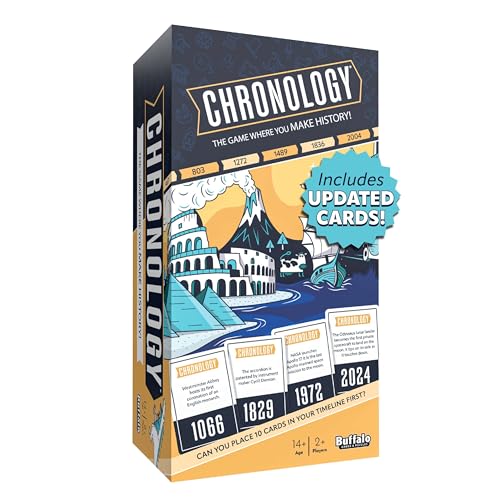
Chronology
Chronology replaces exact recall with a sense of proportion. Each card names a historical event, invention, or milestone, and your job is to place it in the right gap in your personal timeline of cards. Early in the game the gaps are wide and easy; as your timeline grows to five, six, or seven cards, the gaps narrow and the decisions get deliciously hard. The first player to build a timeline of ten cards wins.
You never need to name a date. Knowing that the telephone arrived before the aeroplane, and that both came before the moon landing, is enough to play well, and the arguments about whether the dishwasher or the microwave came first are the heart of the game. It supports two or more players and suits ages fourteen and up.
Because the challenge scales with your own timeline, beginners and history enthusiasts face a similar level of difficulty in the same game, which few trivia designs manage. A full game usually fits inside half an hour. Choose Chronology when your group enjoys history, storytelling, and educated guesses more than rapid-fire recall.
Specs
| Detail | Value |
|---|---|
| Publisher | Buffalo Games |
| Players | 2 or more |
| Recommended age | 14 and up |
| Goal | First to a timeline of 10 cards |
| Knowledge needed | Relative order, not exact dates |
| Model | 159 |
Products at a Glance
| Game | Publisher | Players | Age | Style |
|---|---|---|---|---|
| Trivial Pursuit Classic Edition | Hasbro Gaming | 2 to 6 | 16+ | Classic category board |
| Wits & Wagers Vegas Edition | Mattel Games | 5 or more | 13+ | Guess and bet |
| Half Truth | Studio71 Games | Small groups | 12+ | Multiple correct answers |
| …I Should Have Known That! | Hygge Games | 2 or more | 14+ | Everyday knowledge cards |
| Chronology | Buffalo Games | 2 or more | 14+ | Timeline placement |
FAQ
Which trivia game is best for a large party group?
Wits & Wagers Vegas Edition handles big groups best, because everyone writes a guess and places bets on every question, and teams can share a single board. Its seven-question format also keeps the energy high and the game short enough to replay.
Which trivia game works well with just two players?
Chronology and …I Should Have Known That! both support two or more players and lose nothing at that count. Chronology suits couples who enjoy history and deduction, while the Hygge card game is lighter, faster, and easy to play in short bursts.
How do these games stop one expert from winning every time?
Betting and partial-credit formats level the field. Wits & Wagers lets you win chips by backing another player’s guess, and Half Truth rewards eliminating wrong answers and judging odds, so table sense and nerve count alongside raw knowledge.
How long does a typical game from this list take?
Most card-based picks finish in about half an hour, and Wits & Wagers ends after seven questions. Trivial Pursuit Classic Edition is the longest session here, because collecting six wedges and winning a final question takes a full evening with a large group.
Conclusion
The right trivia game depends on the people around your table. Trivial Pursuit Classic Edition remains the safest choice for traditionalists who want depth and a big question pool. Wits & Wagers Vegas Edition is the party pick, Half Truth rewards clever partial knowledge, …I Should Have Known That! covers casual everyday play in the smallest box, and Chronology turns history into a deduction puzzle anyone can enjoy.
FAQ
Which trivia game is best for a large party group?
Which trivia game works well with just two players?
How do these games stop one expert from winning every time?
How long does a typical game from this list take?
More from Amazon
Programs that pair well with the guide above. Offers and eligibility are set by Amazon and may change.
Free shipping on eligible items, Prime Video and more. Eligible new members can start with a free trial.
Start a Prime free trialAd-free music streaming. Eligible new subscribers can start with a free trial.
Try Music Unlimited freeA Prime membership for ages 18-24 with a trial period. Eligibility is set by Amazon.
See Prime for Young AdultsAudiobooks and podcasts to listen to on the go. Eligible new members can start with a free trial.
Try Audible freeAs an Amazon Associate we earn from qualifying purchases.