Key takeaways
- A spec-based Nintendo Switch 2 review covering the 7.9-inch 120Hz display, DLSS performance, Joy-Con 2 mouse mode, GameChat, battery life, and backward compatibility.
As an Amazon Associate we earn from qualifying purchases.
Affiliate disclosure: This article contains affiliate links. If you buy through them, this site may earn a commission at no additional cost to you.
The Nintendo Switch 2, launched on June 5, 2025, is a deliberately conservative successor in the best sense of that phrase. Nintendo did not reinvent the hybrid concept that made the original system so successful. Instead, the company kept the detachable controllers, the dock, and the ability to move a game from a television to a handheld screen in seconds, and then addressed almost every technical limitation that had become harder to ignore over the original console’s long life. The screen is larger and sharper, the processor is dramatically more capable, the controllers attach differently and do more, and communication features that were previously absent are now built into the system itself.
That raises an obvious question: is a more powerful version of the same idea enough, especially when choices such as an LCD panel rather than OLED and a new storage card format involve real compromises? On paper, the Switch 2 is not a minor refresh. Published figures show a console that can target higher resolutions, higher frame rates, modern upscaling, and more demanding game worlds while preserving access to most of an existing Switch library. At the same time, battery life at the demanding end and the storage expansion requirement deserve honest scrutiny. This review is built from published specifications and launch coverage, and the picture that emerges is of a system designed for longevity.
Design and Display: Familiar Shape, Noticeably Better Screen
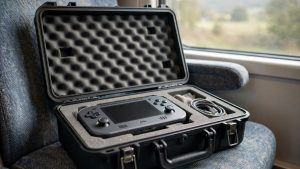
The first impression is scale. The Switch 2 carries a 7.9-inch display, a substantial step up from the original model’s screen, and the console itself feels like a larger, more mature evolution of the same design language. It remains unmistakably a Switch, with detachable controllers on either side and a dock for television play, but proportions have shifted to accommodate the bigger panel and the more capable hardware behind it.
At the back, a larger kickstand now spans much of the rear of the console. A wider, more stable stand makes shared play away from a television more practical, supports a broader range of viewing angles, and reduces the precarious feeling that a narrow stand can create on uneven surfaces.
Practicality also improves with two USB-C ports, one on the top and one on the bottom. The bottom port handles docking and charging, while the top port allows more flexible charging and accessory arrangements in tabletop mode, where a cable exiting the bottom can get in the way. It also supports the system’s new camera-based communication features.
The display itself is where the upgrade becomes most immediately visible. The 7.9-inch LCD runs at 1080p in handheld mode, supports HDR10, and can reach refresh rates of up to 120Hz, with variable refresh rate support to help smooth out fluctuations in frame delivery. Each element of that specification matters. The move to 1080p gives games a cleaner, less soft image on a larger screen, where lower resolutions become easier to notice. HDR10 support allows for a wider range between dark and bright areas where games implement it. A refresh ceiling of 120Hz creates headroom for titles that target higher frame rates, and variable refresh rate helps prevent the judder that appears when a game’s output does not line up neatly with a fixed refresh cycle.
There is, however, a trade-off: the panel is LCD rather than OLED, so the perfect blacks and per-pixel contrast that OLED owners value are not present here. The resolution, refresh rate, size, and HDR support all represent clear progress, and LCD technology at this level can still produce a bright, sharp, responsive image. But for players who prioritized the deep contrast of the earlier OLED model, this is a genuine step sideways in one dimension, even as almost every other display metric moves forward. In bright rooms and fast-moving games, sharpness and motion clarity tend to dominate. In dark scenes, contrast becomes harder to overlook.
Performance and DLSS: The Real Generational Leap
If the display is the most visible upgrade, the processor is the most consequential one. The Switch 2 uses a custom NVIDIA processor with support for DLSS upscaling and ray tracing. Those two technologies signal a shift in how a Nintendo console achieves its results. Rather than relying purely on raw rendering at a target resolution, the system can render at a lower internal resolution and use DLSS, an AI-driven upscaling method, to reconstruct a sharper final image. Used well, that approach frees processing resources for frame rate, effects, and world complexity while maintaining a convincing level of detail on screen.
The practical headline is docked output at up to 4K on a compatible television. That figure should be read carefully. Up to 4K describes the output ceiling, not a promise that every game will render natively at that resolution at all times. The more meaningful development is the combination of a stronger processor, DLSS, and the 120Hz and variable refresh support in handheld mode. Together, they give developers a toolkit of trade-offs: prioritize resolution, prioritize frame rate, or balance the two with upscaling bridging the gap. The original Switch increasingly forced visible compromises as game ambition grew. The Switch 2, on published specifications, has far more flexibility before those compromises become severe.
Ray-tracing support adds future-proofing. It can improve reflections, lighting, and shadows, but it is computationally expensive, and its presence should not be mistaken for a guarantee that it will feature prominently in every release. Its inclusion matters mainly as an indicator of a modern architecture that developers can deploy selectively.
For players, the expected benefits are straightforward: games that struggled on the older hardware have a path to smoother delivery, detail can increase, and multiplatform releases that previously required heavy reductions become more plausible in fuller form. Launch coverage framed the performance jump as the defining difference between the generations, and the specifications support that framing. DLSS in particular can extend a console’s useful life, because upscaling tends to improve as developers gain experience with it.
Joy-Con 2 and Mouse Mode: Magnets, Plus a Genuinely New Idea
The Joy-Con 2 controllers keep the familiar two-piece, detachable layout, but the connection method has changed. Instead of sliding along rails, the new controllers attach magnetically to the sides of the console. The benefit is partly tactile and partly practical: attaching and removing them becomes a quicker, cleaner action, with less mechanical fuss and a more secure-feeling connection when in place. Detachable controllers remain central to the Switch identity, enabling handheld play, single-controller multiplayer, and motion-based and tabletop configurations, so refining how they connect touches almost every way the system is used.
The headline addition is mouse control. Each Joy-Con 2 can be turned on its side and used as a mouse on a suitable surface. That opens design possibilities that a conventional controller cannot easily replicate: precise pointer control for strategy and simulation titles, more accurate aiming in suitable games, menu and creative tools that benefit from cursor movement, and entirely new mini-game and interface concepts built around sliding a controller across a table. It is the kind of feature that sounds like a novelty in a specification list but could become significant if developers embrace it, because it effectively gives every owner a pointer device without requiring a separate peripheral.
Mouse mode also reinforces what has always distinguished Nintendo hardware. Where rival systems tend to compete on processing power alone, the Switch 2 pairs its performance increase with an input experiment. The honest assessment is that mouse control will likely shine in specific genres rather than everywhere. Strategy games, point-and-click adventures, and creative applications are natural fits; fast action titles designed around twin sticks may gain little. Even so, including the capability in the standard controllers, on each side, means developers can rely on its availability rather than treating it as an optional accessory.
Otherwise, the Joy-Con 2 controllers build on established strengths: they remain versatile, shareable, and central to local multiplayer. The magnetic attachment, mouse functionality, and new communication button make them feel like a considered redesign rather than a repackaging.
GameChat: Communication Finally Built In
One of the most notable gaps in the original Switch experience was communication. The Switch 2 addresses it directly with GameChat, accessed through a dedicated C Button on the controller. GameChat supports voice chat, screen sharing, and video, with video enabled by a USB-C camera that is sold separately. A built-in microphone with noise filtering means voice communication does not depend on an external headset or a phone application workaround, which represents a meaningful change in how social play on the platform is structured.
The significance is less about any single feature and more about integration. Voice, screen sharing, and optional video inside the console’s own interface lower the friction of playing with friends remotely. Screen sharing suits the social style of many Nintendo titles, where watching a friend attempt a level or navigate a race can be as entertaining as playing. Noise filtering on the built-in microphone is pragmatic, since living rooms contain televisions and ambient sound that a bare microphone would otherwise pass into a chat.
There are caveats. Video requires the separate camera, so the full GameChat experience is not entirely contained in the box. Players who prefer not to be on camera can treat voice and screen sharing as the core offering. Even so, GameChat closes a long-standing weakness. For families coordinating play across households and friend groups whose gaming has moved online, built-in communication makes the Switch 2 a more complete social machine than its predecessor.
Battery Reality: The Number That Needs Context
Battery specifications require careful reading. The Switch 2 contains a 5,220 mAh battery, with a rated range of roughly 2 to 6.5 hours depending on the game. That is a wide spread, and the honest interpretation is that both ends of it are informative. Lighter titles, older library games, and modest brightness settings can be expected to sit toward the upper end. Demanding releases pushing the processor, the 120Hz display, and wireless communication features will pull play time toward the lower end.
This is the predictable cost of the performance leap. A larger, higher-resolution, faster-refreshing screen and a much stronger processor draw more power, and physics limits what a handheld enclosure can hold. For a long journey built around a demanding game, access to charging is close to essential, whereas mixed or lighter play presents far less concern. The top USB-C port helps, making charging in tabletop mode more convenient.
Compared with the broader handheld market, such a range is not unusual for a device attempting console-class output in portable form. Still, buyers upgrading from later revisions of the original Switch, which could stretch longer on undemanding games, may notice the difference. Battery life is where the Switch 2 most clearly trades endurance for capability, and anyone whose primary use is long, untethered sessions should weigh that trade directly.
Library and Backward Compatibility: The Back Catalogue Is the Launch Asset
A new console’s early library is usually its weakest point. Nintendo mitigated that risk in two ways: a major launch title, and broad backward compatibility. Most Nintendo Switch games are compatible with the Switch 2, which means an existing collection largely carries forward rather than being stranded on old hardware. For upgraders, that continuity protects the value of years of purchases. For newcomers, it provides an enormous catalogue from day one, spanning some of the most acclaimed games of the previous generation.
Select titles also receive enhancements under the Nintendo Switch 2 Edition label, with upgrades that are in some cases free and in other cases paid. Enhanced versions can use the stronger hardware for improved resolution, performance, or added features, giving standout older games a second life. Paid upgrades for games a player already owns will not please everyone, however, and their value depends on how substantial the improvements are. Free upgrades are an unambiguous benefit; paid ones should be assessed title by title, and the charge for some enhancements belongs on the list of genuine drawbacks, even if the underlying compatibility policy is generous.
Headlining the launch was Mario Kart World, a fitting flagship because the series demonstrates the platform’s strengths: local and online multiplayer, broad accessibility, and long-term replay value. It introduces an open-world structure and knockout modes, expanding familiar circuit racing into a connected environment and adding elimination-style pressure. An open world gives the stronger hardware something visible to do, while knockout modes give a long-running formula a fresh competitive edge. Combined with the inherited library, the system does not depend on a single game to justify itself in its early months.
Storage ties the library story together. The console includes 256GB of internal storage, a healthy increase reflecting how much larger modern games have become. Expansion, however, works only with microSD Express cards. The internal capacity should cover a reasonable collection, while players with large digital libraries should expect to invest in the newer, faster card format eventually.
The Honest Drawbacks
No verdict on the Switch 2 is credible without consolidating its compromises. Four stand out.
First, the display technology. An LCD panel, however sharp and fast, cannot match OLED for black levels and contrast. Nintendo presumably balanced cost, brightness, longevity, and supply considerations, but players who loved the previous OLED screen will register this as a loss in one specific respect.
Second, battery life at the demanding end. A lower bound of roughly two hours for intensive games is limiting for travel and long sessions away from power. The range is understandable given the hardware, but understanding it does not remove the inconvenience.
Third, storage expansion. Requiring microSD Express cards means older, slower cards from an existing collection cannot be used to expand the Switch 2, and the newer format carries the premium typical of faster media. The technical rationale is sound, since game loading and streaming demands have risen with the hardware’s capabilities, but it remains an additional consideration for buyers with big libraries.
Fourth, paid upgrades. While many enhancements are welcome and some are free, charging for certain Nintendo Switch 2 Edition upgrades of already-owned games adds friction to an otherwise strong compatibility story.
None of these is a deal-breaker on its own, and each has a rationale behind it. Together, though, they define the terms of the purchase: this is a powerful, well-judged system whose compromises cluster around endurance, display contrast, and the extra spending that can accumulate around the console itself, rather than around its core performance or library.
Verdict: Who the Switch 2 Suits
The Nintendo Switch 2 succeeds by refusing to gamble with a formula that worked. It keeps the hybrid design, the shareable controllers, and the library continuity that defined its predecessor, and it layers on the things that predecessor most lacked: a large 1080p display with HDR10, up to 120Hz refresh and variable refresh rate, a modern NVIDIA processor with DLSS and ray-tracing support, docked output at up to 4K, magnetic Joy-Con 2 controllers with a genuinely inventive mouse mode, and integrated GameChat with voice, screen sharing, and optional video. Mario Kart World gives it a flagship launch title with open-world ambition, and backward compatibility gives it depth from the start.
It suits several kinds of player especially well. Existing Switch owners with sizable libraries gain the most straightforward upgrade, since most of that library carries across and select favorites can look and run better than before. Families and local multiplayer groups get a more capable, more stable, and more social version of the shared-play machine they already understand. Newcomers get the strongest possible entry point into the catalogue, with hardware that will not feel dated quickly. Players who primarily want the deepest possible contrast from an OLED screen, or who need the longest possible untethered battery life for demanding games, are the ones who should pause and weigh the trade-offs most carefully.
Taken as a whole, the Switch 2 is an evolution executed with discipline. Its best qualities are the ones that will still matter years from now: performance headroom, smart upscaling, a deep and compatible library, and controllers that invite developers to try something new. Its weaknesses are real but clearly defined, and none of them undermines the central proposition. For anyone who values the freedom to play the same game on a television and on the move, this is the most complete and capable expression of that idea Nintendo has produced.
More from Amazon
Programs that pair well with the guide above. Offers and eligibility are set by Amazon and may change.
Free shipping on eligible items, Prime Video and more. Eligible new members can start with a free trial.
Start a Prime free trialAd-free music streaming. Eligible new subscribers can start with a free trial.
Try Music Unlimited freeA Prime membership for ages 18-24 with a trial period. Eligibility is set by Amazon.
See Prime for Young AdultsAudiobooks and podcasts to listen to on the go. Eligible new members can start with a free trial.
Try Audible freeAs an Amazon Associate we earn from qualifying purchases.