
Key takeaways
- Measure Your Inseam and Sitting Height: Put on the shoes you plan to race in. Sit in your racing seat in your preferred driving posture. Measure the distance from your hip joint (greater trochanter) down along your thigh to your knee, and from your knee to the sole of your heel. This total distance dictates your baseline pedal reach.
- Determine Your Knee Angle: Use a simple goniometer or a smartphone camera to check your knee angle. When your foot fully depresses the brake pedal (especially heavy load cell brakes requiring 80 to 150 lbs of force), your knee should not lock straight, nor should it bend sharper than 110 degrees. Aim for a comfortable 120- to 130-degree bend for GT rigs.
- Check Rig Clearance and Width: Measure the inner width of your rig’s pedal deck area. Standard aluminum profile rigs typically provide 16 to 19 inches (41 to 48 cm) of horizontal clearance. Ensure your pedal plate, such as a heavy-duty base plate or an inverted bracket set, has at least 1 inch (2.5 cm) of clearance on either side to allow for angle adjustments.
- Account for Pedal Travel Depth: Keep in mind that pedals do not remain static. Measure the throw of your pedals—clutches and throttles can travel up to 3 to 4 inches (7.6 to 10 cm) forward. Ensure there is enough clearance behind your pedal plate and against any wall or monitor stands to prevent the pedal arms from making contact with external structures.
What's inside
The Short Answer
For an ergonomic and realistic driving experience, the ideal configuration in our sim racing pedal plate distance and angle guide depends heavily on your seating posture. For a standard upright GT-style setup, position your pedal plate 32 to 42 inches (81 to 107 cm) from your seat’s hip point, set at an angle of 15 to 22 degrees. For a reclined, low-slung Formula-style setup, extend the distance to 36 to 46 inches (91 to 117 cm) and elevate the pedal plate to an angle of 25 to 40 degrees. Ensuring your knees maintain a 120- to 150-degree bend when the pedals are fully depressed is the gold standard for preventing joint strain and maximizing brake modulation control.
Standard Sizes
When planning your sim rig layout, understanding the physical footprint and adjustability limits of pedal plates and brackets is essential. Heavy-duty aftermarket brackets and modular pedal assemblies require specific floor space and clearance. Below are the standard dimensions and angle recommendations across the most common racing disciplines:
As an Amazon Associate we earn from qualifying purchases at no extra cost to you. Product prices and availability are accurate as of the date shown and are subject to change.
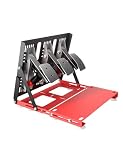


| Rig Style & Configuration | Ideal Distance Range (Hip to Pedal) | Recommended Plate Angle | Standard Plate Footprint (W x D) |
|---|---|---|---|
| GT / Touring / Rally (Upright posture, seat back at 95°–110°) | 32" – 42" (81 – 107 cm) |
15° – 22° | 13" x 15" to 15" x 18" (33 x 38 cm to 38 x 46 cm) |
| Formula / Prototype (Reclined posture, hips low, feet elevated) | 36" – 46" (91 – 117 cm) |
25° – 40° | 14" x 16" to 16" x 20" (36 x 41 cm to 41 x 51 cm) |
| Inverted Pedal Setups (Hanging clutch/brake, floor gas) | 30" – 38" (76 – 97 cm) |
5° – 15° (base plate) 75° – 85° (pedal face) |
16" x 14" x 12" (H) (41 x 36 x 30 cm) |
| Desk / Wheel Stand (Compact, non-fixed office chair) | 28" – 36" (71 – 91 cm) |
0° – 10° | 12" x 12" to 14" x 14" (30 x 30 cm to 36 x 36 cm) |
How to Measure Your Space
Setting up your pedal deck correctly requires precise measurements of your physical space and your body geometry. As sim racing hardware evolves into 2026, manufacturers are offering more modularity, making preparation even more critical. Follow these steps to map out your pedal plate position:
- Measure Your Inseam and Sitting Height: Put on the shoes you plan to race in. Sit in your racing seat in your preferred driving posture. Measure the distance from your hip joint (greater trochanter) down along your thigh to your knee, and from your knee to the sole of your heel. This total distance dictates your baseline pedal reach.
- Determine Your Knee Angle: Use a simple goniometer or a smartphone camera to check your knee angle. When your foot fully depresses the brake pedal (especially heavy load cell brakes requiring 80 to 150 lbs of force), your knee should not lock straight, nor should it bend sharper than 110 degrees. Aim for a comfortable 120- to 130-degree bend for GT rigs.
- Check Rig Clearance and Width: Measure the inner width of your rig’s pedal deck area. Standard aluminum profile rigs typically provide 16 to 19 inches (41 to 48 cm) of horizontal clearance. Ensure your pedal plate, such as a heavy-duty base plate or an inverted bracket set, has at least 1 inch (2.5 cm) of clearance on either side to allow for angle adjustments.
- Account for Pedal Travel Depth: Keep in mind that pedals do not remain static. Measure the throw of your pedals—clutches and throttles can travel up to 3 to 4 inches (7.6 to 10 cm) forward. Ensure there is enough clearance behind your pedal plate and against any wall or monitor stands to prevent the pedal arms from making contact with external structures.
By Room or Use Case
Every home sim racing setup is unique, governed by the type of racing you prefer and the physical constraints of your room. Here is how to configure your pedal plate based on specific use cases:
GT and Rally Racing Setups
If you primarily race GT3, touring cars, or rally stages, you want an upright, command-style seating position. Your seat will be mounted relatively high, with your hips sitting slightly above your heels. For this use case, position your pedal deck lower relative to the seat cushion. The pedal plate angle should be moderate—around 15 to 20 degrees. This allows you to press down and forward on the pedals, utilizing your leg muscles effectively without straining your Achilles tendons. High-quality modular pedals like the Thrustmaster Raceline Pedals III (ranging from $160 to $180) fit perfectly in this layout due to their adjustable faceplates and progressive travel profiles.
Formula and Prototype Racing Setups
Formula racing demands a highly reclined posture where your hips are positioned incredibly close to the floor, and your heels are raised nearly level with your chest. In this scenario, your pedal plate must be raised and angled steeply, usually between 30 and 40 degrees. This steep angle ensures that the bottoms of your feet rest flat against the pedal faces rather than pointing upward, which would cause severe ankle fatigue over long stints. When using highly adjustable hydraulic or load cell units like Simjack UT pedals (ranging from $70 to $110 for base plates), elevating the entire pedal deck on profile risers is necessary to achieve this authentic single-seater geometry.
Inverted Pedal Configurations
For those seeking the ultimate road-car realism, inverted pedals simulate the hanging pedal feel found in real-world passenger and GT cars. Utilizing an aftermarket inverted pedal kit (typically priced between $75 and $95 for heavy-duty brackets compatible with Logitech G PRO, Moza, or Simagic units) shifts the pivot point of the clutch and brake to the top. For inverted setups, the bottom base plate should remain relatively flat (5 to 10 degrees), while the vertical bracket face holds the hanging pedals at a steep 75- to 85-degree angle relative to the floor. This setup requires a deeper footprint—at least 16 inches (41 cm) of horizontal depth—and a rigid rig frame to handle the leverage of pressing high up on the hanging arms.
Compact / Desk-Based Racing Setups
If your sim rig is a temporary setup at an office desk, ergonomics can be challenging due to non-locking chairs. Keep your pedal plate distance short—around 28 to 32 inches (71 to 81 cm)—and keep the angle flat (under 10 degrees). A steep angle in a desk environment will push your office chair backward every time you press the brakes. Opt for a compact base plate, and consider using a wheel stand with a built-in cradle to lock your chair casters in place.
Common Sizing Mistakes
A poorly configured pedal deck can lead to physical discomfort and slower lap times. Avoid these common pitfalls when setting up your rig:
- Setting the Pedal Angle Too Vertical: Many racers assume a 90-degree vertical pedal face provides the most direct input. However, unless your feet are highly elevated (Formula style), a vertical pedal forces your foot into constant dorsiflexion, causing shin splints and rapid ankle fatigue. Always angle the plate back toward you by at least 15 degrees in standard seats.
- Ignoring Rig Flex Under Heavy Braking: High-end load cell pedals require significant force to operate. If your pedal plate is made of thin sheet metal or is poorly braced, it will flex forward under heavy braking. This flex absorbs your physical input, ruins muscle memory, and artificially alters your pedal distance by up to an inch during hard stops. Opt for reinforced steel or thick aluminum profile mounts.
- Inadequate Heel Plate Height: If your heel plate is too low relative to the pivot point of your pedals, your heels will slide forward or lift off the deck during braking. Ensure your heel rest is height-adjustable or elevated enough so that your heels stay firmly planted, allowing you to pivot your foot naturally.
- Setting the Distance Too Far: It is a common mistake to set pedals far away to mimic a spacious real-world car. In a sim rig, if your leg is fully extended when braking, you lose fine-motor control over the trail-braking phase and put immense pressure on your lower back. Keep a noticeable bend in your knee even at 100% pedal depression.
FAQ
How do I stop my sim racing pedals from sliding on carpet or hardwood?
If you do not have a dedicated metal cockpit, pedals will slide easily under heavy braking. To prevent this, mount your pedal set to a dedicated wooden or metal base plate that rests against the back wall, or use a wheel stand that links your chair directly to the pedal plate. Heavy-duty rubber grip mats or high-friction caster cups for your office chair can also stabilize your position.
What is the difference between floor-mounted and inverted pedals?
Floor-mounted (or F1-style) pedals pivot from the bottom, meaning the pedal face arches away from you as you press it. This is standard in open-wheel race cars. Inverted pedals pivot from the top, swinging down and forward, which mimics the pedal geometry of most production road cars, drift cars, and GT3 machinery.
How high should my heel rest be relative to the pedal faces?
Your heel rest should generally sit about 1.5 to 2.5 inches (3.8 to 6.4 cm) below the bottom edge of your pedal faces. This height allows the ball of your foot to rest comfortably in the center of the pedal face, maximizing leverage and preventing your toes from slipping over the top of the pedal during rapid transitions.
Does pedal angle affect brake pressure performance?
Yes. The angle of the pedal plate directly affects how your leg muscles transfer energy to the brake pedal. A plate angled too low forces you to use your calf muscles, which fatigue quickly. A correctly angled plate (15 to 25 degrees) allows you to push using your quadriceps and glutes, offering much greater consistency and control over high-pressure load cell sensors.


