
Key takeaways
- Budget Sim Racing ($250 – $400): Includes entry-level direct drive bundles (like the MOZA R3 at $279.99) that come with a base, steering wheel, and basic pedals. These operate under 5 Nm of torque and are perfect for desk mounting.
- Mid-Range Sim Racing ($500 – $900): Wheelbases offering 8 Nm to 12 Nm of torque. These are sold as standalone bases and require a dedicated wheel rim and a sturdy metal cockpit.
- Premium Sim Racing ($1,000 – $2,000+): Professional-grade wheelbases offering 15 Nm to 25 Nm of torque with ultra-low latency, multi-protocol wireless connectivity, and premium steering rims wrapped in genuine Alcantara or carbon fiber.
- Budget Automotive Tools ($25 – $40): Standard all-metal click-style torque wrenches (such as the EPAuto or HERONIX models) featuring mechanical spring scales, knurled steel grips, and basic blow-molded storage cases.
- Premium Automotive Tools ($80 – $200+): Digital smart wrenches (such as the SUERCUP model) featuring LCD screens, multiple measurement units (Ft.Lb, In.Lb, Nm, Kg.cm), memory storage presets, and high-precision strain gauges.
What's inside
- Decide These 3 Things First
- Choosing Your Sim Torque Output: Entry-Level vs. High-End
- Chassis Construction and Mounting Footprint
- Sim Performance, Power Draw, and Signal Latency
- Real-World Automotive Wheel Torque: Wrench Drive Sizes and Ranges
- Price Tiers: Sim Rigs vs. Garage Tools
- Warranty, Calibration, and Long-Term Maintenance
- Spec Checklist
- Red Flags
- FAQ
When searching for how to choose a direct drive wheel torque, buyers frequently run into a confusing intersection of two entirely different industries. In the home entertainment, gaming, and simulation space, “direct drive torque” refers to the force feedback power of a sim racing steering wheel base, measured in Newton-meters (Nm). In the home garage and automotive maintenance space, “wheel torque” refers to the mechanical force required to tighten lug nuts on a physical car wheel using a 1/2-inch drive torque wrench, measured in foot-pounds (Ft.Lb).
- Decide These 3 Things First
- Choosing Your Sim Torque Output: Entry-Level vs. High-End
- Chassis Construction and Mounting Footprint
- Sim Performance, Power Draw, and Signal Latency
- Real-World Automotive Wheel Torque: Wrench Drive Sizes and Ranges
- Price Tiers: Sim Rigs vs. Garage Tools
- Warranty, Calibration, and Long-Term Maintenance
- Spec Checklist
- Red Flags
- FAQ
Whether you are building a state-of-the-art virtual racing cockpit in your game room or setting up a home garage bay for seasonal tire swaps, choosing the wrong torque specifications can lead to disastrous results. In sim racing, buying an overpowered wheelbase can easily flex a weak desk to the point of breaking, or even cause physical wrist strain. Conversely, buying a weak automotive torque wrench or using the wrong drive size can lead to under-tightened lug nuts that risk shearing off on the highway.
As an Amazon Associate we earn from qualifying purchases at no extra cost to you. Product prices and availability are accurate as of the date shown and are subject to change.



This comprehensive guide breaks down exactly how to choose a direct drive wheel torque for both virtual racing rigs and real-world garage wheel maintenance, ensuring you buy the exact power and precision your home setup requires.
Decide These 3 Things First
Before looking at specific model specs or opening your wallet, you must establish three baseline criteria for your home space:
- Your Mounting Platform: For sim racing, a direct drive motor must be mounted to something solid. If you plan to clamp your wheel to a standard hollow-core office desk, you cannot safely exceed 5 Nm of torque. If you own a heavy, dedicated steel or aluminum profile (8020) rig, you can comfortably handle 10 Nm to 25 Nm of force.
- Your Target Application: If you are setting up a virtual racing rig, determine if you are a casual gamer or a competitive simulation enthusiast. For garage work, determine whether you are performing light maintenance on bicycles and motorcycles, or heavy-duty tire rotations on large SUVs and trucks.
- Digital Precision vs. Mechanical Click: If you are buying a garage torque tool, decide if you prefer the tactile, mechanical “click” of a preset spring wrench, or the digital beep and real-time LED readout of an electronic sensor. Digital wrenches offer broader torque ranges and higher accuracy but require batteries and cost more.
Choosing Your Sim Torque Output: Entry-Level vs. High-End
For virtual racing, direct drive (DD) technology connects the steering wheel directly to the motor shaft, eliminating the lag, friction, and mushiness of belt or gear systems. The primary metric of a DD wheelbase is its peak torque, measured in Newton-meters (Nm).
For beginners and desk-bound racers, an entry-level torque output of 3 Nm to 5 Nm is the sweet spot. A prime example is the MOZA R3 Bundle Racing Wheel, Direct Drive Base, Pedals Simulator Kit for PC. Priced at $279.99, its 3.9 Nm motor delivers crisp, immediate road details without overpowering your wrists or shaking a standard desk to pieces. It represents a highly accessible entry point for those wanting to transition from sloppy gear-driven wheels to pure direct drive fidelity.
If you have a dedicated metal cockpit, upgrading to a mid-range base of 8 Nm to 12 Nm allows you to feel sustained cornering forces (holding torque) without the signal “clipping” (saturating and losing detail) during heavy curb strikes. Professional-grade bases pushing 15 Nm to 25 Nm are reserved for those seeking 1:1 realism matching real-world IndyCar or GT3 steering weights.
Chassis Construction and Mounting Footprint
Direct drive sim bases are heavy, compact blocks of metal. Entry-level 3.9 Nm to 5 Nm bases usually weigh between 5 and 8 lbs and feature compact footprints of roughly 5 x 5 x 4 inches, making them easy to mount via temporary table clamps.
As torque increases to 10 Nm and beyond, bases utilize heavy-duty industrial servo motors housed in solid CNC-machined aluminum casings. These mid-to-high-end bases can weigh anywhere from 15 to 28 lbs. They require permanent hard-mounting using M6 or M8 bolts in specific pattern configurations (typically 78mm x 66mm or front-mounting brackets). The immense rotational force of a high-torque motor will quickly strip threads or bend thin metal plate mounts, meaning your rig’s wheel deck must be constructed of at least 3mm-thick carbon steel or heavy aluminum profiles.
Sim Performance, Power Draw, and Signal Latency
A direct drive motor is only as good as its internal controller. High-torque bases require significant power to react instantly to in-game physics. Power supplies for entry-level bases draw around 90 Watts to 120 Watts, while high-torque 20 Nm bases can pull over 450 Watts during heavy spikes.
When selecting a base, look at the motor’s slew rate, which measures how fast the motor can output torque (expressed in Nm/ms). A higher slew rate (typically 1.5 to 3.0 Nm/ms) means sharp transitions—like hitting a patch of ice or a concrete barrier—are transmitted to your hands with zero perceived latency. Lower-quality direct drive motors may have high peak torque but sluggish slew rates, resulting in a heavy, muddy steering feel rather than sharp, realistic feedback.
Real-World Automotive Wheel Torque: Wrench Drive Sizes and Ranges
If you are looking to torque the physical wheels on your car, you are dealing with a completely different set of specifications. Most automotive wheel lug nuts require between 80 Ft.Lb and 150 Ft.Lb of torque to be properly secured. To safely handle these loads, you need a 1/2-inch drive torque wrench.
For budget-conscious home mechanics, a mechanical click-style wrench is the standard. The EPAuto 1/2-inch Drive Click Torque Wrench, priced at $35.87, offers a classic 10 to 150 Ft.Lb (13.6 to 203.5 N/m) range. This is the ideal window for standard sedans and light crossovers.
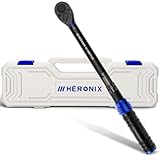
If you own larger vehicles, SUVs, or half-ton trucks, you will want a slightly wider range. The HERONIX 1/2 Inch Drive Click Torque Wrench, priced at $28.49, steps up the range from 10 to 180 Ft.Lb (13.6 to 244.0 Nm). It features a 72-tooth dual-direction ratchet and boasts a ±3% accuracy rating, making it highly versatile for motorcycles, cars, and heavy-duty bicycle repairs alike.
For those who want maximum precision with no guesswork, digital wrenches are the premium choice. The SUERCUP 1/2-Inch Drive Digital Torque Wrench retails for $98.86 and spans a massive 3.8 to 250.8 Ft.Lb range. Instead of listening for a mechanical click, which can be hard to hear in a noisy garage, the digital unit utilizes a backlit LCD screen, LED progress lights, and an audible buzzer that warns you as you approach your target torque, preventing accidental over-tightening.
Price Tiers: Sim Rigs vs. Garage Tools
Your budget will quickly dictate the level of performance and features available to you. As we look at the landscape of home entertainment and garage setups in 2026, the market has segmented into highly defined pricing brackets:
- Budget Sim Racing ($250 – $400): Includes entry-level direct drive bundles (like the MOZA R3 at $279.99) that come with a base, steering wheel, and basic pedals. These operate under 5 Nm of torque and are perfect for desk mounting.
- Mid-Range Sim Racing ($500 – $900): Wheelbases offering 8 Nm to 12 Nm of torque. These are sold as standalone bases and require a dedicated wheel rim and a sturdy metal cockpit.
- Premium Sim Racing ($1,000 – $2,000+): Professional-grade wheelbases offering 15 Nm to 25 Nm of torque with ultra-low latency, multi-protocol wireless connectivity, and premium steering rims wrapped in genuine Alcantara or carbon fiber.
- Budget Automotive Tools ($25 – $40): Standard all-metal click-style torque wrenches (such as the EPAuto or HERONIX models) featuring mechanical spring scales, knurled steel grips, and basic blow-molded storage cases.
- Premium Automotive Tools ($80 – $200+): Digital smart wrenches (such as the SUERCUP model) featuring LCD screens, multiple measurement units (Ft.Lb, In.Lb, Nm, Kg.cm), memory storage presets, and high-precision strain gauges.
Warranty, Calibration, and Long-Term Maintenance
Sim racing wheelbases are complex electronic devices. Most reputable manufacturers offer a 1-year to 2-year warranty. Because these bases rely heavily on firmware to translate game physics into motor currents, look for brands with active software support. A direct drive motor itself has virtually no moving parts to wear out, meaning a high-quality base can easily last a decade if it has proper thermal management and isn’t subjected to physical drops.
For garage torque wrenches, calibration is your most critical maintenance factor. Over time, the internal spring of a click wrench or the digital sensor of an electronic wrench will drift. High-quality tools are calibrated at the factory to an accuracy of ±3% or ±4% and include a certificate of calibration. To maintain this accuracy, mechanical click wrenches must always be wound back down to their lowest setting (typically 10 Ft.Lb) before being stored. Leaving them tensioned will ruin the spring calibration. Digital wrenches do not suffer from spring fatigue but require fresh batteries to ensure the digital strain gauge reads accurately.
Spec Checklist
Use this quick-reference table to match your specific needs to the right torque class, whether you are building a virtual sim rig or working on a real car in the driveway.
| Specification / Use Case | Budget Option | Mid-Range Option | Premium Option |
|---|---|---|---|
| Sim Racing Torque (Nm) | 3.0 Nm – 5.0 Nm (e.g., MOZA R3) | 8.0 Nm – 12.0 Nm | 15.0 Nm – 25.0 Nm |
| Sim Rig Mounting Requirements | Table clamp or basic wheel stand | Rigid steel wheel stand or entry-level rig | Heavy-duty 8020 aluminum profile cockpit |
| Sim Base Power Supply | 90W – 120W | 180W – 250W | 350W – 500W+ |
| Garage Wrench Type | Mechanical Click (e.g., EPAuto / HERONIX) | Heavy-Duty Mechanical / Basic Digital | Advanced Digital Smart Wrench (e.g., SUERCUP) |
| Garage Wrench Range | 10 – 150 Ft.Lb | 10 – 180 Ft.Lb | 3.8 – 250.8 Ft.Lb |
| Wrench Accuracy Rating | ±4% Clockwise | ±3% Clockwise | ±2% Clockwise / ±3% Counter-Clockwise |
Red Flags
Avoid these common pitfalls when shopping for direct drive wheel bases and automotive torque tools:
- Plastic Quick-Releases on Sim Bases: High-torque sim motors generate violent forces. Avoid bases that use plastic quick-release mechanisms to attach the steering wheel to the shaft. These will flex, wear down, and eventually snap under high torque loads. Look for solid aluminum ball-lock quick releases.
- Lack of Active Cooling on High-Torque Bases: Any sim base pushing over 10 Nm of torque should have robust passive cooling fins or an internal fan. Small, completely sealed plastic housings will heat up during long endurance races, causing “thermal throttling” where the base automatically cuts its torque in half to prevent melting.
- Wrenches with No Storage Case: A torque wrench is a precision instrument, not a standard breaker bar. Never buy a torque wrench that does not come with a dedicated, hard-plastic protective case. Storing it loose in a metal toolbox will knock it out of calibration quickly.
- Unmarked or Painted Scales on Click Wrenches: Avoid cheap mechanical wrenches with painted-on torque scales. These paint markings quickly rub off from grease and oil, leaving you with an unusable tool. Look for stamped or laser-etched scales on the steel sleeve.
FAQ
Is 5 Nm of torque enough for a realistic direct drive sim racing experience?
Yes. For most casual drivers and those mounting their wheel to a standard desk, 3.9 Nm to 5 Nm of torque (like the MOZA R3) is plenty of power. It provides incredibly fast, detailed feedback that allows you to feel loss of traction, road texture, and weight transfer far better than any gear- or belt-driven wheel, without causing physical fatigue during long play sessions.
What is the difference between peak torque and holding torque?
Peak torque is the absolute maximum force a sim racing motor can output for a fraction of a second, such as when you hit a curb or crash into a wall. Holding torque is the sustained force the motor can continuously output through a long, high-speed corner. Cheap motors may boast high peak torque but have very low holding torque, resulting in a wheel that feels weak during sustained turns.
Why do I need a 1/2-inch drive torque wrench instead of a 3/8-inch drive for my car wheels?
Automotive lug nuts typically require 80 to 150 Ft.Lb of torque. A 3/8-inch drive wrench is designed for lighter work (typically topping out around 80 Ft.Lb) and has a thinner steel shaft that can bend or snap under the heavy loads required for car wheels. A 1/2-inch drive tool is built with a thicker steel body and a larger ratcheting head designed to handle high-torque automotive applications safely.
How often do I need to calibrate my wheel torque tools and sim bases?
Sim racing direct drive bases do not require manual calibration, though you should regularly update their firmware to keep the motor controllers optimized. Automotive torque wrenches, however, should be calibrated once a year or every 5,000 clicks if used frequently. If you accidentally drop your torque wrench on a concrete garage floor, you should have it recalibrated immediately, as physical impacts can shift the internal spring alignment.


