
Key takeaways
- Your Platform Compatibility (PC vs. Console): If you are racing on a PC, your choices are virtually endless. PC Windows recognizes independent USB controllers, meaning you can plug a standalone handbrake directly into your motherboard alongside any wheel brand. If you race on an Xbox or PlayStation, however, you must plug your handbrake directly into your wheel base. This limits you to proprietary ecosystems (like Fanatec, Thrustmaster, or Logitech) unless you use expensive, third-party signal converters.
- Your Preferred Racing Discipline (Drift vs. Rally vs. GT): Drift enthusiasts typically require a tall, vertical lever mounted close to the steering wheel for quick, instinctive grabs. Rally drivers often prefer a slightly angled vertical lever that sits lower down, next to a sequential shifter. If you occasionally run gymkhana but mostly drive road or GT cars, a convertible handbrake that can lay flat (horizontal) is highly recommended.
- Mounting Surface and Rig Space: You must decide if you are mounting the unit to a dedicated aluminum extrusion cockpit, a wheel stand, or a standard wooden desk. A heavy-duty handbrake pulled with 20 pounds of force will rip a weak desk clamp loose or warp a thin metal wheel stand plate. Assess your mounting surface before choosing between a lightweight budget unit and a heavy-duty steel model.
What's inside
When building or upgrading a virtual racing cockpit, most drivers pour their entire budget into a high-torque direct-drive wheel and a load-cell pedal set. The handbrake is frequently treated as an afterthought—a cheap add-on purchased quickly to complete a drift or rally setup. This is where the frustration begins.
The most common mistake sim racers make when researching what to look for in sim racing handbrake units is buying a device with a simple binary switch. In a real car, pulling a hydraulic handbrake is a highly modular, sensory experience; you can drag the rear brakes slightly to rotate the chassis, or lock them completely to initiate a slide. A binary handbrake acts like a keyboard button—it is either 0% or 100% engaged, completely destroying your ability to modulate drift angles or execute precise Scandinavian flicks in rally simulators.
As an Amazon Associate we earn from qualifying purchases at no extra cost to you. Product prices and availability are accurate as of the date shown and are subject to change.


![RYLNOK 64bit PC USB Handbrake Upgrade Sim Racing Gamges Handbrake For Logitech G25 G27 G29 G920 T500 T300 2m Nylon Wire Reinforced Spring Black And Clamp Simulate [windows]](https://m.media-amazon.com/images/I/41x-rjj7aqL._SL160_.jpg)
Another major pitfall is ignoring structural rigidity. A handbrake is subjected to sudden, violent pulling forces. If you mount a cheap, thin-gauge aluminum frame to your rig, it will flex under pressure, ruining your muscle memory and eventually snapping at the pivot point. Before you spend your money, you must understand the mechanical and electronic factors that separate a realistic, durable simulator input from a fragile toy.
Decide These 3 Things First
Before diving into individual specifications, you must narrow down your options by making three fundamental decisions about your racing style and cockpit layout.
- Your Platform Compatibility (PC vs. Console): If you are racing on a PC, your choices are virtually endless. PC Windows recognizes independent USB controllers, meaning you can plug a standalone handbrake directly into your motherboard alongside any wheel brand. If you race on an Xbox or PlayStation, however, you must plug your handbrake directly into your wheel base. This limits you to proprietary ecosystems (like Fanatec, Thrustmaster, or Logitech) unless you use expensive, third-party signal converters.
- Your Preferred Racing Discipline (Drift vs. Rally vs. GT): Drift enthusiasts typically require a tall, vertical lever mounted close to the steering wheel for quick, instinctive grabs. Rally drivers often prefer a slightly angled vertical lever that sits lower down, next to a sequential shifter. If you occasionally run gymkhana but mostly drive road or GT cars, a convertible handbrake that can lay flat (horizontal) is highly recommended.
- Mounting Surface and Rig Space: You must decide if you are mounting the unit to a dedicated aluminum extrusion cockpit, a wheel stand, or a standard wooden desk. A heavy-duty handbrake pulled with 20 pounds of force will rip a weak desk clamp loose or warp a thin metal wheel stand plate. Assess your mounting surface before choosing between a lightweight budget unit and a heavy-duty steel model.
1. Sensor Technology and Resolution
As we look at what to look for in sim racing handbrake designs in 2026, the shift toward contactless magnetic sensors is practically complete, making older potentiometer-based designs obsolete. The sensor is the brain of the handbrake; it translates the physical travel of the lever into a digital signal for your computer.
You will find three primary sensor types on the market today:
- Potentiometers: These use physical contact wipers to measure distance. They are incredibly cheap but prone to wearing out over time as dust, hair, and pet dander get trapped inside the housing, causing signal “flicker” and dead zones.
- Hall Effect Sensors (Contactless Magnets): This is the gold standard for budget and mid-range handbrakes. Because there are no rubbing parts, a Hall Effect sensor will never wear out. Look for units offering at least 14-bit to 16-bit resolution (such as the RYLNOK 64-bit upgraded PC handbrake or standard 16-bit generic models). This level of resolution provides thousands of distinct input steps, allowing for incredibly smooth brake modulation.
- Load Cells: Found in high-end equipment, load cells measure actual physical pressure (force) rather than how far the lever travels. This mimics a real hydraulic racing brake, where the pedal or lever stops moving physically but registers more stopping power the harder you pull.
2. Material and Structural Construction
The structural integrity of a handbrake directly impacts both its longevity and the realism of your simulator. Cheap units often use thin, stamped aluminum plates (around 2mm thick) that will twist sideways when pulled diagonally during a frantic slide.
For a rigid, long-lasting setup, look for handbrakes constructed from CNC-machined structural aluminum or high-grade steel plates that are at least 4mm thick. The weight of the unit is a great indicator of material quality. A robust handbrake should weigh between 2.5 lbs (1.1 kg) and 5.0 lbs (2.3 kg) without its mounting clamp.
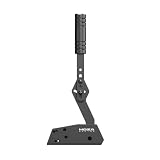
Pay close attention to the pivot point. High-quality mid-range options, like the MOZA HBP Sim Racing Handbrake, utilize solid steel axes with press-fitted ball bearings or high-density brass bushings. Avoid handbrakes that use plastic spacers at the main pivot, as these will quickly wear down, introducing side-to-side wobble that ruins the premium feel of your cockpit.
3. Physical Dimensions and Rig Footprint
A handbrake can take up a surprising amount of physical space next to your shifter. You must measure your cockpit’s mounting plate to ensure the footprint of the handbrake matches your available real estate.
Most standard USB handbrakes feature a rectangular base measuring approximately 3.0 to 3.5 inches (76 to 89 mm) in width and 5.5 to 6.5 inches (140 to 165 mm) in length. The total height of the unit from the bottom of the base to the top of the handle grip typically ranges from 11.5 inches (292 mm) to 15.5 inches (394 mm).
Ensure that the handle height allows for proper ergonomic clearance. When mounted next to your steering wheel, the grip of a vertical handbrake should sit roughly level with the center of your wheel rim, allowing you to quickly move your hand from the wheel to the brake without hitting your knuckles on your sequential or H-pattern shifter.
4. Adjustability and Tactile Resistance
No two drivers prefer the exact same handbrake feel. A drift driver might want a soft, long pull to easily feather the rear brakes, while a rally driver might want a ultra-stiff, short throw that locks the rear wheels instantly with a quick jerk of the arm.
To accommodate these styles, look for a handbrake that offers physical adjustability. This is achieved through three primary mechanisms:
- Interchangeable Springs: Premium units include multiple springs with varying wire thicknesses. Swapping a light spring for a heavy-duty spring completely changes the resistance profile of the pull.
- Elastomer Dampeners: High-end handbrakes combine steel springs with polyurethane elastomer rubbers. These elastomers compress progressively, mimicking the feeling of hydraulic fluid compressing inside a brake line.
- Lever Angle Adjustment: Look for a chassis that allows you to adjust the resting angle of the handle by 15 to 30 degrees forward or backward. This ensures that even if your mounting plate is slightly too far forward, you can tilt the handle back into a comfortable ergonomic zone.
5. Price Tiers and Value Proposition
The sim racing handbrake market is divided into three distinct price brackets, each offering a specific balance of durability, precision, and brand ecosystem integration.
Budget Tier ($50 to $75): This segment is dominated by generic USB handbrakes, such as the RYLNOK 64bit PC handbrake or various generic 14-bit USB handbrakes. These units are typically constructed of basic aluminum, feature simple Hall Effect sensors, and plug directly into PC Windows systems via a USB cable. They are excellent entry-level choices but often feature stiff, unprogressive springs and basic foam grips that wear down over time.
Mid-Range Tier ($80 to $150): This is the sweet spot for serious hobbyists. Products like the MOZA HBP Sim Racing Handbrake ($99.99) fall into this category. Here, you get aviation-grade aluminum construction, highly customizable spring stiffness, adjustable lever angles, and dedicated companion software to calibrate dead zones and output curves. These units offer significantly better structural rigidity and zero side-to-side play.
Premium Tier ($150 to $300+): Aimed at professional simulators and hardcore enthusiasts. These handbrakes utilize load cell sensors measuring up to 200 lbs of force, hydraulic cylinders filled with actual brake fluid, and custom-molded rubber grips. Brands in this space offer extreme durability and highly realistic, progressive resistance profiles.
6. Connectivity, Cabling, and Mounting Hardware
The physical connection between your handbrake and your computer is a common point of failure. Because you are constantly pulling and vibrating the handbrake chassis, the connection cable must be highly durable.
Look for handbrakes that feature a reinforced, nylon-braided USB cable. A length of at least 6.5 feet (2.0 meters) is ideal for routing the cable cleanly through your rig’s cable management channels to your PC. Avoid units with cheap, thin plastic cables that plug into the handbrake via an unreinforced micro-USB port; a hardwired cable with a molded rubber strain relief boot is far superior and prevents the cable from snapping inside the housing during high-intensity sessions.
Furthermore, check what mounting hardware is included in the box. A quality handbrake should come with a selection of M6 or M8 bolts, washers, and t-nuts compatible with standard aluminum extrusion profiles. If you do not have a dedicated rig, ensure the product listing specifically includes a heavy-duty steel desk clamp (often a $15 to $20 add-on if purchased separately).
Spec Checklist
Use this quick-reference table to compare what features you should expect at different budget levels when shopping for a sim racing handbrake.
| Feature / Spec | Budget Tier ($50 – $75) | Mid-Range Tier ($80 – $150) | Premium Tier ($150 – $300+) |
|---|---|---|---|
| Sensor Type | 14-bit or 16-bit Hall Effect | 16-bit High-Precision Hall Effect | Load Cell (Pressure Sensitive) or Hydraulic |
| Main Materials | Stamped Aluminum & Mild Steel | Aviation-Grade CNC Aluminum | Heavy-Duty Hardened Steel & Carbon Fiber |
| Pivot Mechanism | Plastic Washers / Simple Bolt | Dual Ball Bearings / Brass Bushings | Industrial Bearings & Hydraulic Seals |
| Adjustability | Fixed Angle, Single Spring | Adjustable Lever Angle & Dual Springs | Adjustable Elastomers, Springs & Stroke Length |
| Grip Style | Simple Foam (Wears quickly) | Anodized Aluminum or Textured Rubber | Genuine Leather, Alcantara, or Knurled Metal |
| Connectivity | Direct USB (PC Only) | Direct USB & Wheelbase Passthrough | Direct USB, RJ12, & Console Adapters |
Red Flags
When browsing online marketplaces, watch out for these warning signs that indicate a low-quality or poorly engineered handbrake:
- “Plug and Play” with zero calibration software: If a handbrake has no way to calibrate its start and end points via software (either proprietary software or Windows Game Controllers), you may suffer from a permanent 5% brake drag or find that you have to pull the lever 90% of the way before it registers any input.
- Exposed circuit boards: Avoid handbrakes where the sensor’s PCB (printed circuit board) or wiring is completely exposed to the open air. Dust, sweat, or spilled drinks will quickly short-circuit the electronics. Look for fully enclosed sensor housings.
- Excessive side-to-side play in product videos: If you see reviews where the lever wobbles left and right before the driver even pulls it back, the tolerances are poor. This play will worsen rapidly under regular use.
- No-name brands with generic “64-bit” claims: Some budget handbrakes advertise “64-bit resolution.” In reality, standard USB controllers cannot process or benefit from 64-bit resolution for a single-axis handbrake (16-bit already provides over 65,000 steps of resolution). This is purely marketing jargon used to mask cheap internal components.
FAQ
Can I use a USB handbrake directly on a PlayStation 5 or Xbox Series X?
Direct USB handbrakes (like most budget models under $70) only work on PC Windows. Consoles require all inputs to go through a single authorized security chip, which is housed inside your steering wheel base. To use a handbrake on a console, you must buy a handbrake from the same manufacturer as your wheel base (e.g., matching a Fanatec handbrake to a Fanatec wheel) and connect them using a proprietary RJ12 or DIN cable. Alternatively, you can use a third-party console adapter like a DriveHub, though compatibility can be inconsistent.
What is the difference between a progressive handbrake and a digital handbrake?
A digital handbrake acts like an on/off switch; as soon as you pull the lever past a certain point, it registers 100% braking force. A progressive (analog) handbrake uses a Hall Effect or load cell sensor to measure the exact distance or force of your pull. If you pull the lever 20% of the way, the game registers 20% braking force, allowing you to gently slide the rear tires to adjust your line without completely killing your forward momentum.
How do I mount a handbrake if I do not have a full metal racing rig?
If you do not have a dedicated aluminum extrusion rig, you must purchase a handbrake that includes a heavy-duty desk clamp. The clamp should feature rubber padding to protect your desk surface and prevent slipping. Ensure your desk is made of solid wood or thick MDF; avoid clamping a high-tension handbrake to thin glass or hollow-core cardboard desks (like cheap IKEA Linnmon tops), as the pulling forces can crack or crush the desk material.
Why does my handbrake feel too stiff, and can I adjust it?
Many budget handbrakes come pre-installed with a highly stiff industrial spring to make up for their lack of progressive dampening. If your handbrake feels too stiff to pull comfortably, check if the manufacturer offers alternative springs. You can often swap the stock spring for a softer, aftermarket compression spring of the same physical dimensions (outer diameter and free length). For mid-range and premium handbrakes, adjusting the tension is as simple as turning an adjustment nut on the main threaded shaft to compress or decompress the spring/elastomer stack.


