Our Top Picks
 Thrustmaster T-Flight Hotas X USB Flight Sim Stick10.43 x 10 x 9.47 inches4.32 poundsCheck on Amazon
 Turtle Beach VelocityOne Flightstick Universal Sim Controller6.46 x 8.54 x 9.07 Inches1.81 PoundsCheck on Amazon
If you want the most complete flight sim joystick setup in this group, the Logitech G X56 H.O.T.A.S is the pick: a stick plus twin throttles, four selectable spring options, hall-effect elevator and aileron sensors and a large bank of programmable controls for serious cockpit work. Pilots who want a gentler way into a stick-and-throttle pairing should look at the Thrustmaster T-Flight Hotas X, while the T16000M models suit people who care most about drift-free sensors. A flight sim joystick is simply a PC controller with the axes and buttons a simulator expects: pitch, roll, usually a rudder input, and a throttle.
Quick List
- Logitech G X56 – best for full stick-and-throttle cockpits and VR-style flying
- Thrustmaster T-Flight Hotas X – best for a first stick-and-throttle pairing
- Thrustmaster T16000M FCS – best for a single precise stick with a twist rudder
- Thrustmaster T16000M Space Sim Duo – best for two-handed space and combat sims
- Turtle Beach VelocityOne Flightstick – best for Xbox and PC players who want a display on the stick
- PXN 2113PRO – best for simple one-handed PC flying with vibration
Which One Is Right for You?
| If you… | Choose |
|---|---|
| want a full HOTAS with adjustable stick force and twin throttles | Logitech G X56 |
| play on both Xbox and PC and like an on-stick OLED screen | Turtle Beach VelocityOne Flightstick |
| want a detachable throttle and a gentle learning curve | Thrustmaster T-Flight Hotas X |
| fly space sims and want a stick in each hand | Thrustmaster T16000M Space Sim Duo |
| need a compact single stick with rudder built into the twist | Thrustmaster T16000M FCS |
| just want a light, simple stick for casual PC flying | PXN 2113PRO |
Decide first whether you need a throttle. Sticks that ship alone, such as the single T16000M and the PXN, work best when you map power to a keyboard key or a second device. If you already know you want pitch, roll, yaw and engine power on separate hardware, step up to one of the HOTAS-style sets. Then check the platform line, because only one stick in this group mentions Xbox.
Thrustmaster T-Flight Hotas X USB Flight Sim Stick & Throttle - PC
Included for 'Best Flight Sim Joysticks in 2026: 6 Picks by Specs' as a relevant option in this category; details come from the product listing.
View on Amazon
Thrustmaster T16000M FCS Space Sim Duo Combat Flight Sim Joystick - PC
Included for 'Best Flight Sim Joysticks in 2026: 6 Picks by Specs' as a relevant option in this category; details come from the product listing.
View on Amazon
Thrustmaster T16000M FCS - Precision Combat Flight Sim Joystick - PC
Included for 'Best Flight Sim Joysticks in 2026: 6 Picks by Specs' because the listing specifies Precision Combat Flight Sim Joystick, details this guide uses to compare options.
View on Amazon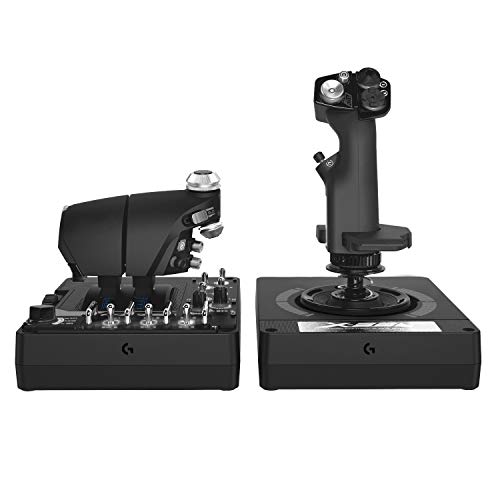
Logitech G X56 H.O.T.A.S Throttle and Joystick Flight Simulator Game Controller, 4 Spring Options, +189 Programmable Controls, RGB Lighting, 2x USB, PC - Black
Included for 'Best Flight Sim Joysticks in 2026: 6 Picks by Specs' because the listing specifies 4 Spring Options and +189 Programmable Controls, details this guide uses to compare options.
View on AmazonTurtle Beach VelocityOne Flightstick Universal Sim Controller, Xbox, PC
Included for 'Best Flight Sim Joysticks in 2026: 6 Picks by Specs' because the listing specifies Xbox, details this guide uses to compare options.
View on Amazon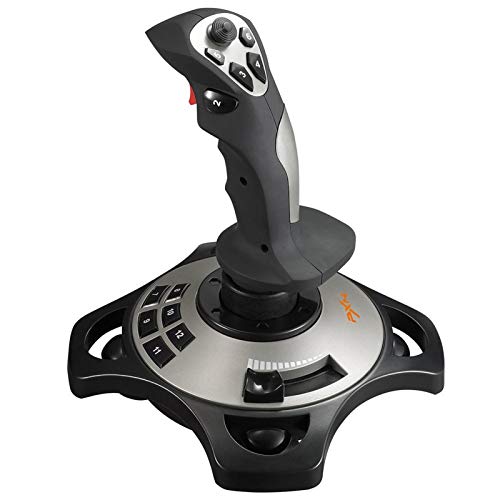
PXN 2113PRO PC Joystick USB Gaming Flight Simulator Controller Flight Stick
Included for 'Best Flight Sim Joysticks in 2026: 6 Picks by Specs' as a relevant option in this category; details come from the product listing.
View on AmazonAll 6 Picks in Detail
1. Logitech G X56 H.O.T.A.S – Best for Full Cockpit Control
As an Amazon Associate we earn from qualifying purchases at no extra cost to you.

The X56 is the most feature-dense option here and is built for people who want switches and sub-controls under their fingers instead of on a keyboard. The listing describes mini analog sticks for gimballed weapons or translation, RGB backlighting, twin throttles with a friction adjuster and throttle lock, and a four-spring system for changing stick force. It connects over two USB 2.0 ports, and the listing names Windows 11 through Windows 7 as supported.
- Hall-effect, 16-bit aileron and elevator axes
- Four spring options for adjustable stick force
- Twin throttles with friction adjuster and lock
- Mini analog sticks on the controls, plus RGB lighting
- Listing title cites 189 programmable controls
The listing also calls the layout a good fit for VR, because the controls are shaped so you can tell them apart by feel without looking. That matters when a headset blocks the desk.
Who should skip it: anyone with a shallow desk or a laptop with a single free USB port. The X56 also rewards patience, since its many switches only pay off once you have mapped them to the aircraft you fly most.
Pros:
- Deepest control set in the group
- Stick tension you can change by swapping springs
Cons:
- Two USB ports are required and the base is the heaviest in the list
- More setup and mapping work than a plug-and-play stick
Compared with the T-Flight Hotas X, it asks for more desk space and more configuration time in return for far more controls.
2. Thrustmaster T-Flight Hotas X – Best for a First HOTAS

This is the entry-level stick-and-throttle pair, and it is an easy way to learn what a real throttle lever does for flying. The detachable throttle can sit beside the stick on a desk or be separated for a mounting arrangement. The listing says all 12 action buttons and 5 axes can be programmed, and a preset button swaps stored profiles in the middle of a flight. The product name in this listing says PC; Thrustmaster’s own page has also listed another platform, so confirm which system you intend to use.
- 12 action buttons and 5 axes, all programmable
- Resistance dial for stick tension
- Rudder via handle twist or a tilting lever
- Built-in memory keeps your programming when unplugged
- Listed at about 4.3 pounds, which gives the base some weight
The wide hand rest and full-size throttle are aimed at long sessions, and the preconfigured controls mean you can fly before touching any software. That makes it a sensible way to find out whether you enjoy HOTAS flying at all.
Who should skip it: pilots who already know they want hall-effect precision or lots of buttons. The T-Flight is a learner’s HOTAS, and heavy users will eventually want more controls than its 12 buttons provide.
Pros:
- Throttle and stick in one box
- Plug-and-play with a preset button
Cons:
- The listing does not state a magnetic or hall-effect sensor, so confirm on the product page
- Fewer buttons than the X56 or VelocityOne
Next to the single T16000M, it trades stated sensor technology for the throttle you get in the box.
3. Thrustmaster T16000M FCS – Best for Precision on a Single Stick

The T16000M is the stick to choose when drift matters more than extra hardware. The listing describes Thrustmaster’s magnetic hall-effect sensor technology, three swappable components for left- or right-hand use, 16 buttons with braille-style markings, an 8-way hat switch and four independent axes including a twist rudder. Because it has a rudder in the handle, it covers pitch, roll and yaw without separate pedals, which keeps it compact.
- Hall-effect sensors described as drift free
- 16 action buttons plus 8-way POV hat
- Four axes including a built-in twist rudder
- Ambidextrous with three swappable parts
- Listed at roughly 1.9 pounds and 8.2 inches wide
It is configured through the T.A.R.G.E.T. software, which lets you load community profiles or build your own for each game. Plan on spending a short session in the software if your simulator does not map every button automatically.
Who should skip it: players who want a physical throttle lever. On the single T16000M you map power to a button or slider, which is workable but less natural for long cruises or careful approach speed control.
Pros:
- Compact desk footprint
- Works for left-handed pilots without a separate model
Cons:
- No separate throttle, so power is a button or axis on the stick
- Lighter base than the Duo or the T-Flight
It is the natural partner if you later add a throttle, and a smaller commitment than the Duo when you only need one hand on the stick.
4. Thrustmaster T16000M Space Sim Duo – Best for Two-Handed Space Sims

The Duo gives you two joysticks, one for each hand, which suits space sims where one hand handles translation or power and the other aims. Each stick uses the same hall-effect technology as the single model, and the listing counts 32 programmable buttons across both, each marked for identification by touch. The two-handed layout lets you split flight and weapons duties instead of cramming them on one grip.
- Two sticks with hall-effect sensors
- 32 buttons in total, with tactile identification
- Three detachable components on each stick
- Weighted bases to anchor each stick to the desk
- Programmed through the T.A.R.G.E.T. software
The heavy bases are meant to stop wobble over long sessions, and the listing weight is about 2.2 pounds for the package, so confirm what ships in the box on the product page.
Who should skip it: pilots in tight spaces or those who prefer one stick plus a throttle. Two bases take real room, and the dual layout is less useful for airliner-style flying where one stick and one throttle are the norm.
Pros:
- Two-handed layout is natural for space combat
- Community profiles can be loaded in the software
Cons:
- Needs space for two bases
- No true throttle lever; a lever-style throttle is better served by the T-Flight or X56
Choose it over the X56 if your sim favors two sticks rather than a stick-plus-throttle pairing.
5. Turtle Beach VelocityOne Flightstick – Best for Xbox and PC Crossover
The VelocityOne is the only option here built around both Xbox and PC. The listing states 27 programmable buttons, 8 axes, a POV hat, a rapid-fire trigger and non-contact main axes. It adds multi-function throttle and flap levers and an integrated OLED flight management display on the base, so you can see settings without leaving the cockpit view.
- Compatible with Xbox Series X|S, Xbox One and PC
- 27 programmable buttons and 8 axes
- Throttle and flap levers built into the unit
- OLED flight management display
- Listed at about 1.8 pounds and 6.5 inches wide
It is a self-contained design: the levers on the base cover power and flaps, so there is no second box to place. That makes it appealing on a small desk or a couch table.
If you plan to use it on a console, confirm game support for the display and levers before buying. Not every title reads every axis, so check your main simulator’s controller list on its own support page.
Who should skip it: serious PC simmers who want a heavy base and a real stick-and-throttle pair. The VelocityOne is clever and compact, but its light weight suggests clamping or a mount for aggressive flying.
Pros:
- Works on console and PC
- Levers and display reduce keyboard reaching
Cons:
- Lighter base than the Thrustmaster sets
- Display and lever function depend on the game and software support, so confirm on the product page
It sits closest to the X56 in ambition, but only the VelocityOne speaks to Xbox.
6. PXN 2113PRO – Best for Casual One-Handed PC Flying

The PXN is a small, light PC-only stick. The listing states Windows 7 through 11 support only and explicitly excludes Mac, PlayStation, Xbox and Switch. It offers a rapid-fire trigger, 4-axis control, an 8-way hat and 12 programmable buttons, plus a vibration function with a switch on the underside. The listing names Microsoft Flight Simulator and War Thunder among titles it works with.
- PC and Windows 7/8/10/11 only
- 4 axes, 8-way hat, 12 programmable buttons
- Vibration function (not force feedback)
- Suction cups on the base for smooth desks
- Listed at about 1.1 pounds
Setup is plain: the listing says no driver is required to play, although a driver is available for calibration and button mapping. The vibration has to be switched on and set to a reasonable strength in the driver to be noticeable.
Because the base is light, a non-slip mat or a clamp helps if you pull hard on the stick. Plug it in before starting your PC, as the listing recommends, so Windows detects it reliably.
Who should skip it: Mac, console or Xbox players, because the listing is explicit that it is Windows only. Anyone wanting a throttle, a weighted base or hall-effect sensors should look higher in this list.
Pros:
- Small footprint and one-hand operation
- Simple setup with no required driver
Cons:
- Very light base compared with the weighted Thrustmaster units
- No throttle lever and no stated hall-effect sensor
It is the runner-up for casual players; the single T16000M is the sturdier next step.
Specs Compared
| Model | Type | Buttons | Axes | Sensors | Platform |
|---|---|---|---|---|---|
| Logitech G X56 | Stick plus twin throttles | 189 programmable controls per title | 16-bit aileron/elevator, mini analog sticks | Hall-effect aileron/elevator | Windows, 2 USB 2.0 ports |
| T-Flight Hotas X | Stick plus detachable throttle | 12 action buttons | 5 | Confirm on listing | PC |
| T16000M FCS | Single stick | 16 plus 8-way hat | 4 with twist rudder | Hall effect | PC |
| T16000M Space Sim Duo | Dual sticks | 32 total | Confirm on listing | Hall effect | PC |
| VelocityOne Flightstick | Stick with levers and display | 27 programmable | 8 | Non-contact main axes | Xbox Series X|S, Xbox One, PC |
| PXN 2113PRO | Single stick | 12 programmable plus hat | 4 | Confirm on listing | Windows 7/8/10/11 only |
How We Chose These
This list was built from research, not lab work. We started with the six joysticks in the current catalog, then compared the specifications each listing states: axis count, button count, sensor type, platform support and how the stick holds its position on a desk. Manufacturer pages were used to cross-check Thrustmaster and Logitech details. Where a listing did not state a value, such as the sensor in the T-Flight or the PXN, we say so instead of guessing. Ranking favors sensor stability, flexibility of mapping and clear platform support over extras such as lighting. This is a research-based guide and does not claim physical evaluation of any unit.
What to Look For
Axes: what pitch, roll, yaw and throttle mean
A simulator expects at least four controls: pitch (nose up and down), roll (banking), yaw (rudder) and throttle (engine power). A single stick with a twist handle gives you three of these on one hand and leaves throttle to a button, wheel or slider. A HOTAS, short for hands on throttle and stick, gives power a dedicated lever, which is much easier to hold at a steady setting. If you plan to fly helicopters or heavy aircraft, count the extra axes for items such as flaps, trim or mixture. Listings that mention more than five axes, such as the VelocityOne, have room for these.
Rule of thumb: five axes covers a stick, a rudder and a throttle. Anything beyond that is for trim, brakes or camera control, and you should value it only if you actually use those functions.
Sensors and drift
Older potentiometer-style axes wear and can start to drift, so the aircraft slides without input. The hall-effect or non-contact sensors named in the T16000M, X56 and VelocityOne listings read position through magnets and have no worn contact surface. That is why they are described as drift free or durable. It does not make a stick perfect: you still want a small dead zone in software for the center of travel, and a stated sensor type is not the same as a measured precision figure. When a listing is silent about sensors, treat the sensor as an open question.
Stick force and desk stability
Lighter springs are comfortable for airliners and slow approaches. Stiffer springs help fine control in combat. The X56 offers four spring options, while the T-Flight offers a resistance dial. Stick force only works if the base stays put, so check the weight: a base listed at several pounds is much steadier than one around one pound. Suction cups help on smooth surfaces but are no match for a table clamp or a cockpit mount for aggressive flying. If the stick lifts off the desk when you pull back hard, no spring setting will make it feel precise.
Platform, drivers and mapping software
Most PC sticks map through the simulator’s own controls menu, and some also use a manufacturer tool such as Thrustmaster’s T.A.R.G.E.T. Confirm the platform before buying: the PXN is PC only, the VelocityOne covers Xbox and PC, and the Thrustmaster listings here are described for PC. Also count USB ports. The X56 lists two USB 2.0 ports, so a crowded laptop may need a powered hub. Finally, check whether your simulator recognizes the stick by default; community profiles exist for many Thrustmaster models, but support is never guaranteed for every title.
Worked example: choosing a stick for a small desk
Measure the free width beside your keyboard. A dual base such as the Duo, listed near 13 inches wide, needs more room than a stick listed near 8 inches. If you have only one hand free, a single stick plus a keyboard throttle works. If you want to rest your left hand on a throttle, plan for a second base or a detachable throttle arrangement, and leave several extra inches for cables. A typical 24-inch-deep desk leaves roughly 10 to 12 inches in front of the keyboard, which is enough for a single stick but tight for a throttle beside it.
Questions
Do I need a HOTAS or is a single joystick enough?
A single stick is enough for arcade-style flight and many space sims. A HOTAS adds a physical throttle, which is helpful for realistic aircraft where power settings matter. If you are unsure, start with a stick that has a rudder twist and add a throttle later.
Are these sticks compatible with Microsoft Flight Simulator?
The PXN listing explicitly names Microsoft Flight Simulator among supported PC titles. For the others, confirm on the product page and in the simulator’s controller list, since specific profiles can vary by game and version.
What does hall-effect mean on a joystick?
It means the stick reads magnet position with a sensor that does not touch the moving part. As a result there is less wear and drift over time than with contact-style potentiometers.
Can a joystick be used left-handed?
Some can. The T16000M listings describe swappable components for left- and right-hand use. Other sticks have a fixed shape, so confirm the grip layout if you are left-handed.
Do any of these have force feedback?
None of the listings state true force feedback. The PXN listing even says force feedback is not supported, and its vibration function is a different feature. Check the product page if force feedback is important to you.
Will a stick work on my console?
Only the VelocityOne lists Xbox support. The rest are described for PC, so confirm the platform before ordering.
Update History
- October 14, 2026 – Initial publication; product set drawn from current catalog listings.
- Check the product page for current specifications and availability before buying.
Sources
- Manufacturer product and specification pages for Thrustmaster and Logitech G
- Retailer listing titles, feature bullets and specification fields for each product