Key takeaways
- Sensor quality over DPI numbers: Almost every modern gaming sensor tracks flawlessly at the 400–1600 DPI range that most players actually use. Ignore 26,000 DPI marketing claims and look for a known sensor with consistent tracking and no smoothing or acceleration.
- Grip style and hand size: A mouse that fits your grip matters more than any feature. Palm grippers generally want a taller, longer ergonomic shell; claw and fingertip users tend to prefer shorter, lighter, flatter shapes. Measure your hand from wrist crease to middle fingertip before you buy.
- Weight and cable quality: Under $50, expect roughly 70–110g. Lighter isn’t automatically better, but a heavy mouse paired with a stiff rubber cable will fight you in every flick. If you’re going wired, prioritize a flexible paracord-style or well-relieved cable.
- Wired vs. wireless trade-offs: Reliable low-latency wireless has reached this price bracket, but usually by trimming RGB, battery capacity, or extra buttons. If you don’t mind a cable, wired models at this price typically offer more features and better switches for the money.
- Buttons and software: Decide whether you need a two-button MMO-style thumb cluster or just a clean main pair with two side buttons. Also check that the software is lightweight and allows onboard memory storage, so your settings travel with the mouse.
What's inside
Shopping for a gaming mouse under $50 sounds simple until you actually start looking. The category is flooded with lookalike shells, inflated DPI claims, and marketing language that says almost nothing about how a mouse performs during a long session. Meanwhile, the genuinely good budget options change every year as last-generation flagships get discounted and newer entry-level models quietly adopt better sensors and switches.
This guide cuts through that. We’ve focused on mice that are realistically available under $50 in 2026, prioritizing sensor accuracy, build quality, click feel, and long-term reliability over spec-sheet bragging rights. Below you’ll find our top picks, a short buying framework, and answers to the questions we get asked most often.
As an Amazon Associate we earn from qualifying purchases at no extra cost to you. Product prices and availability are accurate as of the date shown and are subject to change.




⚡ Save on Your Next PC — Amazon Prime
Prime members get fast free shipping on the systems above, plus early access to Prime Day & Black Friday PC deals. New members get a 30-day free trial.
Watch: Best Gaming Mouse Under $50 — Video Review
How to Choose Gaming Mouse Under $50
- Sensor quality over DPI numbers: Almost every modern gaming sensor tracks flawlessly at the 400–1600 DPI range that most players actually use. Ignore 26,000 DPI marketing claims and look for a known sensor with consistent tracking and no smoothing or acceleration.
- Grip style and hand size: A mouse that fits your grip matters more than any feature. Palm grippers generally want a taller, longer ergonomic shell; claw and fingertip users tend to prefer shorter, lighter, flatter shapes. Measure your hand from wrist crease to middle fingertip before you buy.
- Weight and cable quality: Under $50, expect roughly 70–110g. Lighter isn’t automatically better, but a heavy mouse paired with a stiff rubber cable will fight you in every flick. If you’re going wired, prioritize a flexible paracord-style or well-relieved cable.
- Wired vs. wireless trade-offs: Reliable low-latency wireless has reached this price bracket, but usually by trimming RGB, battery capacity, or extra buttons. If you don’t mind a cable, wired models at this price typically offer more features and better switches for the money.
- Buttons and software: Decide whether you need a two-button MMO-style thumb cluster or just a clean main pair with two side buttons. Also check that the software is lightweight and allows onboard memory storage, so your settings travel with the mouse.
The Best Picks Reviewed
Logitech G305 Lightspeed
Still the benchmark for budget wireless in 2026, the G305 pairs Logitech’s Lightspeed connection with a genuinely competitive sensor and battery life measured in months rather than hours on a single AA. It’s the easiest recommendation here for anyone who wants to ditch the cable without dropping into unreliable Bluetooth territory.
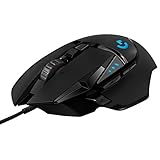
Logitech G502 Hero
The G502 remains the feature-per-dollar champion: eleven programmable buttons, an adjustable weight system, and a free-spin scroll wheel that’s genuinely useful outside of gaming. It’s heavier and busier than minimalist competitors, but for MMO, strategy, and productivity crossover use, nothing under $50 matches its versatility.
Redragon M612
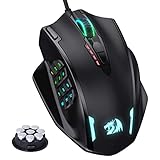
At the very bottom of this price range, the Redragon M612 delivers an honest 8000 DPI optical sensor, remappable keys, and RGB lighting for less than the cost of a new game. The shell finish and switch feel won’t fool anyone into thinking it’s a flagship, but as a first gaming mouse or a spare for a second rig, the value is hard to argue with.
Razer Basilisk V3
The Basilisk V3 offers the most refined ergonomics in this roundup, with a sculpted thumb rest, a multi-mode scroll wheel that switches between tactile and free-spin, and eleven-zone lighting that actually looks good. It frequently dips under $50 during sales, and at that price it comfortably outclasses most purpose-built budget models.
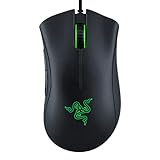
Razer DeathAdder Essential
A stripped-back version of one of the most copied shapes in gaming, the DeathAdder Essential focuses on the fundamentals: a proven right-handed ergonomic body, a reliable optical sensor, and five programmable buttons. If you have larger hands and use a palm grip, this is the safest blind buy on the list.
Frequently Asked Questions
Is a wireless gaming mouse under $50 actually good enough for competitive play?
Yes. Modern proprietary 2.4GHz wireless like Logitech’s Lightspeed has latency indistinguishable from wired for practical purposes, and models such as the G305 have been used in competitive settings for years. The compromises at this price are usually in battery capacity, weight, and extra features, not in connection quality.
Does higher DPI make me a better player?
No. The vast majority of competitive players use somewhere between 400 and 1600 DPI combined with a low in-game sensitivity, because that combination gives finer aim control. High DPI figures are primarily useful for high-resolution multi-monitor setups, not for improving accuracy.
How long should a gaming mouse in this price range last?
With normal use, expect two to four years before switch bounce or cable fatigue becomes noticeable. Buying from established brands helps here, since replacement feet, warranty support, and firmware updates are far more likely to be available than with unbranded alternatives.
Do I need to install the manufacturer’s software?
Only for initial setup. All the mice here support onboard memory, so you can configure DPI stages, button mapping, and lighting once, save the profile to the mouse, and then uninstall the software if you’d rather not run it in the background.
Final Thoughts
For most buyers, the Logitech G305 Lightspeed is the smartest purchase in this bracket, delivering genuine wireless freedom and competitive-grade tracking without a price premium. If you’d rather have maximum features for your money, the Logitech G502 Hero remains unbeaten on button count and versatility, while the Razer Basilisk V3 is the one to watch during sales for anyone who prioritizes comfort and build quality above all else.