Key takeaways
- Footprint: Full-size boards typically run 44–46cm wide; TKL models sit around 35–38cm, freeing meaningful desk real estate.
- Mouse room and ergonomics: TKL lets you centre the keyboard on your body and keep your mouse arm closer in, reducing shoulder abduction over long sessions.
- Numeric input: Only full-size gives you dedicated fast data entry; TKL relies on the number row or a separate numpad accessory.
- Portability: TKL boards fit LAN bags and backpacks easily — the Logitech G PRO TKL even uses a detachable cable specifically for transport.
- Binding space: Full-size offers ~20 extra keys for MMO macros, sim bindings and streaming shortcuts without layers.
- Price parity: At the same tier, TKL models often cost slightly less for identical switches and build quality.
What's inside
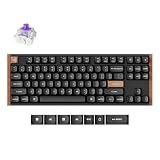
Choosing between a full-size and a tenkeyless (TKL) keyboard is the first real decision most PC gamers make when planning a desk, and it quietly shapes everything else: how much room your mouse has, where your shoulders sit, and how comfortable long sessions feel. A full-size board carries the complete 104-key layout including the number pad. A TKL board removes that number pad — roughly 20 keys and four to six inches of width — while keeping the function row and arrow cluster fully intact.
In 2026 the feature gap between the two has all but closed. Analog optical switches, rapid trigger, adjustable actuation, hot-swap sockets and per-key lighting are available in either size, so this is no longer a compromise between “serious” and “compact.” What has changed is the pull of competitive play. Low-sensitivity aim in tactical shooters demands wide mouse sweeps, and esports desks have standardised around layouts that make room for them. Anyone who spends their working hours in spreadsheets, CAD or accounting software, however, still has an excellent reason to keep the numpad. The right answer depends on your desk and your workload, not on a spec sheet.
As an Amazon Associate we earn from qualifying purchases at no extra cost to you. Product prices and availability are accurate as of the date shown and are subject to change.


⚡ Save on Your Next PC — Amazon Prime
Prime members get fast free shipping on the systems above, plus early access to Prime Day & Black Friday PC deals. New members get a 30-day free trial.
Watch: Full-Size vs TKL Keyboard: 2026 Comparison — Video Review
Quick Verdict
Pick a full-size keyboard if you split time between gaming and number-heavy work, bind macros to the numpad, or fly sims that use it for systems control — and you have the desk width to spare. Pick a TKL if you play mouse-intensive competitive games at low DPI, work on a compact or shared desk, travel with your gear, or want a more neutral shoulder position. For most gamers today, TKL is the smarter default, and boards like the Razer Huntsman V3 Pro TKL and Corsair K70 CORE TKL prove you give up nothing in performance to get there.
Key Differences
- Footprint: Full-size boards typically run 44–46cm wide; TKL models sit around 35–38cm, freeing meaningful desk real estate.
- Mouse room and ergonomics: TKL lets you centre the keyboard on your body and keep your mouse arm closer in, reducing shoulder abduction over long sessions.
- Numeric input: Only full-size gives you dedicated fast data entry; TKL relies on the number row or a separate numpad accessory.
- Portability: TKL boards fit LAN bags and backpacks easily — the Logitech G PRO TKL even uses a detachable cable specifically for transport.
- Binding space: Full-size offers ~20 extra keys for MMO macros, sim bindings and streaming shortcuts without layers.
- Price parity: At the same tier, TKL models often cost slightly less for identical switches and build quality.
Full-Size Keyboards: The Complete Layout
A full-size keyboard remains the correct choice for anyone whose PC does double duty. If your day involves invoices, statistics, spreadsheets or 3D software, the numpad is not a luxury — it is a genuine productivity tool, and touch-typing digits is dramatically faster than reaching for the number row. Flight and space sim players benefit similarly, since titles like DCS and Elite Dangerous assign meaningful functions across the entire board.
MMO and MOBA players also get value from the extra keys. Twenty additional inputs within easy reach means fewer layered shortcuts and fewer modifier chords to memorise. The trade-off is physical: you need a deep, wide desk, and you will be reaching further right for your mouse all session long. If your monitor centre and your keyboard centre don’t line up, that misalignment compounds over hours of play.
TKL Keyboards: The Competitive Standard
TKL has become the default for competitive gaming for one simple reason: mouse space. Removing the numpad lets you angle the board inward and keep your mousing arm in a natural position, which matters enormously for low-DPI CS2, Valorant and Apex players. The Razer Huntsman V3 Pro TKL leads the performance end with analog optical switches, Snap Tap, rapid trigger and adjustable actuation, plus a media dial and doubleshot PBT keycaps. The Corsair K70 CORE TKL counters with pre-lubed MLX Red v2 linears, SOCD handling and sound dampening for a quieter, deeper typing feel.
The category scales down sensibly too. The Logitech G413 TKL SE keeps things simple with tactile mechanical switches, anti-ghosting and cross-platform support, while the Logitech G PRO TKL adds clicky switches, Lightsync RGB and a detachable Micro USB cable for tournament travel. On the membrane side, the SteelSeries Apex 3 TKL brings whisper-quiet switches with IP32 water and dust resistance, and the Corsair K55 CORE TKL offers spill-resistant quiet keys, 8-zone RGB and dedicated media controls — both excellent budget picks.
Which Should You Buy?
- For competitive FPS: Pick TKL — the Razer Huntsman V3 Pro TKL for adjustable actuation and rapid trigger, or the Corsair K70 CORE TKL for smooth pre-lubed linears.
- For work and gaming on one PC: Pick full-size, or run a TKL plus a standalone numpad you can move aside.
- For small or shared desks: Pick TKL — the SteelSeries Apex 3 TKL or Corsair K55 CORE TKL keep costs and clutter down.
- For LAN events and travel: Pick TKL — the Logitech G PRO TKL’s detachable cable makes packing painless.
- For MMOs and sims: Pick full-size for the extra binding space, unless you already use a dedicated macro pad.
Frequently Asked Questions
Does TKL actually improve aim?
Not directly, but it improves consistency. More mouse room means fewer arm resets mid-flick and a more repeatable posture, which is where the real benefit shows up over long sessions.
Can I add a numpad to a TKL keyboard?
Yes. Standalone USB or wireless numpads are inexpensive and can be placed on your left side, which many users find more ergonomic than a fixed right-hand numpad.
Are TKL keyboards cheaper?
Usually slightly, since there is less material and fewer switches. At the same tier you generally get identical switch technology and build quality for a modest saving.
Do TKL boards still have arrow keys and function keys?
Yes — that is what separates TKL from 65% and 60% layouts. You keep the full function row, arrows and the insert/delete cluster; only the numpad is removed.
Final Verdict
If your keyboard is primarily a gaming device, buy TKL: it gives you more mouse room, better posture and, in 2026, exactly the same top-tier switch technology as any full-size flagship. If numbers are part of your daily workflow or you play sims and MMOs that use every key, stay full-size — a cramped mouse arm is a fair trade for input you genuinely need. Match the layout to how you actually use the machine, and you will not be second-guessing the purchase six months from now.