Our Top Picks
 Wonder Forge Disney Princess Matching Game10.6 inches (L) x 1.6 inches (W)1.6 x 10.6 x 9 inches0.7 poundsCheck on Amazon
 Melissa & Doug Flip-to-Win Portable Wooden Travel Memory11.7 x 8.5 x 0.911.7 x 8.7 x 1.2 inches0.01 poundsCheck on Amazon


A memory game is usually the first real game a child learns, and it earns that place honestly. The rules fit in one sentence — turn over two tiles, keep them if they match — yet the game quietly trains concentration, visual recognition and patience every single round. Because a three-year-old and a grandparent can play the same set on equal terms, a good matching game tends to outlast far more complicated toys.
The five games below all follow that classic flip-and-match format, but they suit different children. Two are gentle nature and world-culture tile sets for the youngest players, two are big licensed tile games built around familiar film characters, and the last is a wooden travel board with no loose pieces at all.
As an Amazon Associate, we earn from qualifying purchases.
Quick Picks
- Best first memory game: eeBoo Life on Earth Memory & Matching Game — 24 pairs of nature tiles with art by Melissa Sweet, for ages 3 and up.
- Best for world-culture learning: eeBoo I Never Forget a Face Memory & Matching Game — smiling faces of children from around the world.
- Best for princess fans: Wonder Forge Disney Princess Matching Game — 72 tiles of Belle, Ariel, Elsa and more, playable solo or together.
- Best for classic Disney fans: Wonder Forge Disney Classic Characters Matching Game — Mickey, Minnie, Dumbo and friends across 72 tiles.
- Best travel memory game: Melissa & Doug Flip to Win Travel Memory Game — a wooden board with hinged flaps and nothing to lose in the car.
How to Choose
Start with the pair count, not the box art. A full memory game can run to 36 pairs, a long, demanding game for a four-year-old. Young children do better when adults deal out only part of the set — eight or ten pairs is plenty for a first game — and add tiles as recall improves. Every game here scales down that way, so buy the set your child will grow into.
Look at tile size and thickness. Little hands flip tiles over dozens of times in one sitting, so chunky, sturdy tiles matter. Thick board tiles with rounded corners survive being bent, chewed on and swept off the table, and larger tiles are easier for toddlers to pick up from a flat surface. A game played on a wooden board with fixed flaps removes the loose-tile problem entirely, which is why the travel pick below works so well in cars and waiting rooms.
Pick a theme your child already loves. Memory games ask children to stare closely at pictures for minutes at a time, so the artwork does real work. A child who adores animals will study a nature set far longer than a generic one, and a child who knows every Disney character by name will happily hunt for the matching Mickey.
Decide whether solo play matters. Some children enjoy flipping tiles alone against their own memory, and the tile games here all support that. Others only engage when there is a winner, in which case a built-in scorekeeper, like the sliding markers on the wooden travel board, settles arguments about who found most pairs.
eeBoo Life on Earth Memory & Matching Game
This is the gentlest starting point in the guide. Life on Earth spreads 24 pairs of tiles across the table, each pair carrying a piece of nature artwork by illustrator Melissa Sweet — animals, birds, leaves and plants from around the world. The pictures are detailed without being busy, so a three-year-old can tell tiles apart at a glance while an older child still finds new details to talk about.
The tiles are thick and sturdy, sized for small hands, and the game is made with 90% recycled materials. Play works with one child practising alone or with up to four players taking turns, and adults can shrink the grid to a handful of pairs for a first game.
Specs
| Detail | Value |
|---|---|
| Brand | eeBoo |
| Model | EB-MGLOE3 |
| Pairs | 24 pairs (48 tiles) |
| Players | 1 to 4 |
| Age range | 3 years and up |
| Artwork | Melissa Sweet |
| Materials | 90% recycled materials |
See the eeBoo Life on Earth Memory Game on Amazon
eeBoo I Never Forget a Face Memory & Matching Game
The second eeBoo set keeps the same proven format — 24 pairs of thick tiles — but swaps nature for people. Each pair shows the smiling face of a child from a different country, illustrated by Lizzy Rockwell, and the back cover of the box identifies each child’s home country. It is a simple idea that gives the game a second life as a talking point about the wider world, and it has picked up an Oppenheim Toy Portfolio Gold Seal Award along the way.
The tiles measure about 2.25 inches square with rounded corners and a glossy coating, and the set stores in a sturdy square box. Like its sibling, it plays well solo or with up to four players, and the grid scales down easily for beginners. Pick it if you want faces and cultures rather than flora and fauna — just do not buy both sets expecting different gameplay, because the format is identical and only the artwork changes.
Specs
| Detail | Value |
|---|---|
| Brand | eeBoo |
| Pairs | 24 pairs (48 tiles) |
| Tile size | About 2.25 in square |
| Players | 1 to 4 |
| Age range | 3 years and up |
| Illustrator | Lizzy Rockwell |
| Box size | 9.5 x 9.5 x 1.5 in |
See the eeBoo I Never Forget a Face Memory Game on Amazon
Wonder Forge Disney Princess Matching Game
Wonder Forge takes the same flip-and-match rules and scales them up: 72 tiles, making 36 pairs, each printed with a Disney princess or a scene from her films — Belle, Ariel and Elsa among them. The larger grid makes this a longer, harder game than the 24-pair sets above, which is exactly why princess-obsessed preschoolers will sit still for it. A child who can name every character at sight starts with a real advantage, and that familiarity keeps frustration low while memory does the work.
The game supports solo play as happily as family play, so a child can spread the tiles out alone and hunt pairs against their own recall. Instructions are short and the game is easy to teach in a couple of minutes. Because the tile count is high, deal out half the set for younger children and add tiles as they improve.
Specs
| Detail | Value |
|---|---|
| Brand | Wonder Forge |
| Model | 01219 |
| Tiles | 72 tiles (36 pairs) |
| Players | 1 or more |
| Age range | 3 years and up |
| Theme | Disney princesses |
| Setup | Picture tiles and instructions included |
See the Wonder Forge Disney Princess Matching Game on Amazon
Wonder Forge Disney Classic Characters Matching Game
This is the companion set to the princess game, built on the identical format — 72 tiles, 36 pairs, the same quick setup — but the artwork reaches across the whole classic Disney catalogue instead of one corner of it. Mickey Mouse, Minnie, Donald Duck, Goofy, Dumbo, Tinker Bell and Buzz Lightyear all appear, so it suits households where children prefer the classic characters, or where brothers and sisters cannot agree on a princess theme.
A full game takes about 15 minutes, which lands well for family game night with preschoolers: long enough to feel like a real contest, short enough to finish before attention wanders. As with its sibling, the set works for one player or a group, and the pair count can be trimmed for an easier round. If you already own the princess version, treat this as an either-or choice rather than a second purchase.
Specs
| Detail | Value |
|---|---|
| Brand | Wonder Forge |
| Model | 01284 |
| Tiles | 72 tiles (36 pairs) |
| Players | 1 or more |
| Age range | 3 to 5 years |
| Play time | About 15 minutes |
| Theme | Classic Disney characters |
See the Wonder Forge Disney Classic Characters Matching Game on Amazon
Melissa & Doug Flip to Win Travel Memory Game
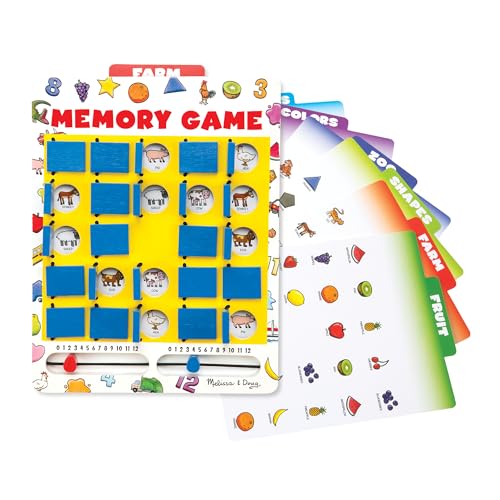
The last pick abandons loose tiles altogether. Melissa & Doug builds the game into a wooden board fitted with 25 hinged flaps. Seven double-sided game cards slide into the board — fourteen different picture grids in total — and children lift the flaps to hunt for matching pairs, then flip them shut again at the end of the turn. Sliding scorekeepers built into the frame track each player’s pairs, so the contest survives the journey intact.
Because every piece is attached, nothing can slide under a car seat or vanish into a sofa, which makes this the obvious choice for travel, restaurants and waiting rooms. The bungee-hinge flaps stand up to repeated flipping, and the whole game stores inside its own board. The trade-off is scale: 25 flaps means a smaller grid than the 72-tile games, and the format is aimed at two players rather than a crowd.
Specs
| Detail | Value |
|---|---|
| Brand | Melissa & Doug |
| Format | Wooden board with 25 hinged flaps |
| Game cards | 7 double-sided cards (14 games) |
| Players | 2 |
| Age range | 5 years and up |
| Scorekeeping | Built-in sliding scorekeepers |
| Pieces | No loose pieces; stores in the board |
See the Melissa & Doug Flip to Win Memory Game on Amazon
Products at a Glance
| Product | Format | Pairs | Players | Ages |
|---|---|---|---|---|
| eeBoo Life on Earth | Picture tiles | 24 pairs | 1 to 4 | 3+ |
| eeBoo I Never Forget a Face | Picture tiles | 24 pairs | 1 to 4 | 3+ |
| Wonder Forge Disney Princess Matching | Picture tiles | 36 pairs | 1 or more | 3+ |
| Wonder Forge Disney Classic Characters Matching | Picture tiles | 36 pairs | 1 or more | 3 to 5 |
| Melissa & Doug Flip to Win | Wooden flap board | 25-flap grid | 2 | 5+ |
FAQ
What age can a child start playing memory games?
Most children can start at around three years old with a small grid. Deal out six to ten pairs face down, let the child flip two tiles at a time, and add more pairs as their recall grows. The full 24- and 36-pair sets here are sized so one box serves from first games through the early school years.
How is a memory game different from flashcards?
Flashcards are shown face up and used for naming and quizzing, while a memory game hides its pictures face down and asks the child to remember where each picture is. That hidden information is the whole game: it trains recall and concentration rather than recognition alone, and it turns practice into a contest children ask to repeat.
Can one child play a memory game alone?
Yes. Every tile game here works solo — the child deals the grid, flips tiles and tries to clear the board in fewer turns than last time. Solo play is a good way to learn a new set before playing against adults, and makes these games useful quiet-time activities too.
How long does a game of memory take?
A small grid of ten pairs takes a few minutes. A full 36-pair game like the Wonder Forge sets runs about 15 minutes with preschoolers, and the 24-pair eeBoo games sit in between. If a game drags, remove a few pairs mid-game to bring it to a close.
Conclusion
For a first memory game, the eeBoo Life on Earth set is the safest buy: 24 sturdy pairs, beautiful nature art and a grid that shrinks gracefully for beginners. Its sibling, I Never Forget a Face, plays identically and swaps in faces from around the world. Children who live and breathe Disney get the biggest grids from the two Wonder Forge sets — princesses in one, the classic character catalogue in the other. And for cars, planes and waiting rooms, the Melissa & Doug Flip to Win board removes loose tiles from the equation entirely. Whichever theme you choose, start with fewer pairs than the box holds and let the game grow with your child.
FAQ
What age can a child start playing memory games?
How is a memory game different from flashcards?
Can one child play a memory game alone?
How long does a game of memory take?
More from Amazon
Programs that pair well with the guide above. Offers and eligibility are set by Amazon and may change.
Free shipping on eligible items, Prime Video and more. Eligible new members can start with a free trial.
Start a Prime free trialAd-free music streaming. Eligible new subscribers can start with a free trial.
Try Music Unlimited freeA Prime membership for ages 18-24 with a trial period. Eligibility is set by Amazon.
See Prime for Young AdultsAudiobooks and podcasts to listen to on the go. Eligible new members can start with a free trial.
Try Audible freeAs an Amazon Associate we earn from qualifying purchases.