Key takeaways
- Do you want a sliding or pendular motion? Sliding pedals move parallel to the floor on tracks. Pendular pedals mimic real aircraft by hanging from a top pivot point, providing a natural arc motion.
- What is your primary gaming platform? While almost all rudder pedals work natively on PC via USB, console pilots (Xbox Series X/S or PS5) have limited options. If you fly on a console, you must choose pedals that plug directly into a compatible wheelbase or hotas, such as the Thrustmaster TFRP Precision Flight Sim Rudder Pedals, which offer cross-platform support.
- What is your seating posture? If you fly from a standard rolling office chair, heavy spring tensions will push your chair backward instead of moving the pedals. You must decide whether you will lock your chair wheels, mount the pedals to a dedicated sim rig, or opt for a lightweight unit with low resistance.
What's inside
- Decide These 3 Things First
- Footprint, Under-Desk Clearance, and Floor Grip
- Material Quality and Mechanical Longevity
- Kinematics: Sliding Tracks vs. Pendular Suspension
- Sensor Technology: Potentiometers vs. Magnetic Hall Sensors
- Toe Brake Ergonomics and Tension Adjustability
- Market Segments and Real-World Value
- Spec Checklist
- Red Flags to Avoid When Shopping
- FAQ
Most flight simulator enthusiasts spend thousands of dollars on high-end yokes, throttle quadrants, and VR headsets, only to treat their feet as an afterthought. It is a classic mistake. When searching for a flight sim rudder pedal buying guide with toe brakes, many buyers simply sort by price and select the cheapest option available. They quickly realize that poorly designed pedals ruin the immersion. They slide across the carpet, stick at the center point, or lack the independent axis control required for smooth crosswind landings and precise taxiing.
- Decide These 3 Things First
- Footprint, Under-Desk Clearance, and Floor Grip
- Material Quality and Mechanical Longevity
- Kinematics: Sliding Tracks vs. Pendular Suspension
- Sensor Technology: Potentiometers vs. Magnetic Hall Sensors
- Toe Brake Ergonomics and Tension Adjustability
- Market Segments and Real-World Value
- Spec Checklist
- Red Flags to Avoid When Shopping
- FAQ
In 2026, the flight simulation landscape is more realistic than ever, demanding hardware that mimics real-world aviation physics. If you want to coordinate your turns, command differential braking on the runway, and avoid the frustration of cheap plastic components snapping mid-flight, you need to know exactly what specifications matter for your home setup.
As an Amazon Associate we earn from qualifying purchases at no extra cost to you. Product prices and availability are accurate as of the date shown and are subject to change.



Decide These 3 Things First
Before diving into specific product listings, you must narrow your search by answering three fundamental questions about how you fly:
- Do you want a sliding or pendular motion? Sliding pedals move parallel to the floor on tracks. Pendular pedals mimic real aircraft by hanging from a top pivot point, providing a natural arc motion.
- What is your primary gaming platform? While almost all rudder pedals work natively on PC via USB, console pilots (Xbox Series X/S or PS5) have limited options. If you fly on a console, you must choose pedals that plug directly into a compatible wheelbase or hotas, such as the Thrustmaster TFRP Precision Flight Sim Rudder Pedals, which offer cross-platform support.
- What is your seating posture? If you fly from a standard rolling office chair, heavy spring tensions will push your chair backward instead of moving the pedals. You must decide whether you will lock your chair wheels, mount the pedals to a dedicated sim rig, or opt for a lightweight unit with low resistance.
Footprint, Under-Desk Clearance, and Floor Grip
Rudder pedals are deceptively large pieces of hardware. A typical entry-level unit like the Logitech G Pro Flight Rudder Pedals measures roughly 12 inches wide by 15 inches deep, but high-end metal units can exceed 19 inches in width and weigh over 15 pounds.
Before buying, measure the space between your desk legs. You need at least 20 inches of clear width to accommodate the pedal chassis and allow your feet to move comfortably without scraping your desk’s side panels. Vertical clearance is equally critical; when you fully depress a toe brake, your knees will rise by 2 to 4 inches. If your desk has a low keyboard tray or drawer, ensure you have at least 24 to 26 inches of vertical clearance from the floor to the underside of the desk to prevent bruised kneecaps.
Furthermore, consider your flooring. Lightweight plastic pedals (weighing 4 to 6 pounds) will slide on hardwood floors or bunch up carpets unless secured. Look for units with integrated rubber feet for hard surfaces, or carpet spikes and velcro strips if you plan to place them on medium-pile carpets.
Material Quality and Mechanical Longevity
The internal mechanics of a rudder pedal endure substantial force. When you stomp on a brake during an emergency landing, you can easily exert 30 to 40 pounds of downward pressure. Budget-friendly options are constructed primarily of injection-molded ABS plastic. While cost-effective, plastic gears and sliders wear down over time, creating “slop” or play in the center axis.
This wear often leads to mechanical failure in the toe brake linkages. For example, users of older Saitek designs frequently seek out aftermarket solutions like the Takteq Replacement Rudder Toe Gear (a 2-pack priced around $16.97) to repair broken internal plastic gears. If you want a unit that lasts a decade, prioritize metal construction. Premium pedals utilize cast aluminum, steel linkages, and ball bearings on all pivot points. These materials eliminate flexing, provide a smooth, fluid travel, and weigh enough to remain anchored to the floor without requiring a dedicated cockpit rig.
Kinematics: Sliding Tracks vs. Pendular Suspension
How the pedals move determines how accurately you can control your aircraft. There are two primary mechanical designs on the market today:
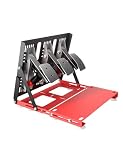
- Sliding Track Pedals: These units use plastic or metal rails. Your feet push forward and backward in a flat, linear plane. While space-saving and affordable, sliding tracks are prone to collecting dust, pet hair, and debris, which increases friction and causes a “sticky” sensation near the center detent.
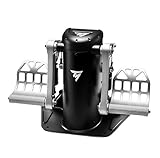
- Pendular/Hanging Pedals: Systems like the Thrustmaster TPR Rudder Pedals ($589.95) suspend the pedal arms from an overhead gantry. This creates a natural swinging arc that matches the rudder controls of commercial airliners and modern military jets. Because the mechanism relies on gravity and high-grade springs rather than sliding friction, the travel is incredibly smooth, allowing for micro-adjustments of just 1 or 2 millimeters.
Sensor Technology: Potentiometers vs. Magnetic Hall Sensors
How the pedals translate physical movement into digital signals dictates your precision. Cheaper pedals rely on rotary potentiometers. These are small mechanical resistors that measure physical contact. Over time, dust enters the potentiometer housing, causing signal “noise” or jittering, where your rudder appears to flutter in the sim even when your feet are completely still.
Premium units employ contactless magnetic sensors, often referred to as Hall effect sensors. These sensors measure the change in a magnetic field as the pedal moves, meaning there are no physical contacts to wear out. Hall effect sensors provide up to 16-bit resolution (65,536 distinct values along the axis), ensuring that your inputs are perfectly mirrored in the flight simulator without deadzones or calibration drift.
Toe Brake Ergonomics and Tension Adjustability
A true flight sim rudder pedal system must include independent toe brakes. This means the left and right pedals tilt forward independently of the main rudder axis, mimicking the differential braking used to steer taildragger aircraft or slow down large jets.
Look for pedals that offer adjustable physical angles for the footplates. Ideally, you want to adjust the resting angle between 30 and 45 degrees so that you do not accidentally engage the brakes when you are simply pushing the rudder. Additionally, high-quality pedals feature adjustable tension. This is achieved either through a dial that compresses an internal spring or by physically swapping out different spring sets (light, medium, heavy) included in the box. Adjustable tension allows you to match the resistance of the pedal to your physical strength and the type of aircraft you fly—light resistance for a Cessna 172, and heavy, stiff resistance for a commercial airliner.
Market Segments and Real-World Value
Understanding what you get at different price points will help you set realistic expectations:
- Entry-Level ($100 – $160): Products like the Thrustmaster TFRP ($129.99) or the Logitech G Pro ($143.99) dominate this space. They are lightweight, mostly plastic, and use potentiometer sensors. They are excellent for casual flyers, space-constrained desks, or those testing the waters of flight simulation.
- Mid-Range ($250 – $400): These units feature solid metal construction in key areas, Hall effect sensors on the main axis, and wider pedal spacing (typically 14 to 16 inches). They balance durability with affordability.
- Premium ($500+): Products like the Thrustmaster TPR ($589.95) offer all-metal construction, pendular mechanisms, highly customizable spring tensions, and high-resolution magnetic sensors on all three axes (rudder, left brake, right brake). They are designed for hardcore enthusiasts and home cockpit builders.
Spec Checklist
Use this checklist to compare the typical specifications found across different price tiers before making your final purchase decision:
| Spec / Feature | Budget ($100 – $160) | Mid-Range ($250 – $400) | Premium ($500+) |
|---|---|---|---|
| Primary Material | ABS Plastic | Hybrid Plastic & Aluminum | Steel & Cast Aluminum |
| Sensor Type | Rotary Potentiometers | Hall Effect (Main Axis) | Magnetic Hall Effect (All Axes) |
| Motion Style | Sliding Track (Narrow) | Sliding Track (Wide) | Pendular / Suspended Arc |
| Unit Weight | 4 to 6 lbs | 8 to 11 lbs | 15 to 22 lbs |
| Pedal Spacing | 9 to 11 inches | 12 to 14 inches | 15 to 18 inches |
| Tension Adjustment | None or single rotary dial | Swappable physical springs | Multiple spring profiles & damper options |
Red Flags to Avoid When Shopping
When searching for the perfect rudder pedals, avoid these common design pitfalls:
- Proprietary RJ12-Only Connectors: Avoid pedals that only connect via proprietary telephone-style jacks unless you already own that specific brand’s throttle or wheel. Look for USB-native connectivity or included USB adapters.
- Narrow Pedal Spacing: Cheap pedals often crowd your feet close together (less than 10 inches apart). This forces your knees together, causing hip fatigue and lower back pain during long flights.
- Hard Center Detents: A physical “clunk” or notch when the pedal passes through the center position makes smooth, minor corrections impossible. Avoid pedals known for harsh center detents.
- No Carpet Grips or Floor Mount Options: Lightweight pedals without mounting holes or high-traction rubber pads will slide away from you the moment you apply the brakes.
FAQ
Do I really need toe brakes for flight simulation?
Yes. While you can control a rudder without toe brakes, you cannot perform differential braking. Differential braking is essential for steering taxiing aircraft on the ground, slowing down on short runways, and successfully landing taildragger aircraft without ground-looping them.
How do I stop my rolling office chair from moving when using rudder pedals?
You can use rubber caster cups under your chair wheels, swap your wheels for stationary bell glides, or use a simple webbing strap to connect the base of your office chair to the frame of your rudder pedals, preventing them from pushing apart.
Can I mix and match rudder pedals with a different brand of yoke or joystick?
Yes, on PC. Windows treats each USB flight controller as an independent input device. You can easily use Logitech rudder pedals alongside a Thrustmaster yoke. However, on consoles (Xbox or PlayStation), all components must typically plug into the same brand’s ecosystem to function.
How do I clean and maintain sliding track rudder pedals?
Wipe the tracks down weekly with a dry microfiber cloth to remove dust and pet hair. Avoid using heavy wet greases, which attract dirt and create a grinding paste. If lubrication is needed, use a light spray of dry PTFE (Teflon) lubricant.