Key takeaways
- Bandwidth: DDR4 gaming kits typically run 3200–3600MT/s, while DDR5 starts at 4800MT/s and comfortably reaches 6000–6400MT/s, delivering roughly 70–90% more raw bandwidth per module.
- Latency: DDR4-3600 CL16 works out to about 8.9ns of true latency versus roughly 10ns for DDR5-6000 CL30, so DDR4 still wins on paper — but DDR5’s dual 32-bit subchannels per module make far better use of every cycle.
- Architecture: Each DDR5 DIMM is split into two independent subchannels with a deeper 32-bank structure, improving parallelism and access efficiency in ways raw timings do not capture.
- Power and regulation: DDR5 moves voltage regulation onto the module via an integrated PMIC and drops to 1.1V baseline (1.35–1.4V for XMP/EXPO kits), whereas DDR4 relies on the motherboard at 1.2–1.35V.
- Reliability: DDR5 includes on-die ECC to correct errors within the DRAM array — not the same as full system ECC, but it meaningfully improves stability at high densities.
- Capacity and platform support: DDR5 scales to 64GB single modules and is mandatory on AMD AM5 and Intel’s LGA1851 platforms; DDR4 is capped at 32GB per DIMM and is now legacy-only.
What's inside
Choosing between DDR5 and DDR4 used to be a simple budget question. In 2026 it is really a platform question: DDR5 is the memory standard for every current AMD and Intel desktop socket, while DDR4 survives only on older boards that many gamers are still running perfectly happily. If you are building new, the decision is largely made for you. If you are upgrading an existing rig, the maths is more interesting than it looks.
What changed is the economics. DDR4 production has been winding down since 2025, and with DRAM fabs prioritising DDR5 and HBM for AI demand, DDR4 kits are no longer the automatic bargain they once were. Meanwhile DDR5-6000 CL30 has settled in as the mainstream gaming sweet spot, with well-binned SK hynix A-die kits available at prices that were flagship territory two years ago. Below we compare both standards, then look at the DDR5 kits worth buying today.
As an Amazon Associate we earn from qualifying purchases.


⚡ Save on Your Next PC — Amazon Prime
Prime members get fast free shipping on the systems above, plus early access to Prime Day & Black Friday PC deals. New members get a 30-day free trial.
Watch: DDR5 vs DDR4 RAM: Does It Matter in 2026? — Video Review
Quick Verdict
DDR5 is the correct choice for any new build and for anyone chasing 1% low frame rates, high-refresh 1440p gaming, or heavy multitasking alongside streaming and content creation — a 32GB DDR5-6000 CL30 kit such as the KLEVV FIT V or Urbane V RGB is the value benchmark. DDR4 remains a sensible, cost-effective choice only if you already own an AM4 or LGA1200/1700 DDR4 motherboard and simply want more capacity without replacing your CPU and board.
Key Differences
- Bandwidth: DDR4 gaming kits typically run 3200–3600MT/s, while DDR5 starts at 4800MT/s and comfortably reaches 6000–6400MT/s, delivering roughly 70–90% more raw bandwidth per module.
- Latency: DDR4-3600 CL16 works out to about 8.9ns of true latency versus roughly 10ns for DDR5-6000 CL30, so DDR4 still wins on paper — but DDR5’s dual 32-bit subchannels per module make far better use of every cycle.
- Architecture: Each DDR5 DIMM is split into two independent subchannels with a deeper 32-bank structure, improving parallelism and access efficiency in ways raw timings do not capture.
- Power and regulation: DDR5 moves voltage regulation onto the module via an integrated PMIC and drops to 1.1V baseline (1.35–1.4V for XMP/EXPO kits), whereas DDR4 relies on the motherboard at 1.2–1.35V.
- Reliability: DDR5 includes on-die ECC to correct errors within the DRAM array — not the same as full system ECC, but it meaningfully improves stability at high densities.
- Capacity and platform support: DDR5 scales to 64GB single modules and is mandatory on AMD AM5 and Intel’s LGA1851 platforms; DDR4 is capped at 32GB per DIMM and is now legacy-only.
DDR5: The 2026 Standard
For gaming, DDR5’s advantage shows up most clearly where CPU-bound performance matters: competitive shooters at 1080p/1440p, large-scale simulation titles, open-world games with heavy streaming, and anything running alongside OBS or a browser full of tabs. On AMD’s AM5 platform, DDR5-6000 with CL30 timings remains the ideal target because it keeps the memory controller in its efficient 1:1 mode — which is exactly why kits like the KLEVV FIT V DDR5-6000 CL30 and the RGB-equipped KLEVV Urbane V are so widely recommended. Both use SK hynix A-die at a modest 1.35V, so they run cool and overclock further if you want to tune manually.
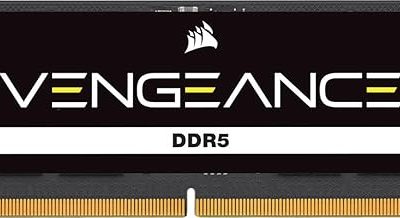
If you are on Intel, the memory controller tolerates higher frequencies well, and kits such as the KLEVV CRAS V RGB DDR5-6400 CL32 or the CORSAIR Vengeance DDR5-6400 CL36 make more sense. The CRAS V is also available in a sharper 6400 CL30 binning at 1.4V for enthusiasts pushing for maximum bandwidth, while the Lexar Thor Z RGB DDR5-6000 CL38 is the pragmatic pick if you want RGB and XMP 3.0/EXPO support without paying the premium for tight-timing A-die. All of these ship with on-die ECC and PMIC as standard, and all are 32GB (2x16GB) — the correct capacity for gaming in 2026.
DDR4: Still Viable, No Longer Cheap
DDR4 is far from useless. A Ryzen 5 5600X or Core i5-12400F paired with 32GB of DDR4-3600 CL16 still drives a modern GPU respectably at 1440p and above, where the bottleneck sits with the graphics card rather than memory. If you own an AM4 or DDR4-equipped LGA1700 board, adding capacity or tightening your existing kit’s timings is by far the cheapest way to extend that system’s life, and you avoid the cost of a new CPU, motherboard, and memory all at once.
The problem is trajectory. DDR4 is end-of-life at the major fabs, supply is thinning, and per-gigabyte pricing has drifted upward rather than down. Motherboard availability is shrinking, resale value is falling, and you are buying into a platform with no upgrade path — no next-generation CPU will accept it. Spending meaningfully on new DDR4 in 2026 usually means spending money you would recoup by putting it toward an AM5 or LGA1851 build instead.
Which Should You Buy?
- For a new gaming build: DDR5, without hesitation — a 32GB DDR5-6000 CL30 kit like the KLEVV FIT V or Urbane V RGB.
- For AMD AM5 systems: Pick DDR5-6000 CL30 to stay in 1:1 UCLK mode; higher frequencies rarely pay off.
- For Intel Arrow Lake and newer: Go faster — the CRAS V RGB 6400 CL32 or CORSAIR Vengeance 6400 CL36 suit Intel’s controller better.
- For RGB-focused builds: The Lexar Thor Z RGB or KLEVV Urbane V RGB deliver addressable lighting without a large price premium.
- For an existing DDR4 rig: Stick with DDR4 and put your budget into a GPU upgrade instead; save the platform jump for your next full rebuild.
Frequently Asked Questions
Can I put DDR5 in a DDR4 motherboard?
No. Although both use 288-pin DIMMs, the notch position differs and the electrical design is incompatible. A DDR5 upgrade always requires a new motherboard, and usually a new CPU as well.
Is 32GB still enough for gaming in 2026?
Yes. 32GB remains the sweet spot for gaming, streaming, and general multitasking. 16GB is now genuinely limiting in demanding titles, while 64GB only pays off for video editing, 3D rendering, or local AI workloads.
Do DDR5’s higher CAS latencies hurt gaming performance?
Barely. CAS latency in nanoseconds is what matters, and DDR5-6000 CL30 lands within roughly a nanosecond of good DDR4 while offering far more bandwidth. In real benchmarks DDR5 wins clearly, especially in 1% lows.