
Key takeaways
- Logitech G RS Sim Racing Pedals ($149.99): This modular set features a highly adjustable 75 kg (approx. 165 lbs) load cell brake, allowing you to customize the resistance using interchangeable elastomer springs.
- MOZA SRP2 Pedals Set ($169.99): This set steps up the physical ceiling with a heavy-duty 100 kg (approx. 220 lbs) load cell sensor, offering a stiffer, highly professional pedal feel right out of the box.
What's inside
The Short Answer
Yes, you absolutely need load cell pedals if you want to improve your consistency, build reliable muscle memory, and shave tenths of a second off your lap times. However, this recommendation comes with one crucial condition: you must have a dedicated, rigid way to mount them. Because load cell brakes measure the physical force of your foot rather than the distance the pedal travels, they require significant pressure to operate. If you are currently playing at a standard desk while sitting in a rolling office chair, pressing a load cell brake will simply push your chair backward across the room or tilt your pedal board off the floor.
What You Actually Get
To understand why load cell pedals are considered the single most important hardware upgrade in sim racing—even more critical than a direct-drive wheel base—you have to understand how human biology interacts with physics. Standard entry-level pedals use potentiometers or magnetic Hall-effect sensors. These sensors measure travel distance (how far the pedal moves). A load cell, on the other hand, is a strain gauge that measures force (how hard you press).
As an Amazon Associate we earn from qualifying purchases at no extra cost to you. Product prices and availability are accurate as of the date shown and are subject to change.
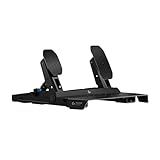

When you drive a real car, you do not think about moving your foot exactly 1.5 inches to slow down for a corner; your brain remembers how hard to squeeze the pedal. Human muscle memory is incredibly efficient at replicating pressure, but highly inaccurate at replicating exact travel distances under pressure. A load cell brake mimics this real-world hydraulic feel.
In the current gear landscape of 2026, getting into this technology is more accessible than ever. You no longer have to spend $500 or more to get a high-quality load cell setup. Excellent entry-level options have democratized the market:
- Logitech G RS Sim Racing Pedals ($149.99): This modular set features a highly adjustable 75 kg (approx. 165 lbs) load cell brake, allowing you to customize the resistance using interchangeable elastomer springs.
- MOZA SRP2 Pedals Set ($169.99): This set steps up the physical ceiling with a heavy-duty 100 kg (approx. 220 lbs) load cell sensor, offering a stiffer, highly professional pedal feel right out of the box.
When you step on a load cell brake, the pedal barely moves compared to a cheap plastic set. Instead, the elastomer bushings compress slightly, and the sensor registers the pressure. This allows you to “trail brake”—slowly easing off the brake pressure as you turn into a corner—with surgical precision. This technique is almost impossible to execute consistently on distance-based pedals, where the transition from 80% braking to 20% braking feels like guessing in the dark.
Pros
- Incredible Consistency: Your brain naturally memorizes pressure curves, allowing you to hit your exact braking markers lap after lap without locking up your tires.
- Realistic Trail Braking: Modulating your brake pressure on corner entry becomes an intuitive, physical behavior rather than a visual guessing game.
- Adjustable Resistance: Most load cell kits allow you to swap out polyurethane elastomers of varying durometers (hardness ratings) to make the pedal feel as stiff as a Formula 1 car or as compliant as a road car.
- Superior Durability: Because load cells rely on internal metal strain gauges rather than moving gears or contact-based wipers (like potentiometers), they do not degrade when exposed to dust, pet hair, or carpet fibers.
Cons
- Strict Mounting Requirements: You cannot use these loose on the floor. You will need a wheel stand, a dedicated steel pedal plate, or an aluminum profile cockpit to handle the 100 to 220 pounds of force.
- Physical Fatigue: Operating a load cell brake requires real leg work. During long endurance sessions, your calves and thighs will get a genuine workout, which may cause fatigue if you are not used to it.
- Steep Initial Learning Curve: Because your muscles are trained to look for pedal travel, switching to a pressure-based system will feel incredibly stiff and strange for the first few days. You will likely be slower before you become significantly faster.
- Footwear Required: Pressing against 50+ kg of resistance with bare feet or socks can quickly cause bruising or plantar discomfort. You will almost certainly need to wear stiff-soled shoes or karting booties.
Who Should Buy It
You should buy load cell pedals if you are transitionining from a casual gamer to a dedicated sim racer and already own (or plan to buy) a wheel stand or a full cockpit. If you find yourself constantly locking up your tires, missing your braking zones, or struggling to find consistency in competitive multiplayer lobbies, a load cell set like the MOZA SRP2 or Logitech G RS is the most cost-effective way to elevate your performance. It is a far better investment for your lap times than upgrading from a belt-driven wheel to a direct-drive wheel.
Who Should Skip It
You should skip load cell pedals if you race casually from a couch, a standard office chair, or a desk setup that cannot be modified. If your pedals must sit loose on a carpet or hardwood floor, the sheer force required to actuate a load cell will cause the pedal deck to flip forward or slide away from you. In these scenarios, you are much better off sticking to high-quality Hall-effect distance pedals, which provide smooth inputs without requiring heavy physical force.
Cheaper Alternatives
If you aren’t ready to commit to a full load cell setup and the rigid mounting hardware it requires, there are several alternative pathways to improve your braking feel:
| Option | Cost | Trade-off |
|---|---|---|
| Potentiometer Pedals with Elastomer Mods | $15 – $40 (mod only) | Adding a stiff rubber insert or progressive spring to your existing pedal set mimics the physical resistance of a load cell, but the sensor is still only measuring travel distance, limiting ultimate precision. |
| Hall-Effect Sensor Pedals | $80 – $130 | Uses contactless magnets to measure pedal travel. Extremely durable and immune to dust, but still relies entirely on distance rather than pressure for input. |
| Hydraulic Damper Upgrades | $50 – $90 (add-on kit) | An oil-filled cylinder added to a standard pedal to smooth out the travel and add hydraulic resistance. Provides great feel but does not change the underlying distance-based telemetry. |
FAQ
Do load cell pedals actually make you faster?
Yes, but not by increasing your top speed. They make you faster by drastically reducing your braking zones and eliminating mistakes. Because you can modulate your braking pressure with precision, you will suffer fewer lockups, spin out less on corner entry, and carry more mid-corner speed via successful trail braking.
Can I use load cell pedals on a carpeted floor?
Generally, no. Under heavy braking, a load cell requires anywhere from 60 to 150 pounds of force. This force will cause the front of the pedal base to lift off the carpet or slide backward. To use them on carpet, you must secure the pedals to a solid frame, brace them against a wall, or use a wheel stand that connects your chair to the pedal deck.
What is the difference between a load cell and a Hall-effect sensor?
A Hall-effect sensor measures the physical distance and angle of the pedal arm using magnets, detecting how far you have pushed the pedal down. A load cell measures the actual mechanical strain and pressure applied to the pedal face, completely ignoring how far the pedal physically moves.
Do I need to calibrate load cell pedals?
Yes. Every load cell pedal set requires calibration software. This software allows you to set the “deadzones” and customize the force curve. For example, if you have a 100 kg load cell but only want to exert 40 kg of physical force to achieve 100% braking in-game, you can easily adjust this limit within the software profile.


