Our Top Picks


A GPS watch fails in the worst possible moment: halfway through a long run, the track jumps across a river on the map, or the battery dies before the finish line. That is the real choice here, not brand loyalty. You are weighing satellite accuracy against battery life, training depth against everyday convenience, and a dedicated running watch against a smartwatch that also takes calls. The wrong pick still tells the time, but it cannot be trusted for the one job you bought it for.
This guide is for runners, trail hikers, and triathletes who want a watch they can rely on outdoors. It also helps anyone replacing a basic fitness band with a real GPS watch. Each of the five watches below was chosen from the names and specifications shown on its Amazon product page, with the focus on GPS performance, battery life in tracking mode, and the training tools that matter on the road.
Quick Picks
As an Amazon Associate we earn from qualifying purchases
| Product | Best for | Key spec from title |
|---|---|---|
| Garmin Forerunner 255 | Long training runs | Multi-band GPS, up to 30 hours in GPS mode |
| Garmin Forerunner 165 | First GPS watch | 1.2-inch AMOLED display, up to 11-day battery |
| Garmin Forerunner 265 | Bright screen and coaching | 1.3-inch AMOLED touchscreen, up to 13-day battery |
| COROS PACE 4 | Lightweight long-distance runs | Dual-frequency GPS, up to 19-day battery |
| Apple Watch Ultra 2 | Rugged all-rounder | Dual-frequency GPS, up to 36-hour battery |
How to Choose
GPS Accuracy and Satellite Systems
GPS accuracy is the first thing to check, because a watch that drifts under tree cover or between tall buildings records the wrong distance and pace. Look for multi-band or dual-frequency GPS, which listens to more than one satellite signal and holds a lock better in difficult terrain. Garmin calls its version SatIQ, and it appears on the Forerunner 255 and 265. Single-band GPS still works fine on open roads and tracks, but it struggles in forests and city canyons. Check whether the watch lists GPS, GLONASS, and Galileo support, since more satellite systems mean a faster fix at the start of a run and fewer lost signals mid-route.
Battery Life in GPS Mode
Smartwatch battery claims hide an important split: standby time and GPS time are very different numbers. A watch rated for two weeks of normal use may last only 20 to 30 hours with GPS running, and that gap decides whether it survives a marathon, an ultramarathon, or a multi-day hike. Runners who train daily should look for at least 20 hours of GPS battery, while hikers and ultrarunners need 30 hours or more, or a watch with a solar option. Also check how the watch charges. A proprietary cable left at home ends the trip, while a watch that tops up quickly during a lunch stop keeps a long weekend on track.
Training Tools Versus Everyday Features
Some GPS watches are coaching tools first and smartwatches second, while others do a bit of everything. Dedicated running watches offer training readiness scores, suggested workouts, race predictions, and recovery advice based on heart rate variability. Those features matter if you follow a training plan. Everyday smartwatches add phone calls, music streaming, contactless payments, and a bigger app store, but often with shorter battery life and less training depth. Decide which side you live on. A runner chasing a personal best needs the coaching; a casual jogger who wants notifications and music may be happier with the all-rounder.
Fit, Screen, and Water Resistance
A GPS watch lives on your wrist through sweat, rain, and long hours, so comfort and readability matter as much as the sensor list. Check the weight and case size before buying: a 46 mm case suits larger wrists, while smaller wrists do better with a 41 or 42 mm case. AMOLED screens look vivid and stay readable in bright sun, while memory-in-pixel displays sip battery and stay visible without waking the screen. Buttons beat touchscreens when your hands are wet or gloved. Finally, confirm the water rating — 5 ATM handles swimming, while 10 ATM adds cover for open water and diving to shallow depths.
The 5 Best Options
Garmin Forerunner 255

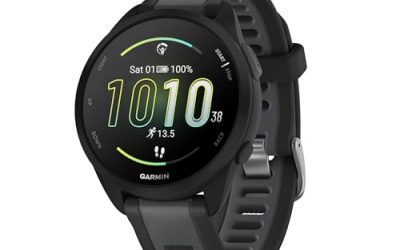
The Forerunner 255 is the steady pick for runners who want serious GPS tracking without paying for a flagship. Its multi-band GPS holds a lock under tree cover and between buildings, and the watch runs for up to 14 days in smartwatch mode or up to 30 hours with GPS on. Training readiness, race predictions, and daily suggested workouts help structure a training block, while the 1.3-inch sunlight-visible display stays readable outdoors. It lacks a touchscreen and an AMOLED screen, but for runners who train by feel and by data, that trade keeps the price and the battery in check.
Specs
- 1.3-inch sunlight-visible display
- Multi-band GPS with SatIQ
- Up to 14 days smartwatch battery, up to 30 hours GPS
- Training readiness, race predictions, daily suggested workouts
- 5 ATM water resistance
- 46 mm case, 49 g
Best for: Runners training for a marathon or half marathon.
Watch out for: No touchscreen; check the 46 mm case fits your wrist before ordering.
ASIN: B09WTYT878
Garmin Forerunner 165
The Forerunner 165 is the easiest entry point into a real GPS running watch. Its bright 1.2-inch AMOLED display makes stats easy to read at a glance, and the watch still manages up to 11 days of battery in smartwatch mode or up to 19 hours with GPS running. Training metrics, recovery insights, and wrist-based heart rate cover the basics most new runners need, and the touchscreen plus buttons give two ways to control it mid-run. Music storage is missing on the base model, so runners who want songs on their wrist should look at the Music version instead.
Specs
- 1.2-inch colorful AMOLED display
- Up to 11 days smartwatch battery, up to 19 hours GPS
- Training metrics and recovery insights
- Wrist-based heart rate monitoring
- 5 ATM water resistance
- Touchscreen with button controls
Best for: New runners buying their first GPS watch.
Watch out for: The base model has no onboard music storage; the Music version costs more.
ASIN: B0CT3SGHXL
Garmin Forerunner 265
The Forerunner 265 pairs a bright AMOLED touchscreen with the training depth Garmin is known for, and that combination suits runners who want both. The 1.3-inch display shows pace, heart rate, and maps clearly in sunlight, while training readiness, morning reports, and daily suggested workouts turn each run into part of a plan. Battery lasts up to 13 days in smartwatch mode and up to 20 hours with GPS, and 8 GB of storage holds music for phone-free runs. It costs more than the 165, but the screen and coaching justify the step up for regular runners.
Specs
- 1.3-inch AMOLED touchscreen, 416 x 416 resolution
- Multi-band GPS with SatIQ
- Up to 13 days smartwatch battery, up to 20 hours GPS
- Morning report and training readiness
- 8 GB music storage
- 47 g, 46 mm case
Best for: Regular runners who want a bright screen and guided training.
Watch out for: The 46 mm case feels large on small wrists; the smaller 265S is a separate model.
ASIN: B0BS1T9J4Y
COROS PACE 4
The COROS PACE 4 is built for runners who count grams and hours. At 32 grams with the nylon band it almost disappears on the wrist, yet the battery runs up to 19 days in normal use and up to 41 hours with GPS tracking. Dual-frequency GPS keeps the track accurate on trails and in cities, and the watch adds navigation, a barometric altimeter, and training plans without piling on smartwatch extras. The 1.2-inch AMOLED screen is a clear upgrade over the old transflective display, staying bright in direct sun while the battery still stretches for days.
Specs
- 1.2-inch AMOLED touchscreen
- Dual-frequency GPS
- Up to 19 days battery, up to 41 hours GPS
- Navigation and barometric altimeter
- 32 g with nylon band
- 5 ATM water resistance
Best for: Long-distance runners and trail runners who want the lightest watch.
Watch out for: The PACE 4 replaces the discontinued PACE 3, so check the listing says PACE 4 and not old PACE 3 stock before buying.
ASIN: B0FYGTPTRQ
Apple Watch Ultra 2
The Apple Watch Ultra 2 is the rugged all-rounder for people who run, swim, hike, and still want a full smartwatch. Precision dual-frequency GPS tracks routes accurately, and the 49 mm titanium case with a bright Always-On Retina display survives rough conditions and stays readable in sunlight. Battery runs up to 36 hours in normal use and up to 72 hours in Low Power Mode, which covers a weekend away. It also handles calls, messages, music, and safety features like fall and crash detection, so it works as a daily watch as much as a training tool.
Specs
- 49 mm aerospace-grade titanium case
- Always-On Retina LTPO OLED display
- Precision dual-frequency GPS
- Up to 36 hours battery, up to 72 hours Low Power Mode
- 100 m water resistance
- S9 SiP, fall and crash detection
Best for: Runners and adventurers who want one rugged watch for sport and daily life.
Watch out for: It only pairs fully with an iPhone, and the 49 mm case is large on small wrists.
ASIN: B0CSVCVXZF
Which One Fits Your Situation
Training for a First Marathon
If a marathon is the goal, pick the Garmin Forerunner 255. Its multi-band GPS and 30-hour GPS battery cover the longest training runs, and the race predictions and daily suggested workouts keep the plan on track. The sunlight-visible display stays readable on long road sessions, and the 14-day smartwatch battery means charging once a week is enough.
Running Trails and Hiking
For trails, take the COROS PACE 4. It weighs only 32 grams, so it never drags on long climbs, and the 41-hour GPS battery outlasts multi-day hikes. Dual-frequency GPS holds a lock under tree cover, and the built-in navigation and barometric altimeter help on unmarked routes. The AMOLED display stays bright without waking the screen.
One Watch for Sport and Daily Life
If the watch has to do everything, choose the Apple Watch Ultra 2. It tracks runs with dual-frequency GPS, handles swimming and hiking, and still takes calls, plays music, and shows notifications. The 36-hour battery covers a full day plus a morning run, and Low Power Mode stretches it across a weekend. It is the only pick here that fully replaces a phone on the wrist.
Buying a First GPS Watch
New to GPS watches, start with the Garmin Forerunner 165. The AMOLED screen is easy to read, the training metrics cover the basics, and the 11-day battery means it rarely needs charging. It costs less than the 265 while keeping the same training app, and the touchscreen plus buttons make it simple to use mid-run.
Common Mistakes
- Buying for smartwatch battery life and ignoring GPS battery hours, which are far shorter.
- Choosing a watch that does not pair well with their phone — an Apple Watch needs an iPhone, and some Android watches lose features on iOS.
- Picking the biggest case for a small wrist, which slides around and ruins heart rate readings.
- Assuming every GPS watch has onboard music; base models often need a phone nearby.
- Skipping the water rating and then swimming with a watch rated only for splashes.
Frequently Asked Questions
Do I need multi-band GPS for road running?
Not always. Single-band GPS works well on open roads and tracks, where the sky is clear. Multi-band GPS earns its place under tree cover, in city canyons, and on trails, where it holds a lock better and records a truer route. If most of your runs are on open roads, a single-band watch is fine; if you run trails or in a dense city, choose multi-band.
How long should GPS battery last for a marathon?
Look for at least 20 hours of GPS battery for a marathon, which leaves a margin for a slow race, a warm-up, and navigation errors. Most runners finish well inside that window, but a watch rated for exactly four hours of GPS will die before the finish. For ultramarathons or multi-day hikes, aim for 30 hours or more, or a watch that charges while tracking.
Can a GPS smartwatch replace my phone on a run?
Partly. Most GPS watches track routes, pace, and heart rate without a phone, and models with onboard music and LTE can go further. Still, a watch cannot fully replace a phone for maps, messaging, or emergencies in remote areas. Carry a phone on long trail runs, and treat the watch as the tracker, not the safety net.
Are GPS watches accurate for swimming?
Yes, for pool swimming most GPS watches count laps and strokes reliably, and open-water models use GPS to track the route. Accuracy drops in open water when the wrist leaves the water between strokes, so the recorded track can look wavy. Check the water rating first: 5 ATM covers pool swimming, while 10 ATM adds cover for open water and shallow diving.
FAQ
Do I need multi-band GPS for road running?
How long should GPS battery last for a marathon?
Can a GPS smartwatch replace my phone on a run?
Are GPS watches accurate for swimming?
More from Amazon
Programs that pair well with the guide above. Offers and eligibility are set by Amazon and may change.
Free shipping on eligible items, Prime Video and more. Eligible new members can start with a free trial.
Start a Prime free trialAd-free music streaming. Eligible new subscribers can start with a free trial.
Try Music Unlimited freeA Prime membership for ages 18-24 with a trial period. Eligibility is set by Amazon.
See Prime for Young AdultsAudiobooks and podcasts to listen to on the go. Eligible new members can start with a free trial.
Try Audible freeAs an Amazon Associate we earn from qualifying purchases.