Key takeaways
- Physical Dimensions and Footprint: Most sim handbrakes feature a vertical lever standing between 11 and 13 inches (28 to 33 cm) tall. The base plate usually requires a mounting footprint of roughly 3 by 5 inches (7.6 by 12.7 cm).
- Heavy-Duty Materials: Unlike plastic toy controllers, budget-friendly options like the aikeec USB Sim Racing Handbrake (priced around $61.99) are constructed from CNC-machined aluminum and high-tensile steel, weighing in at about 3.5 to 5 pounds (1.6 to 2.3 kg).
- Progressive Resistance: These units utilize stiff industrial compression springs to mimic the resistance of a real hydraulic line. Pulling the lever requires about 8 to 15 pounds of force, giving your arms realistic physical feedback.
- Contactless Sensors: Modern handbrakes use magnetic Hall effect sensors rather than cheap potentiometers. This means there are no physical contacts to wear out over time, ensuring highly accurate, lifetime readings of how far you have pulled the lever.
- Power and Connectivity: These are plug-and-play USB devices. They draw minimal power (less than 5 watts) directly from your PC, meaning you do not need to clutter your wall outlets with another bulky power adapter.
What's inside
The Short Answer
No, you do not strictly need a dedicated physical handbrake to play or enjoy sim rally racing. However, your need for one depends on one crucial condition: if your primary goal is competitive realism and you frequently run tight, technical gravel or tarmac stages with acute hairpin turns, a physical analog handbrake becomes practically essential.
For casual players driving sweeping, high-speed stages in Finland or Kenya, mapping a button on your steering wheel to act as a digital “on/off” handbrake is perfectly adequate. But the moment you tackle the narrow, winding asphalt passes of Monte Carlo or the rocky hairpins of Greece, relying on a wheel button ruins your steering ergonomics and compromises your car control. If you want to rotate the car cleanly without losing precious engine RPM, a dedicated lever is the single best upgrade you can make to a basic wheel-and-pedal setup.
As an Amazon Associate we earn from qualifying purchases at no extra cost to you. Product prices and availability are accurate as of the date shown and are subject to change.

What You Actually Get
Adding a physical handbrake to your home setup changes both the physical layout of your gaming space and the telemetry of your inputs. Unlike a button on your steering wheel, which sends a simple digital signal (either 0% or 100% brake pressure), a dedicated USB handbrake provides progressive analog control.
When you unbox a standard entry-level USB handbrake, such as the widely popular 14-bit or 64-bit Hall sensor models that typically retail between $55 and $75, here is what you are actually adding to your room:
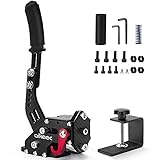
- Physical Dimensions and Footprint: Most sim handbrakes feature a vertical lever standing between 11 and 13 inches (28 to 33 cm) tall. The base plate usually requires a mounting footprint of roughly 3 by 5 inches (7.6 by 12.7 cm).
- Heavy-Duty Materials: Unlike plastic toy controllers, budget-friendly options like the aikeec USB Sim Racing Handbrake (priced around $61.99) are constructed from CNC-machined aluminum and high-tensile steel, weighing in at about 3.5 to 5 pounds (1.6 to 2.3 kg).
- Progressive Resistance: These units utilize stiff industrial compression springs to mimic the resistance of a real hydraulic line. Pulling the lever requires about 8 to 15 pounds of force, giving your arms realistic physical feedback.
- Contactless Sensors: Modern handbrakes use magnetic Hall effect sensors rather than cheap potentiometers. This means there are no physical contacts to wear out over time, ensuring highly accurate, lifetime readings of how far you have pulled the lever.
- Power and Connectivity: These are plug-and-play USB devices. They draw minimal power (less than 5 watts) directly from your PC, meaning you do not need to clutter your wall outlets with another bulky power adapter.
Pros
- True Analog Precision: Instead of instantly locking your rear tires with a digital button, an analog handbrake lets you pull the lever 20% to gently settle the rear of the car, or 80% to slide through a tight hairpin. This drastically reduces spin-outs.
- Consistent Ergonomics: When your steering wheel is rotated 360 degrees mid-slide, finding a tiny thumb button on a spinning wheel face is nearly impossible. A physical lever stays in a fixed position next to your shifter, right where your hand expects it to be.
- Preservation of Steering Wheel Hardware: Constantly mashing a plastic wheel button under high physical stress can prematurely wear out your steering wheel’s internal contact pads. Offloading this high-impact action to a steel lever extends the lifespan of your primary wheel.
- Immense Immersion: Pulling a physical lever to initiate a drift or slide provides a tactile satisfaction that software settings simply cannot replicate. It transforms your gaming desk into a convincing cockpit.
Cons
- Rigidity and Mounting Demands: Because these levers use stiff springs, pulling them puts significant leverage on your mounting surface. If you clamp a handbrake to a flimsy, lightweight hollow-core desk, you will experience severe desk flex and potentially damage your furniture.
- Console Compatibility Barriers: Most affordable USB handbrakes are strictly compatible with PC Windows environments. If you play on Xbox Series X or PlayStation 5, you cannot simply plug in a generic USB handbrake; you are forced to buy proprietary ecosystem gear (like Thrustmaster or Fanatec units) which often costs $150 to $280, or invest in complex third-party converter hubs.
- Increased Desk Clutter: If you do not have a dedicated aluminum profile rig, mounting both a steering wheel, a shifter, and a handbrake to a standard home office desk takes up significant real estate and complicates your daily cable management.
- Mechanical Noise: The metal-on-metal contact and spring compression of these units can produce loud clacking and squeaking sounds. If you share a living space or play late at night, this physical noise can easily disturb others in your home.
Who Should Buy It
You should invest in a dedicated handbrake if you are a PC-based sim racer who spends more than three or four hours a week in titles like Dirt Rally 2.0, Richard Burns Rally, or the EA Sports WRC franchise. It is also a must-have upgrade for drift enthusiasts who spend their time in Assetto Corsa. If you already own a sturdy wheel stand or a dedicated cockpit, your furniture is structurally ready to handle the physical pull forces of a steel lever without bending or shaking.
Who Should Skip It
You should skip the handbrake if you primarily race GT3, Formula 1, or prototype cars on closed asphalt circuits, as these disciplines never utilize a handbrake. Casual players using a gamepad controller or those with ultra-lightweight, folding wheel stands should also pass; the physical force required to pull a spring-loaded lever will easily tip over lightweight, unanchored stands. Finally, if you play exclusively on consoles and are on a strict budget under $100, the high cost of console-compatible handbrakes makes the upgrade hard to justify.
Cheaper Alternatives
If you want to tackle rally stages but aren’t ready to spend money or sacrifice desk space for a dedicated lever, several clever workarounds can get you through those tight hairpin corners.
| Alternative Option | Approximate Cost | Primary Trade-Off |
|---|---|---|
| Wheel Face Button | $0 (Built-in) | Digital on/off signal only; incredibly difficult to locate and press when the steering wheel is turned upside down. |
| Paddle Shifter Mapping | $0 (Built-in) | Requires you to map shifting to automatic, or use an awkward hand position that interferes with manual gear changes. |
| Clutch Pedal Mapping | $0 (Requires 3-pedal set) | Sacrifices your physical clutch pedal, making realistic manual-clutch kick maneuvers impossible. |
| DIY Keyboard Spacebar Hack | $0 to $15 | Unergonomic desk layout; risk of sliding your keyboard off the desk or breaking keys during intense racing moments. |
FAQ
Can I use a cheap USB handbrake on my Xbox or PlayStation?
Generally, no. Budget-friendly USB handbrakes (such as the generic 14-bit or 64-bit models found online for around $60) are designed strictly for PC Windows. Consoles require all input peripherals to route through the steering wheel base’s proprietary data port. To use a handbrake on a console, you must buy one from the same manufacturer as your wheel (e.g., matching a Thrustmaster handbrake to a Thrustmaster wheel base) or buy a specialized translation adapter like a DriveHub, which adds another $90 to $100 to your total cost.
What is the difference between a Hall sensor and a potentiometer handbrake?
A potentiometer relies on a mechanical wiper sliding along a resistive strip to measure how far you have pulled the lever. Over time, dust, pet hair, and physical wear degrade this strip, causing your inputs to flicker or fail. A Hall sensor uses magnets to measure distance without any physical contact. It never wears out, is impervious to household dust, and provides much cleaner, more consistent telemetry data to your simulation software.
Do I need a dedicated racing cockpit to mount a handbrake?
No, you do not need an expensive aluminum profile rig, but you do need a solid mounting surface. Many entry-level handbrakes, such as the aikeec 64-bit USB Handbrake with Clamp, come packaged with heavy-duty metal desk clamps. If you are mounting to a desk, ensure it is made of solid wood or thick MDF. Avoid mounting a stiff handbrake to lightweight plastic folding tables or hollow-core desks (like some budget IKEA options), as the repetitive pulling force will eventually crack the tabletop material.
Will adding a physical handbrake instantly make my stage times faster?
Initially, you might actually find yourself slightly slower as your brain and body adjust to the new muscle memory of reaching away from the wheel to pull a lever. However, as you adapt to the physics engines of modern simulators in 2026, your consistency will skyrocket. An analog handbrake allows you to control the exact angle of your car’s slide. Over the course of a long, grueling 10-mile rally stage filled with dozens of hairpins, this precise control prevents time-wasting spins and wall impacts, ultimately leading to much faster and safer stage times.