Key takeaways
- Preservation of Your Workspace: You no longer have to clamp and unclamp heavy gear from your primary work or study desk. Your office desk remains a calm, clutter-free space for productivity.
- Consistent Ergonomic Alignment: A wheel stand positions your steering wheel lower and at a more natural driving angle than a high computer desk. Furthermore, the pedal plate can be tilted between 0 and 30 degrees to reduce ankle fatigue.
- Excellent Vibration Isolation: Force-feedback steering wheels use powerful internal motors (often drawing 20 to 60 watts of power) to simulate road surfaces. A steel stand absorbs these vibrations, preventing your expensive monitors and desk accessories from rattling.
- True Portability and Foldability: Most models use a scissor-style folding mechanism. By loosening two plastic hand knobs, the stand folds down to a thickness of just 8 to 10 inches, allowing it to slide under a bed, behind a sofa, or flat against a closet wall.
- Dedicated Shifter Mounts: Unlike desks, which rarely have a natural spot for a gear shifter, stands include adjustable side plates that place the shifter right next to your thigh, mimicking a real car interior.
What's inside
As a home and furniture editor, my perspective on gaming gear is slightly different from that of a pure tech reviewer. When a new peripheral enters your home, I do not just think about its performance or frame-rate response. I think about its physical footprint, how it interacts with your flooring, whether it ruins the aesthetic of a carefully curated living room, and how much of a hassle it is to store away when guests arrive.
For years, the standard entry point into virtual racing has been simple: you buy a force-feedback steering wheel and clamp it directly to your office desk or dining table. But within forty-eight hours, the flaws of this setup become painfully obvious. Your monitors shake violently with every turn, your pedals slide away across the carpet whenever you brake, and your workspace is constantly cluttered with thick cables. This brings us to the ultimate hardware middle ground: the dedicated metal wheel stand. Is it a brilliant space-saving compromise, or is it just another piece of metal clutter destined for the garage?
As an Amazon Associate we earn from qualifying purchases at no extra cost to you. Product prices and availability are accurate as of the date shown and are subject to change.


The Short Answer
Yes, a sim racing wheel stand is absolutely worth it, provided you have a way to lock your seat or office chair in place during heavy braking. For a modest investment of $70 to $150, a wheel stand solves the three biggest headaches of desk-based racing: it isolates violent motor vibrations from your computer monitors, locks your pedals at a consistent angle, and lets you pack your entire racing setup into a closet in under two minutes without unplugging a single cable.
What You Actually Get
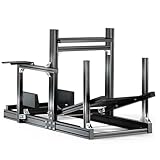
To understand if a wheel stand fits your home, you need to understand its physical makeup. These are not flimsy music stands. A typical entry-level to mid-range wheel stand, such as those from GTPLAYER or Nejoney, is constructed from heavy-duty, powder-coated carbon steel. This material is selected specifically to absorb the high-frequency vibrations generated by steering wheel motors.
Out of the box, a quality stand weighs between 20 and 35 pounds. When you bolt on a standard steering wheel, a three-pedal set, and a metal gear shifter, the entire assembly easily reaches a total weight of 45 to 55 pounds. This weight is actually your friend; it acts as an anchor to keep the rig planted on your floor during intense driving maneuvers.
In terms of physical space, a standard wheel stand occupies a footprint of approximately 22 inches in width by 24 to 30 inches in depth. When fully set up, it rises to an adjustable height of 22 to 32 inches. This compact footprint is significantly smaller than a full-sized racing cockpit, which can easily measure 55 inches long and 24 inches wide. Most stands also feature pre-drilled mounting plates that allow you to hard-mount your pedals and wheel using standard M6 bolts, replacing unreliable plastic clamps entirely.
Pros
- Preservation of Your Workspace: You no longer have to clamp and unclamp heavy gear from your primary work or study desk. Your office desk remains a calm, clutter-free space for productivity.
- Consistent Ergonomic Alignment: A wheel stand positions your steering wheel lower and at a more natural driving angle than a high computer desk. Furthermore, the pedal plate can be tilted between 0 and 30 degrees to reduce ankle fatigue.
- Excellent Vibration Isolation: Force-feedback steering wheels use powerful internal motors (often drawing 20 to 60 watts of power) to simulate road surfaces. A steel stand absorbs these vibrations, preventing your expensive monitors and desk accessories from rattling.
- True Portability and Foldability: Most models use a scissor-style folding mechanism. By loosening two plastic hand knobs, the stand folds down to a thickness of just 8 to 10 inches, allowing it to slide under a bed, behind a sofa, or flat against a closet wall.
- Dedicated Shifter Mounts: Unlike desks, which rarely have a natural spot for a gear shifter, stands include adjustable side plates that place the shifter right next to your thigh, mimicking a real car interior.
Cons
- The “Office Chair Slide” Phenomenon: Because a wheel stand is not physically connected to your seat, pressing a stiff brake pedal will often push your wheeled office chair backward instead of slowing down your virtual car. You must find a way to anchor your chair.
- Deceptive Weight: While these stands are advertised as “portable,” lifting a 50-pound mass of steel, plastic, and dangling wires is a genuine workout. It is not something you will want to carry up and down stairs on a daily basis.
- Flex Under High-Torque Gear: Budget-friendly stands priced under $100 are excellent for gear-driven or belt-driven wheels (like the Logitech G29 or Thrustmaster T300). However, if you upgrade to a heavy-duty Direct Drive (DD) wheel base that outputs more than 8 Newton-meters (Nm) of torque, the steel uprights will sway slightly under heavy cornering.
Who Should Buy It
A wheel stand is the perfect solution for apartment dwellers, casual weekend racers, and remote workers who share their home office space. As we look at the design trends of home gaming setups in 2026, multi-functional furniture is highly valued. If you want to enjoy highly immersive racing games on Friday night, but need your living room or office looking pristine and professional by Monday morning, a folding wheel stand is your best option. It is also ideal for those using entry-level to mid-tier wheel setups who want to improve their lap times through consistent pedal placement.
Who Should Skip It
You should skip a wheel stand if you have already invested in high-end, professional-grade racing gear. If you own a Direct Drive wheel base capable of 10 to 25 Nm of torque, or heavy load-cell pedals that require over 100 pounds of leg force to compress, a folding stand will flex, squeak, and slide under the strain. In this scenario, you require a rigid, non-folding aluminum profile cockpit. You should also skip it if you have a dedicated game room with plenty of space, as a permanent cockpit with an integrated seat offers a far more immersive and structurally stable experience.
Cheaper Alternatives
If you are not ready to spend $70 to $150 on a dedicated steel stand, there are a few alternative routes you can take. Below is a breakdown of how they compare to a purpose-built stand.
| Option | Approximate Cost | Trade-offs & Drawbacks |
|---|---|---|
| Desk Clamping | $0 (Included with your wheel) | Causes desk vibration; poor pedal stability; ruins desk ergonomics; tedious setup and teardown process. |
| DIY Wooden Stand | $20 – $40 (Lumber, screws, and paint) | Very bulky and heavy; cannot fold; looks unrefined in a living room; requires woodworking tools and skills. |
| TV Tray or Folding Table | $15 – $30 | Highly unstable; will wobble violently under force feedback; no way to securely mount pedals; high risk of tipping over. |
FAQ
Do wheel stands slide around on hardwood floors?
Most modern wheel stands come equipped with adjustable rubber leveling feet. These feet provide excellent grip on both low-pile carpets and hardwood floors. Additionally, because the combined weight of the stand and your gear sits directly over these rubber feet, the stand rarely slides forward. If you have slick hardwood or laminate floors, placing a cheap, non-slip rubber utility mat under the stand will protect your floors from scratches and prevent any micro-movements.
Can you fold a wheel stand with the wheel and pedals still attached?
Yes, this is one of their primary selling points. You do not need to unscrew or unplug any of your components to fold the stand. You simply loosen the adjustment knobs, fold the vertical neck down toward the pedal plate, and tighten the knobs to lock it in place. However, you must ensure your cable management is neat, using zip-ties or Velcro straps along the frame, so that the wires do not pinch or stretch during the folding process.
How do I stop my rolling office chair from pushing away from the stand?
This is the most common issue with wheel stands. Fortunately, there are several simple, low-cost solutions. You can purchase rubber caster cups (usually costing under $10) to place under your office chair’s wheels. Alternatively, you can buy a cheap nylon luggage strap and loop it around the base of your office chair gas cylinder and the bottom bar of the wheel stand, physically locking the two units together at a fixed distance.
Are budget wheel stands sturdy enough for Direct Drive wheels?
Budget wheel stands priced under $100 are perfectly adequate for entry-level direct drive wheels, such as the Fanatec CSL DD or Moza R5, when operated at 5 Nm of torque. However, if you run these wheels at their maximum settings, or if you use a stronger 8 Nm or 10 Nm wheel base, you will experience some lateral sway in the upright bars during rapid steering inputs. If you plan to upgrade to high-torque gear in the future, it is wiser to invest in a heavier, dual-column stand or a full cockpit.