
Key takeaways
- Graphics come first: The GPU determines your frame rate more than anything else. Under $800 you’ll mostly see integrated graphics like Radeon RX Vega 8, which handle esports titles (CS2, Valorant, League, Rocket League) at 1080p comfortably but require lowered settings for demanding AAA games. Treat any listing that hides its GPU as a red flag.
- Insist on a named CPU: Phrases like “Core processor (up to 3.40GHz)” tell you nothing about generation or core count. A specifically named chip — AMD Ryzen 7 H255, Ryzen 5 6600H, Ryzen 7 7430U — lets you research actual benchmarks before you buy. Vague branding usually means older silicon.
- 16GB RAM is the floor, DDR5 is the upgrade: Modern games and a browser full of tabs will fill 8GB instantly. 16GB is the minimum for a comfortable experience; 24GB of DDR5 is a genuine advantage on integrated-graphics machines, since the GPU borrows system memory and faster RAM directly improves frame rates.
- NVMe SSD, not eMMC or SATA: 512GB NVMe is the sweet spot at this price. It cuts load times dramatically and leaves room for three or four large installs. Check whether the chassis has a spare M.2 slot or accessible RAM — upgradability stretches an $800 budget considerably.
- Display and cooling over screen size: A 1920×1080 IPS panel gives you accurate colors and usable viewing angles; TN panels at this price look washed out. Also look for dual-fan cooling — sustained performance under load matters far more than a boost clock the laptop can only hold for thirty seconds.
What's inside
Shopping for a gaming laptop under $800 in 2026 is genuinely difficult, and not for the reason most buyers expect. The problem isn’t scarcity — it’s that the sub-$800 shelf is crowded with machines marketed as “gaming laptops” that ship with integrated graphics, generic processor descriptions, and spec sheets designed to look impressive at a glance. A listing can advertise 24GB of DDR5 memory and a 4.9GHz boost clock while pairing it with a GPU that will struggle in modern AAA titles. Knowing which specs actually determine frame rates is the difference between a laptop that lasts three years and one that disappoints in three weeks.
This guide cuts through that noise. Below you’ll find our picks for the best gaming laptops under $800 available right now, each evaluated on real-world performance per dollar rather than headline numbers. We’ve also included a buying framework that explains which components matter most at this price, honest expectations about what integrated and entry-level graphics can and can’t handle, and answers to the questions buyers ask most often. Every recommendation here sits comfortably within budget — no bait-and-switch configurations that quietly climb past $800 once you pick a usable amount of storage.
As an Amazon Associate we earn from qualifying purchases at no extra cost to you. Product prices and availability are accurate as of the date shown and are subject to change.





⚡ Save on Your Next PC — Amazon Prime
Prime members get fast free shipping on the systems above, plus early access to Prime Day & Black Friday PC deals. New members get a 30-day free trial.
Watch: Best Gaming Laptop Under $800 — Video Review
How to Choose Gaming Laptop Under $800
- Graphics come first: The GPU determines your frame rate more than anything else. Under $800 you’ll mostly see integrated graphics like Radeon RX Vega 8, which handle esports titles (CS2, Valorant, League, Rocket League) at 1080p comfortably but require lowered settings for demanding AAA games. Treat any listing that hides its GPU as a red flag.
- Insist on a named CPU: Phrases like “Core processor (up to 3.40GHz)” tell you nothing about generation or core count. A specifically named chip — AMD Ryzen 7 H255, Ryzen 5 6600H, Ryzen 7 7430U — lets you research actual benchmarks before you buy. Vague branding usually means older silicon.
- 16GB RAM is the floor, DDR5 is the upgrade: Modern games and a browser full of tabs will fill 8GB instantly. 16GB is the minimum for a comfortable experience; 24GB of DDR5 is a genuine advantage on integrated-graphics machines, since the GPU borrows system memory and faster RAM directly improves frame rates.
- NVMe SSD, not eMMC or SATA: 512GB NVMe is the sweet spot at this price. It cuts load times dramatically and leaves room for three or four large installs. Check whether the chassis has a spare M.2 slot or accessible RAM — upgradability stretches an $800 budget considerably.
- Display and cooling over screen size: A 1920×1080 IPS panel gives you accurate colors and usable viewing angles; TN panels at this price look washed out. Also look for dual-fan cooling — sustained performance under load matters far more than a boost clock the laptop can only hold for thirty seconds.
The Best Picks Reviewed
KAIGERR 2026 Gaming Laptop (Ryzen 7 H255, 24GB DDR5)
This is the most complete package on the list: an 8-core/16-thread Ryzen 7 H255 boosting to 4.9GHz, 24GB of DDR5, a 512GB NVMe drive, and a 16-inch 1080p panel with a backlit keyboard and Wi-Fi 6. The Radeon RX Vega 8 graphics benefit meaningfully from that extra DDR5 bandwidth, making this the strongest all-round performer here for esports and lighter AAA titles.
Gaming Laptop, AMD Ryzen 7 H255 24GB DDR5
Essentially the same high-value formula — Ryzen 7 H255 at up to 4.9GHz, 24GB DDR5, 512GB NVMe — in a more conventional chassis, and often a little cheaper than the KAIGERR. Buy this one if you’d rather put the savings toward a decent mouse and headset than pay for the larger 16-inch display.
NIMO 15.6″ IPS FHD Light Gaming Laptop (Ryzen 5 6600H)
The Ryzen 5 6600H is a proper H-series mobile chip rather than a low-power U-series part, so it sustains higher clocks under extended load — noticeably better for longer sessions. Paired with a genuine IPS FHD panel, it’s the pick for buyers who care about display quality and thermal consistency over raw core count.
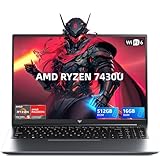
Light Gaming Laptop (Ryzen 7 7430U, 16GB / 512GB)
The 7430U is an efficiency-focused chip, which means modest gaming performance but excellent battery life and a cool, quiet chassis. Consider this the “student who also games” option: strong for coursework, streaming, and esports at medium settings, but not the one to buy if AAA titles are your priority.
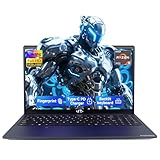
Tunhail 15.6″ Laptop (16GB / 512GB, Win 11 Pro)
A budget-focused entry with 16GB RAM, a 512GB drive, an FHD display, and Windows 11 Pro included — useful if you need BitLocker or Remote Desktop for work. The generically described processor limits its gaming ceiling, so treat it as a capable everyday machine that handles light titles rather than a true gaming rig.
Frequently Asked Questions
Can you actually game on a laptop under $800?
Yes, with realistic expectations. Esports titles like CS2, Valorant, Fortnite, Rocket League, Minecraft and Dota 2 run well at 1080p on modern integrated graphics. Demanding AAA releases will need reduced settings, upscaling, or a 720p render resolution to stay playable.
Is 24GB of DDR5 RAM better than 16GB for gaming?
On these machines, meaningfully so. Integrated GPUs have no dedicated video memory and borrow from system RAM, so both capacity and bandwidth affect frame rates directly. The jump from 16GB DDR4 to 24GB DDR5 can be worth several frames per second in GPU-limited scenarios.
Should I worry about listings that don’t name the exact processor?
Be cautious. A vague “Core processor (up to 3.40GHz)” description often indicates an older or low-power chip that the seller would rather not specify. It doesn’t automatically mean the laptop is bad, but you can’t verify performance beforehand — so weight those models toward general productivity rather than gaming.
Can I upgrade these laptops later?
Often yes, and it’s the smartest way to extend an $800 purchase. Many budget chassis include an extra M.2 slot for a second SSD and SODIMM slots for RAM. Check the service manual or seller Q&A before buying, since some thin models solder memory to the board.
Final Thoughts
For most buyers, the KAIGERR 2026 Gaming Laptop is the one to get — its Ryzen 7 H255, 24GB of DDR5 and 16-inch 1080p display deliver the best overall performance per dollar under $800. If you’d rather save money for peripherals, the near-identical Ryzen 7 H255 24GB DDR5 model offers the same core hardware in a smaller chassis, while the NIMO 15.6″ with the Ryzen 5 6600H is the smarter buy for anyone who values a quality IPS panel and steadier sustained performance during long sessions.


