Key takeaways
- Long-term CPU power: sustained power, sometimes called PL1, TDP, or a configurable TDP, indicates how much heat the laptop can continuously remove.
- Cooling design: thicker laptops with multiple fans and several heat pipes generally sustain performance better than thin systems using the same chip.
- Memory configuration: soldered dual-channel or fast LPDDR5X memory can significantly improve integrated-graphics performance, while upgradeable laptop memory may offer better capacity and longevity.
The best mobile CPU for most gaming laptops in 2026 is AMD’s Ryzen AI 9 HX 370, while Intel’s Core Ultra 9 285HX is the stronger choice for maximum sustained CPU performance and Apple’s M4 Pro remains the better option for quiet, efficient everyday work on macOS.
Best mobile CPU choices in 2026
| Processor | Best for | Typical configurable power | Gaming and workload verdict |
|---|---|---|---|
| AMD Ryzen AI 9 HX 370 | Balanced gaming laptops and creator systems | 15–54 W CPU package range, depending on laptop | Excellent efficiency, strong multicore performance, and a capable integrated GPU |
| Intel Core Ultra 9 285HX | High-end gaming and workstation laptops | 55 W base class; often configured well above 100 W under boost | Very high sustained performance, but demands substantial cooling |
| AMD Ryzen 9 9955HX | CPU-heavy rendering, simulation, and premium gaming laptops | 55 W base class; commonly allowed much higher short-term power | Excellent multicore performance when the chassis can remove the heat |
| AMD Ryzen AI 9 365 | Thin gaming and productivity laptops | 15–54 W configurable range | Strong efficiency and good integrated graphics at a lower system cost |
| Apple M4 Pro | Quiet productivity, development, and creative work | System-dependent; substantially below high-end gaming laptop CPU power | Fast and efficient, but limited by macOS game support and Apple hardware compatibility |
| Snapdragon X Elite | Long battery life and web-based workloads | Usually configured in the roughly 23–80 W laptop design range | Efficient for everyday use, but Windows game and application compatibility requires checking |
Why the “fastest” mobile CPU is not always the best
Laptop processors do not perform in isolation. A processor can sustain high clock speeds only when the laptop provides enough cooling capacity, electrical power, and firmware support. Two laptops with the same CPU can therefore deliver noticeably different results.
For gaming, the graphics processor normally determines frame rate at high settings, especially at 1440p and 4K. The CPU still matters for minimum frame rates, simulation-heavy games, large multiplayer matches, emulation, and high-refresh gaming at 1080p. A powerful CPU paired with a modest GPU can also increase cost, fan noise, and battery drain without improving visual quality.
Look beyond the processor name for three details:
- Long-term CPU power: sustained power, sometimes called PL1, TDP, or a configurable TDP, indicates how much heat the laptop can continuously remove.
- Cooling design: thicker laptops with multiple fans and several heat pipes generally sustain performance better than thin systems using the same chip.
- Memory configuration: soldered dual-channel or fast LPDDR5X memory can significantly improve integrated-graphics performance, while upgradeable laptop memory may offer better capacity and longevity.
Head-to-head: Ryzen AI 9 HX 370 versus Core Ultra 9 285HX
Ryzen AI 9 HX 370: the balanced choice
The Ryzen AI 9 HX 370 combines 12 cores, a modern hybrid-style design with Zen 5 and Zen 5c cores, and Radeon 890M integrated graphics. Its main advantage is efficiency: it can deliver strong performance in a relatively compact laptop without requiring the cooling system associated with the most aggressive HX designs.
That makes it particularly attractive in a laptop with a midrange discrete GPU such as a GeForce RTX 4060 or RTX 4070 Laptop GPU. In that class of system, the processor is unlikely to be the main gaming bottleneck, while its integrated graphics provide a useful fallback for lighter games and battery-powered use.
Core Ultra 9 285HX: the sustained-performance choice
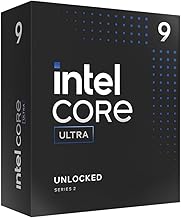
Intel’s Core Ultra 9 285HX is designed for large, performance-focused laptops. Its 24-core configuration is well suited to heavily threaded compiling, video production, 3D rendering, compression, and CPU-limited games. It can maintain very high throughput when paired with a substantial cooling system and a high-capacity power adapter.
The trade-off is power and heat. A laptop configured to let the 285HX run aggressively may become loud under sustained loads and may lose performance on battery power. It is a better fit for a desktop replacement than for a lightweight travel machine.
Power draw changes the buying decision
Consider a laptop CPU running at an average 45 W during a demanding task. If the battery is rated at 80 watt-hours, an idealized CPU-only runtime calculation is:
80 Wh ÷ 45 W = 1.78 hours.
That is not the laptop’s real battery life because the display, memory, storage, fans, wireless hardware, and voltage-conversion losses also consume power. If those other components average 12 W, the system draw becomes approximately 57 W:
80 Wh ÷ 57 W = about 1.4 hours.
At a lighter 12 W total system draw, the same battery could theoretically last:
80 Wh ÷ 12 W = 6.7 hours.
The calculation shows why a high-performance CPU can be excellent while plugged in but a poor choice for long gaming sessions away from an outlet. CPU power limits, not just core count, strongly influence battery life and fan noise.
Best mobile CPU by laptop type
| Your situation | Best processor class | What to prioritize |
|---|---|---|
| 1080p gaming at 144 Hz with a discrete GPU | Ryzen AI 9 HX 370 or a strong Core Ultra H-series chip | High minimum frame rates, good cooling, and dual-channel memory |
| 1440p or 4K gaming | Midrange or high-end H/HX CPU paired with the strongest affordable GPU | GPU performance, VRAM, and cooling matter more than small CPU differences |
| CPU rendering and software compilation | Core Ultra 9 285HX or Ryzen 9 9955HX | Long-duration power limits, cooling, and a large power adapter |
| Thin laptop with occasional gaming | Ryzen AI 9 365 or Ryzen AI 9 HX 370 | Efficiency, integrated graphics, weight, and fan behavior |
| Quiet macOS productivity and creative work | Apple M4 Pro | Application support, unified memory capacity, and external display compatibility |
| Web work and exceptional standby life | Snapdragon X Elite | Native application support, game compatibility, and peripheral drivers |
Integrated graphics and memory considerations
The Ryzen AI 9 HX 370 is unusually versatile for a processor with integrated graphics because its Radeon 890M has enough shader resources for many esports games and older titles at sensible settings. It is not a replacement for a high-end discrete GPU, but it can make a thin laptop practical for gaming without immediately requiring a dedicated graphics chip.
Integrated graphics use system memory as video memory. A laptop with 32 GB of fast dual-channel memory is a safer choice than one with 16 GB when gaming without a discrete GPU, because the operating system and game must share that pool. Reducing texture quality can also prevent memory pressure. For integrated graphics, start at 1080p, use medium textures, enable an upscaler if available, and cap the frame rate slightly below the display’s refresh rate to reduce power and heat.
How to choose without overpaying
- For a gaming laptop with an RTX 4060 or RTX 4070: choose the Ryzen AI 9 HX 370 or a capable Core Ultra 7 H-class processor rather than paying heavily for the most extreme HX chip.
- For an RTX 4080 or RTX 4090 Laptop GPU: consider the Core Ultra 9 285HX or Ryzen 9 9955HX if you play CPU-sensitive games at high refresh rates or run professional workloads.
- For a laptop under roughly $1,000: prioritize a balanced processor, 16 GB or more of memory, and a better GPU over a premium CPU badge.
- For a laptop usually used unplugged: favor Ryzen AI 300-series or Apple silicon and check independent battery and acoustic measurements for the exact model.
- For Linux or specialized Windows software: verify driver and application support before choosing an ARM-based Snapdragon system.
Final verdict
The Ryzen AI 9 HX 370 is the best overall mobile CPU for 2026 because it combines strong gaming support, efficient sustained performance, useful integrated graphics, and flexible laptop designs. The Core Ultra 9 285HX and Ryzen 9 9955HX are better when maximum plugged-in multicore performance is the priority and the laptop has serious cooling. Apple’s M4 Pro leads for efficient macOS work, while Snapdragon X Elite systems make sense primarily when battery life and everyday productivity outweigh game compatibility.
Choose the processor together with the laptop’s cooling system, graphics processor, memory, and power limits. Those details determine whether a nominally powerful mobile CPU remains fast after ten minutes of gaming—or only looks impressive in a short benchmark.