
Our Top Picks
 Razer DeathAdder Essential Ergonomic Wired Gaming Mouse5.01 x 2.86 x 1.69 inches0.3 poundsCheck on Amazon
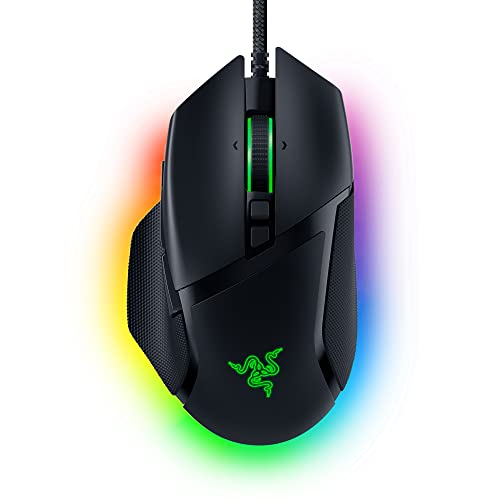 Razer Basilisk V3 Customizable RGB Wired Ergonomic GamingMouse2.96 x 5.12 x 1.67 inches0.2 poundsCheck on Amazon
For most gamers the best choice is a middle setting, commonly 800 or 1600 DPI, paired with an in-game sensitivity that feels natural on your mousepad. DPI by itself does not make you more accurate; it is a multiplier that works together with your game’s sensitivity slider, and what matters is the combined result.
What DPI actually measures
DPI, or dots per inch, describes how far the cursor travels on screen for each inch you move the mouse. Some makers use the term CPI, counts per inch, for the same setting. A higher number means the cursor covers more distance for the same hand movement. You change it with the mouse’s DPI button or through the maker’s software.
Razer DeathAdder Essential Ergonomic Wired Gaming Mouse, Black | 6400 DPI Optical Sensor, 5 Programmable Buttons, Rubber Side Grips, Mechanical Mouse Switches
Chosen because it specifies Black and 6400 DPI Optical Sensor.
View on AmazonRazer Basilisk V3 Customizable RGB Wired Ergonomic Gaming Mouse, Black | Fastest Gaming Mouse Switch, Chroma RGB Lighting, 26K DPI Optical Sensor, 11 Programmable Buttons, HyperScroll Tilt Wheel
Chosen because it specifies Black and Fastest Gaming Mouse Switch.
View on Amazon
Redragon M810 PRO Wireless RGB Gaming Mouse 10000 DPI Remapping Keys | Cable-Free 0 Delay, Rapid-Fire Macro Keybinds, Vibing Backlight, Ergonomic Grip Body Comfort
Chosen because it specifies Cable-Free 0 Delay and Rapid-Fire Macro Keybinds.
View on AmazonIn-game sensitivity is a separate multiplier. Multiply the two and you get eDPI, or effective DPI. For example, 800 DPI at an in-game sensitivity of 0.4 gives 320 eDPI, and 1600 DPI at 0.2 gives the same 320. Sources that explain eDPI say those two setups feel about the same in the game, which is why eDPI is used to compare sensitivity between players.
Quick comparison
| Factor | Low DPI (about 400 to 800) | High DPI (about 1600 and up) |
|---|---|---|
| Hand movement per screen distance | Large arm movements | Smaller wrist or finger movements |
| Typical users | Competitive FPS players | MOBA, MMO, desktop and high-resolution monitor users |
| Mousepad space needed | More | Less |
| Game sensitivity slider | Often set higher | Often set lower |
| Cursor on desktop | Can feel slow on large or high-resolution screens | Feels quick, may overshoot small targets |
The ranges above reflect what guides commonly describe: competitive shooter players typically use 400 to 800 DPI with a low in-game sensitivity, while MOBA and MMO players often prefer 800 to 1600.
Does high DPI hurt aim?
Popular belief says high DPI adds input lag or reduces accuracy. One guide calls this a myth, while noting that settings above about 3200 offer diminishing returns for most gaming. The sources are not unanimous on smoothness. PC Gamer argues that a higher DPI with lower in-game sensitivity gives smoother movement than a low DPI with high sensitivity at the same eDPI, because the sensor reports movement in finer steps. Another guide makes the opposite claim. Because the claims conflict and depend on the specific sensor and game, treat any one-size-fits-all statement with caution.
There is a practical argument for lower DPI: some games do not allow in-game sensitivity below a certain minimum, so a high DPI can make the slowest setting still too fast. Conversely, a very low DPI can make small cursor movements on a high-resolution desktop tedious.
Why eDPI matters more than the DPI number
When you compare yourself to a pro player, copying only their DPI is meaningless without their in-game sensitivity. Games also scale sensitivity differently, so eDPI is only directly comparable within the same game. If you change DPI and want to keep the same feel, use the formula given in the guides: new sensitivity equals old sensitivity times old DPI divided by new DPI. Going from 800 to 1600 DPI, for instance, means halving the in-game value.
Choose based on your pad and grip
Guides advise picking a comfortable DPI first, usually 400, 800 or 1600, then tuning the in-game sensitivity. The important check is mousepad space. If a 180-degree turn runs your mouse off the pad, you will keep lifting and repositioning, which costs more accuracy than a slightly fast sensitivity would. Arm aimers with large pads can handle low eDPI; wrist and fingertip aimers on small pads usually need more.
- Large desk space and arm aiming: lower eDPI works well.
- Small pad, wrist aim or palm grip: a moderate to higher eDPI is easier to control.
- High-resolution monitors: a higher DPI reduces the number of swipes needed on the desktop.
Decision table
| Pick… | If you… |
|---|---|
| 400 to 800 DPI | Play tactical shooters, have room for big swipes and want precise small adjustments |
| 800 to 1600 DPI | Want a balance for mixed games, a 1440p or 4K desktop and moderate mousepad space |
| 1600 DPI and above | Play MOBAs or MMOs, use a very high-resolution display or prefer minimal hand movement |
| A DPI button with stages | Switch between desktop use and gaming, or want a temporary sniper setting |
Sensor limits and marketing numbers
Many mice advertise very large maximum DPI figures, but guides point out the maximum is rarely used in play. A big number on the box does not tell you about tracking quality, smoothing or acceleration, which depend on the sensor and firmware. Look at the maker’s stated polling rate and sensor model, and read reviewers’ notes about tracking consistency rather than choosing on the headline DPI.
Common mistakes
- Changing DPI without adjusting sensitivity. This makes the cursor suddenly fast or slow; recalculate with the formula above.
- Chasing the highest DPI. Diminishing returns apply, and extra speed is not the same as extra precision.
- Copying a pro’s setup unchanged. Their pad size, grip and game settings differ from yours.
- Mixing up profiles. Onboard profiles and software profiles can conflict, so confirm which one is active.
- Ignoring pointer settings. Windows pointer acceleration (“enhance pointer precision”) can change how movement feels, so many players switch it off for gaming.
A simple way to settle on a setting
- Pick 800 DPI as a baseline, or 1600 if you use a high-resolution monitor.
- Set a moderate in-game sensitivity and adjust until a full 180-degree turn takes a comfortable swipe across your pad.
- Use that setting for several sessions before changing it, so muscle memory can settle.
- If you move to a different DPI, convert the sensitivity with the formula rather than guessing.
Polling rate and DPI are different settings
Players sometimes confuse DPI with polling rate. Polling rate is how many times per second the mouse reports its position to the computer, and the maker lists the supported values in its software. DPI is about how far the cursor moves per inch. A higher polling rate can make movement look finer on a fast display, while DPI changes speed. Adjusting one does not substitute for the other, and both should be set conservatively before blaming the sensor for poor aim.
Frequently Asked Questions
Is higher DPI better for gaming?
Not by itself. A higher DPI means the cursor moves farther per inch, but your in-game sensitivity multiplies that effect. What matters is the combined eDPI and whether it suits your pad and aiming style.
What DPI do FPS players usually use?
Guides describe 400 to 800 DPI as typical for competitive shooters, usually paired with low in-game sensitivity. Some players use 1600 with an even lower sensitivity value for the same eDPI. Both approaches can feel identical in game.
Does high DPI cause input lag?
One source calls the idea a myth, and nothing found ties DPI to added latency on its own. Sensor quality, polling rate and wireless connection have a larger effect on responsiveness. Settings above about 3200 are described as offering little benefit for most players.
What is eDPI?
eDPI is your mouse DPI multiplied by your in-game sensitivity. It lets players compare sensitivity across different DPI settings in the same game. It is not directly comparable between games that scale sensitivity differently.
How do I keep the same feel when changing DPI?
Multiply your old sensitivity by the old DPI, then divide by the new DPI to get the new in-game value. For example, moving from 800 to 400 DPI means doubling the in-game sensitivity. Try it in a practice mode before playing seriously.
Should I use the same DPI on the desktop and in games?
You can, but it is not required. Many mice have a DPI button with several stages, so you can use a higher stage on the desktop and a lower one in games. Just remember which stage each profile uses.
FAQ
Does high DPI hurt aim?
Is higher DPI better for gaming?
What DPI do FPS players usually use?
Does high DPI cause input lag?
What is eDPI?
How do I keep the same feel when changing DPI?
Should I use the same DPI on the desktop and in games?
More from Amazon
Programs that pair well with the guide above. Offers and eligibility are set by Amazon and may change.
Free shipping on eligible items, Prime Video and more. Eligible new members can start with a free trial.
Start a Prime free trialAd-free music streaming. Eligible new subscribers can start with a free trial.
Try Music Unlimited freeA Prime membership for ages 18-24 with a trial period. Eligibility is set by Amazon.
See Prime for Young AdultsAudiobooks and podcasts to listen to on the go. Eligible new members can start with a free trial.
Try Audible freeAs an Amazon Associate we earn from qualifying purchases.



