Key takeaways
- Gaming performance: AMD’s 3D V-Cache chips often lead in frame rates, especially in CPU-bound and simulation-heavy titles, while Intel stays very competitive in most games.
- Platform longevity: AMD’s AM5 socket supports multiple CPU generations, so you can upgrade the chip later; Intel tends to refresh sockets more frequently.
- Efficiency: AMD’s X3D chips run cool and sip power for their performance, while Intel’s Core Ultra generation made big efficiency strides of its own.
- Productivity: Intel’s high core and thread counts are excellent for multitasking and content work; AMD’s non-X3D and higher-core parts also compete well here.
- Memory and platform: Both are on DDR5, with AMD favoring a tuned DDR5-6000 sweet spot and Intel offering broad high-speed memory support.
- Value in prebuilts: Intel frequently appears in aggressively priced prebuilt desktops, while AMD dominates the enthusiast gaming conversation.
What's inside
The Intel versus AMD debate is the oldest rivalry in PC gaming, and in 2026 it is closer and more interesting than ever. Both companies make superb gaming processors, but they take different paths to get there. AMD leans on its X3D chips with stacked cache that supercharges gaming performance, while Intel counters with its Core Ultra platform emphasizing efficiency and strong all-around throughput. Choosing between them shapes your motherboard, your memory, and your upgrade path for years.
This comparison cuts through the brand loyalty to focus on what actually matters for a gaming build: real-world frame rates, platform longevity, price-to-performance, and how each stacks up for mixed use like streaming and content creation. Whether you are eyeing a prebuilt with an Intel Core i5 or an AMD Ryzen desktop, here is how the two giants compare and which one deserves your money.
As an Amazon Associate we earn from qualifying purchases at no extra cost to you.


⚡ Save on Your Next PC — Amazon Prime
Prime members get fast free shipping on the systems above, plus early access to Prime Day & Black Friday PC deals. New members get a 30-day free trial.
Watch: Intel vs AMD for Gaming in 2026 — Video Review
Quick Verdict
For pure gaming, AMD’s X3D chips generally take the crown thanks to their massive cache, which many games love, and the AM5 platform promises a long upgrade runway. Intel’s Core Ultra chips are excellent all-rounders that shine in mixed productivity workloads and often compete hard on price in prebuilt systems. If gaming frame rate is your single priority, lean AMD X3D; if you want a balanced do-everything machine or find a better deal, Intel is a strong pick.
Key Differences
- Gaming performance: AMD’s 3D V-Cache chips often lead in frame rates, especially in CPU-bound and simulation-heavy titles, while Intel stays very competitive in most games.
- Platform longevity: AMD’s AM5 socket supports multiple CPU generations, so you can upgrade the chip later; Intel tends to refresh sockets more frequently.
- Efficiency: AMD’s X3D chips run cool and sip power for their performance, while Intel’s Core Ultra generation made big efficiency strides of its own.
- Productivity: Intel’s high core and thread counts are excellent for multitasking and content work; AMD’s non-X3D and higher-core parts also compete well here.
- Memory and platform: Both are on DDR5, with AMD favoring a tuned DDR5-6000 sweet spot and Intel offering broad high-speed memory support.
- Value in prebuilts: Intel frequently appears in aggressively priced prebuilt desktops, while AMD dominates the enthusiast gaming conversation.
Intel Core Platform
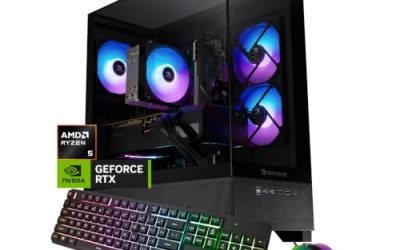
Intel’s current Core Ultra chips are versatile powerhouses that handle gaming, streaming, and heavy multitasking with ease. In prebuilt gaming desktops, you will often find strong-value Intel Core i5 configurations, like a Core i5-14400F paired with a capable GPU, that deliver excellent frames per dollar for mainstream gamers. Intel’s strength is balance: you rarely feel a weakness whether you are gaming, editing video, or running dozens of browser tabs.
The trade-offs are that Intel’s absolute gaming lead has slipped against AMD’s cache-heavy chips, and its sockets historically have shorter upgrade lifespans, so a future CPU swap may mean a new motherboard. For buyers who value all-around capability and often find a compelling deal on an Intel prebuilt or bundle, none of that is a dealbreaker, and the platform remains a rock-solid choice.
AMD Ryzen Platform
AMD’s Ryzen line, especially the X3D models with stacked 3D V-Cache, has become the darling of gaming enthusiasts. Chips like the Ryzen 7 7800X3D are frequently cited as the go-to gaming CPU because that extra cache dramatically boosts performance in many titles while running cool and efficient. The AM5 platform’s promise of long socket support means you can drop in a next-gen chip down the road without replacing your board.
AMD gaming laptops and mini PCs, from Ryzen-powered ASUS TUF machines to compact GMKtec systems, extend that efficiency-first philosophy to portable and small-form-factor builds. The main consideration is that top X3D chips carry a premium and their productivity lead over Intel is narrower, so pure content creators should weigh core counts. For gamers, though, AMD’s combination of frame rate leadership and upgrade longevity is compelling.
Which Should You Buy?
- Choose AMD X3D if: maximum gaming frame rate is your top priority and you want the best performance in demanding, CPU-bound titles.
- Choose AMD if: you value a long upgrade path on the AM5 socket and cool, efficient operation.
- Choose Intel if: you want a balanced machine for gaming plus productivity and streaming.
- Choose Intel if: you find a significantly better-priced prebuilt or bundle that fits your budget.
- Either works if: you pair it with a strong GPU, which matters more than CPU brand at high resolutions.
Frequently Asked Questions
Is AMD or Intel better for gaming in 2026?
For pure gaming, AMD’s X3D chips generally lead thanks to their large cache, but Intel’s Core Ultra parts remain very competitive. At 4K, where the GPU is the bottleneck, the difference narrows to near-negligible for most titles.
Does the CPU or GPU matter more for gaming?
The GPU is usually the bigger factor for frame rate, especially at higher resolutions. The CPU matters most at 1080p, in competitive esports titles chasing very high frame rates, and in simulation-heavy games. Balance both to your target resolution.
Can I upgrade an AMD CPU later?
Yes, that is a key AMD advantage. The AM5 socket is designed to support multiple CPU generations, so you can often drop in a newer Ryzen chip down the line with just a BIOS update, without replacing the motherboard.
Which is better for streaming while gaming?
Both handle it well with modern GPU encoders taking the load off the CPU. Intel’s high thread counts and AMD’s higher-core parts both provide plenty of headroom for gaming and streaming simultaneously; pick based on your gaming and budget priorities.
Final Verdict
There is no wrong answer here, which is a great position for buyers. If your heart is set on the highest gaming frame rates and a future-proof upgrade path, AMD’s X3D chips on AM5 are the enthusiast favorite. If you want a versatile all-rounder for gaming, streaming, and productivity, or you spot a better-priced Intel prebuilt, Intel’s Core Ultra platform delivers beautifully. Match your CPU to a strong GPU and either brand will serve you well for years.