Our Top Picks
Direct drive is the best of the three for detail, smoothness and response, belt drive sits in the middle, and gear drive is the simplest and usually the least refined. The names describe how the motor’s force reaches your hands: through meshed gears, through a rubber belt, or straight onto the steering shaft with nothing in between. Direct drive no longer means “expensive and industrial” either, because compact bases in the 3 to 6 Nm range now exist for desk use. This guide explains what each system does, what the torque numbers mean at the rim of a real wheel, and which kind of buyer each type suits, then looks at three entry-level direct drive bundles.
Quick Verdict
| Your situation | Our verdict |
|---|---|
| You race casually on a console or PC and want a simple clamp-on wheel | Gear-driven wheels remain a reasonable entry point, but expect more noise and a stepped feel. |
| You want smoother force feedback without moving to a bigger motor | Belt-driven bases are the middle path: smoother than gears, with moderate torque. |
| You want the clearest detail and fastest response and will clamp firmly to a desk or rig | Direct drive is the target; entry bases are enough to feel the difference. |
| You have limited desk space | A compact entry direct drive base (about 3 to 6 Nm) fits where a large rig does not. |
| You want to run GT or high-downforce cars with heavy loads and long stints | Plan for more torque than an entry base offers, and a solid cockpit to mount it. |
The Key Differences Between the Three Drive Types
Gear drive: simple and affordable
In a gear-driven base a small motor turns gears that transmit force to the wheel shaft. Gears make it easy to multiply a small motor’s torque, which keeps the product compact and inexpensive. The trade-off is that meshing teeth add friction, backlash and a slightly stepped, noisy character, especially around the center and during small corrections. Logitech’s G923 is the best-known current example; it is gear-driven, rated at 2.3 Nm of peak torque and rotates 900 degrees, according to reviewer and product coverage. For a casual player, a gear wheel is a large step up from a controller. For someone chasing fine detail, it is where the limits show first.

MOZA R5 Bundle Racing Wheel, Direct Drive Base, Pedals Simulator Kit for PC
Chosen because it specifies Direct Drive Base and Pedals Simulator Kit for PC.
View on Amazon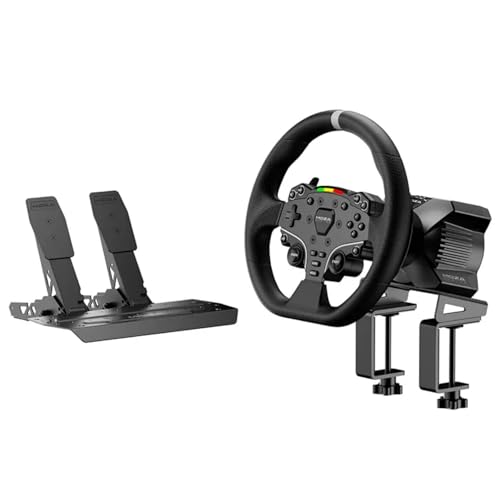
MOZA R3 Bundle Kit Direct Drive Servo base, Racing Wheel and Pedals for PC
Chosen because it specifies Racing Wheel and Pedals for PC.
View on Amazon
PXN V10 PRO Direct Drive Sim Racing Wheel and Pedals for PC, Xbox, PS4
Chosen because it specifies Xbox and PS4.
View on AmazonBelt drive: smoother, with a rubber link
A belt-driven base uses a motor that sits beside the shaft and turns it through a toothed belt, usually with a pulley ratio that multiplies torque. The belt absorbs some of the harshness of a gear train, so force feedback is generally smoother and more detailed. Thrustmaster’s T300RS is a common example at 3.9 Nm of peak torque and 1080 degrees of rotation, per reviewer coverage. Belts can stretch and wear over time, and the pulley ratio still means the motor is not coupled one-to-one with the wheel.
Direct drive: no intermediary
In direct drive, the wheel shaft is attached to the motor’s rotor. There are no gears or belts, so there is no gear backlash, no belt elasticity, and nothing to filter small forces. Because the rotor must be large enough to deliver torque on its own, direct drive motors are bigger, and they are driven by a servo controller. Direct drive is valued for response and fine detail, and for supporting very strong force at the high end of the market. Entry bases are far weaker than the 20 Nm-plus industrial-grade units, but they still offer the same coupling.
What torque numbers mean at the rim
Torque in newton-meters (Nm) is force times distance, so the force you feel at your hands depends on wheel radius. A rule of thumb: divide the torque by the wheel radius in meters. For a 280 mm wheel (radius 0.14 m), 2.3 Nm is about 16 N at the rim, 3.9 Nm is about 28 N and 5.5 Nm is about 39 N, which is roughly 4 kilograms-force. Those are peak figures. Continuous torque is lower, and games rarely sit at the peak. The bigger practical difference is how the base reproduces small forces: an encoder with 15 bits splits one rotation into 32,768 positions, and one with 16 bits splits it into 65,536, so higher-resolution sensors report finer wheel positions to the software.
Side-by-side comparison
| Type | How force reaches the wheel | Typical entry example | Strengths | Limits |
|---|---|---|---|---|
| Gear | Motor turns gears | Logitech G923, 2.3 Nm peak | Low cost, compact, simple | Noisier, stepped feel, less detail |
| Belt | Motor turns belt and pulleys | Thrustmaster T300RS, 3.9 Nm peak | Smoother than gear, moderate cost | Belt wear, indirect coupling |
| Direct drive | Motor shaft is the wheel shaft | Entry bases 3.2 to 5.5 Nm in this guide | Detail, response, no play | Higher cost, needs secure mounting, safety care |
The figures for the G923 and T300RS come from reviewer coverage and the figures for the direct drive bases come from the manufacturers’ product pages. Always check torque, rotation range and platform support for the exact bundle you buy, because makers sell multiple versions.
How to Decide
Work through these points in order. Torque and budget numbers below are rules of thumb.
- Pick your platform first. PC-only, Xbox, PlayStation and multi-platform bases are different products. A base that is perfect on PC may not be recognized on a console without an adapter or a different wheel. Confirm the platform line on the exact listing.
- Decide how you mount it. A desk clamp is fine for the 3 to 6 Nm class if the desk is solid and the clamp bites into thick edge material. Rule of thumb: if the desk visibly flexes when you pull the wheel hard, you need a sturdier surface or a stand before you add torque.
- Match torque to the cars you drive. Road cars, karts and lighter open-wheel cars do not need huge force. Heavy GT cars and long sessions reward more torque and more steady cooling. As a loose guide, 3 to 4 Nm is workable for casual driving, and 5 to 6 Nm gives noticeably more range for those who want stronger effects without a large base.
- Look at the pedals. Many bundles ship with a basic pedal set. A better brake pedal often improves lap consistency more than extra wheel torque does. Check whether the pedals use a load cell (measures pressure) or a Hall sensor (measures travel).
- Plan the power and desk space. Direct drive bases use external power supplies and cables. Make sure the desk has room for the base, the wheel and the cable run, and that the base is not placed where you could catch it with a knee.
- Check software. Tuning force feedback is part of the experience, so look at the maker’s desktop software and driver support for your platform.
Safety note for any direct drive base: it can move with real force. Manufacturer manuals from makers such as Simucube and Asetek give consistent guidance: do not operate the quick release while the base is powered and connected, disable torque before removing or attaching a wheel, keep fingers out of rotating parts, and set torque no higher than you can safely hold with one hand. If torque ever feels out of control, take both hands off and use the torque-off or power-off control rather than relying on software. Read the manual for your specific base because the procedures differ.
Products That Fit
The products below are examples that fit the situations above, not a ranking. Specs are drawn from the listing names and manufacturer product pages; “confirm on listing” marks anything that varies by version.
MOZA R5 Bundle – for a first serious direct drive upgrade on PC
As an Amazon Associate we earn from qualifying purchases at no extra cost to you.

The R5 bundle is the strongest of the three examples on torque, with a 5.5 Nm peak rating. It suits a PC player stepping up from a gear or belt wheel who wants a base that can deliver stronger effects than most entry units while still clamping to a desk. MOZA’s product pages describe a 15-bit encoder and a 1000 Hz USB rate, and the bundle includes a wheel and a pair of pedals. The listing is a PC bundle, so check console compatibility before buying for a console.
- Direct drive base, 5.5 Nm peak torque (manufacturer page)
- 15-bit encoder, 1000 Hz USB refresh (manufacturer page)
- ES steering wheel at about 280 mm and SR-P Lite pedals, with a Hall sensor and no load cell (manufacturer page)
- Platform: PC (confirm on listing)
Caveat: the bundled pedals are an entry set, so serious brake-focused drivers will probably want to upgrade them first. MOZA also sells a newer R5 variant with a higher rating, so confirm you are looking at the 5.5 Nm version.
MOZA R3 Bundle – for compact desks and gentler force
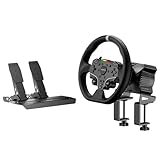
The R3 is the smaller sibling, rated at 3.9 Nm peak with the same 15-bit encoder and 1000 Hz USB rate on MOZA’s pages. It fits a smaller desk or a player who finds a stronger base more than they need. It is also the one in this group where platform matters most: MOZA sells a PC bundle and a separate Xbox and PC bundle with a licensed wheel, so verify which version the listing contains.
- Direct drive base, 3.9 Nm peak torque (manufacturer page)
- 15-bit encoder, 1000 Hz USB refresh (manufacturer page)
- Includes a 280 mm class wheel and SR-P Lite pedals (manufacturer page)
- Xbox versus PC-only version: confirm on listing
Caveat: the torque ceiling is fixed, so heavier GT-style driving may feel limited compared with the R5 class. It is a gentle introduction, not a long-term top end.
PXN V10 PRO – for multi-platform households on a budget

The V10 PRO is aimed at players who move between PC, Xbox and PlayStation 4. Product pages describe a 3.2 Nm peak servo motor, a detachable 270 mm wheel and a three-pedal Hall-sensor set. That makes it the one example here with a clutch pedal in the box, which helps for manual-gearbox cars. It is a less established name in sim racing than MOZA, so check how well the maker’s software and driver support match the games you play.
- Direct drive servo base, 3.2 Nm peak torque (listing and manual)
- Rotation adjustable between 270 and 900 degrees (product pages)
- Three Hall-effect pedals and paddle shifters (listing)
- Platforms: PC, Xbox and PS4 (PS5 requires a separate converter; confirm on listing)
Caveat: some retailers show conflicting torque figures for this model, so rely on the manufacturer’s manual and the figure on the exact listing. Software polish and long-term support are the questions to research.
Common Mistakes
- Chasing peak torque alone. Peak figures are brief; detail, latency and software tuning change how a base feels as much as the headline number.
- Mounting a direct drive base on a wobbly desk. Flex hides detail and can be unsafe. Check your surface before you add torque.
- Ignoring platform support. Console compatibility depends on the version of the bundle and sometimes on a licensed wheel or adapter.
- Neglecting the pedals. Many players find consistent braking helps lap times more than extra wheel force.
- Skipping the manual. Quick release, torque-off and power procedures differ by maker; get them right before the first session.
- Assuming “direct drive” is always strong. The entry bases here range from 3.2 to 5.5 Nm. They offer the direct coupling, not the force of high-end units.
Questions
Is direct drive really that much better than belt drive?
Direct drive removes the belt and pulleys, so small forces and fast changes reach your hands with less filtering. Many drivers notice the extra clarity, but a well-tuned belt wheel can still be enjoyable. The difference matters most when you drive often and care about subtle cues such as the car going light at the limit.
Do I need 8 Nm or more?
Most home users do not. Entry bases in the 3 to 6 Nm range already produce rim forces of roughly 21 to 43 N on a 280 mm wheel by the arithmetic above. Higher-torque bases are mainly useful for players who want heavy GT car effects or who drive long stints in a sturdy cockpit.
Can I use a direct drive base with a console?
Some can, but compatibility depends on the version. Certain bundles ship with licensed wheels for Xbox, and some bases need adapters or are PC-only. Check the platform line on the exact bundle rather than assuming.
Is a direct drive base safe on a desk?
Entry bases are designed for desk clamps, provided the desk is solid and the clamp holds firmly. Use the maker’s torque-off control before changing the wheel, keep fingers away from rotating parts and avoid setting torque higher than you can hold with one hand. Stronger bases demand a proper stand or cockpit.
What is the difference between peak and continuous torque?
Peak torque is the maximum a base can output for a short burst; continuous torque is what it can sustain without overheating. For example, one product page for the PXN V10 PRO lists 3.2 Nm peak and 2.8 Nm continuous. Games spend most of their time well below the peak, so continuous torque and software tuning shape the day-to-day feel.
Should I upgrade the pedals or the base first?
If your pedals are a basic spring-based set, upgrading the brake often gives the most noticeable gain in consistency. If you already have good pedals and your wheel feels vague or loud, a direct drive base is the logical next step.
Update History
- October 14, 2026 – Initial publication.
- Check the product page for current specifications and availability before buying.
Sources and Methodology
We gathered the figures in this guide from manufacturer product and support pages, user manuals and safety guides from direct drive makers, reviewer coverage of the gear and belt examples, and the retailer listing fields for each product. Where sources conflicted, we used the manufacturer’s figure or told you to confirm it. We did not run our own force or latency measurements.
- MOZA Racing product and support pages for the R5 and R3 bundles
- PXN product listing fields and user manual for the V10 PRO
- Simucube 2 user guide and Asetek wheelbase quick start guide for safety practice
- Reviewer coverage by Jalopnik, TechRadar and OC Racing
- Retailer listing fields (title, feature bullets) for each example product