Key takeaways
- Buy a single dual-channel kit (2x16GB) rather than two mismatched single sticks.
- Enable XMP or EXPO in BIOS immediately after installing new RAM.
- Prioritize 6000MHz CL36 DDR5 for Ryzen builds; it is the current value sweet spot.
- Choose 32GB if you stream, keep many tabs open, or want to future-proof for a few years.
What's inside
RAM is one of the most misunderstood parts of a gaming build. Spend too little and games stutter as they swap data to your drive; spend too much and you have paid for capacity that sits empty while your GPU and CPU do the real work. In 2026, with newer titles streaming huge open worlds and background apps like Discord, browsers, and game launchers all fighting for memory, getting your RAM right matters more than it used to.
This guide walks you through exactly how much memory you need for different kinds of gaming, why speed and timings matter alongside raw capacity, and how to avoid the dual-channel and compatibility mistakes that quietly cost you frames. By the end you will be able to look at a kit and know whether it fits your rig and your budget.
As an Amazon Associate we earn from qualifying purchases at no extra cost to you. Product prices and availability are accurate as of the date shown and are subject to change.




⚡ Save on Your Next PC — Amazon Prime
Prime members get fast free shipping on the systems above, plus early access to Prime Day & Black Friday PC deals. New members get a 30-day free trial.
Watch: How Much RAM Do You Need for Gaming in 2026? — Video Review
How Much Capacity You Actually Need
For pure 2026 gaming, 16GB is now the practical floor and 32GB is the comfortable sweet spot. A 16GB kit like the Corsair Vengeance RGB DDR5 16GB still runs the vast majority of titles smoothly, but modern releases plus a browser and a couple of background apps can push past that ceiling, causing texture pop-in and frame drops. Stepping up to a 32GB kit such as the Corsair Vengeance DDR5 32GB or the Crucial 32GB DDR5 kit gives you headroom for heavy multitasking, streaming, and future games without paying for the diminishing returns of 64GB, which only benefits content creators and a handful of simulation titles.
Why Speed and Timings Matter
Capacity is only half the story. On modern AMD Ryzen and Intel platforms, DDR5 memory speed directly feeds the CPU, so a fast kit can add several percent to your average and 1% low frame rates. A 6000MHz CL36 kit like the Patriot Viper Venom DDR5 or the Corsair Vengeance RGB DDR5 32GB hits the current sweet spot for Ryzen, balancing high bandwidth with low latency. Chasing extreme speeds above 6400MHz usually costs far more for a benefit you will struggle to notice in real games.
Dual-Channel Is Not Optional
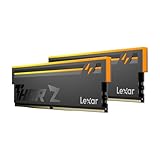
Always install RAM in matched pairs so it runs in dual-channel mode. A single 32GB stick has roughly half the memory bandwidth of two 16GB sticks, and in GPU-limited scenarios that gap can cost you a noticeable chunk of performance. This is why kits like the Lexar Thor Z RGB DDR5 32GB ship as 2x16GB rather than a single module. When you buy, buy the kit, not two separate sticks, so the modules are tested to run together at the rated speed.
Enabling XMP or EXPO
Out of the box, most motherboards run new memory at a slow JEDEC default like 4800MHz, not the speed printed on the box. To unlock the rated performance you must enable the memory profile in your BIOS: XMP on Intel boards, or EXPO on AMD boards. It is a single toggle, but skipping it is one of the most common reasons a new build feels slower than expected. After enabling it, boot into your OS and confirm the speed in Task Manager or CPU-Z.
Matching RAM to Your Platform
DDR4 and DDR5 are not interchangeable, and the slot type is dictated by your motherboard and CPU. Nearly every 2026 gaming build on a current AMD AM5 or Intel LGA1851 platform uses DDR5, so a DDR5 kit is the right call. If you are upgrading an older machine, check your motherboard manual first, because a DDR5 stick will not physically fit a DDR4 board. When in doubt, look up your exact motherboard model on the manufacturer’s memory support list.
Tips
- Buy a single dual-channel kit (2x16GB) rather than two mismatched single sticks.
- Enable XMP or EXPO in BIOS immediately after installing new RAM.
- Prioritize 6000MHz CL36 DDR5 for Ryzen builds; it is the current value sweet spot.
- Choose 32GB if you stream, keep many tabs open, or want to future-proof for a few years.
Frequently Asked Questions
Is 16GB still enough for gaming in 2026?
For most games at high settings, yes, especially if you close background apps. But if you stream, multitask heavily, or play the newest open-world titles, 32GB removes stutter and gives you real headroom.
Does faster RAM actually improve frame rates?
It can, particularly on AMD Ryzen chips where memory feeds the CPU directly. Moving from a slow default speed to a 6000MHz EXPO profile often adds a few percent to averages and smooths out 1% lows.
Can I mix different RAM kits?
It sometimes works, but it is risky. Mixed kits may fail to hit rated speeds or refuse to boot at their XMP/EXPO profile. Buying one matched kit avoids the guesswork entirely.
Do I need 64GB for gaming?
No. 64GB benefits video editing, 3D rendering, and heavy simulation, but games rarely use more than 32GB. Spend the difference on a better GPU or CPU instead.
Conclusion
For a 2026 gaming PC, aim for a 32GB DDR5 kit at 6000MHz CL36, install it as a matched pair, and enable XMP or EXPO so it runs at full speed. That combination covers everything from competitive shooters to demanding open worlds with room to spare, and it costs far less than overspending on 64GB or chasing extreme memory clocks you will never feel.