Our Top Picks
Moving from an RX 5700 to an RX 6700 XT is a real upgrade, not a sidegrade: expect roughly 35-50% more performance at 1440p, 4 GB more VRAM, hardware ray tracing and DirectX 12 Ultimate support, which makes it worth it for 1440p players whose RX 5700 now forces Medium settings, but a weak deal if you mainly play esports titles at 1080p or if a new RX 9060 XT 16GB costs about the same as a used 6700 XT where you live.
Both cards come from AMD’s 7 nm era and share almost the same physical footprint, so the swap is about as painless as GPU upgrades get. The interesting part is what changed between RDNA 1 and RDNA 2, and whether that change still matters in late 2026, when the RX 6700 XT is itself two generations old and RDNA 4 cards such as the RX 9060 XT and RX 9070 are the current lineup.

MSI Gaming Radeon RX 5700 Boost Clock: 1750 MHz 256-bit 8GB GDDR6 DP/HDMI Dual Torx 3.0 Fans Crossfire Navi AMD Radeon FreeSync Graphics Card (RX 5700 MECH GP OC) (Renewed)
Picked as a relevant option in this category.
View on Amazon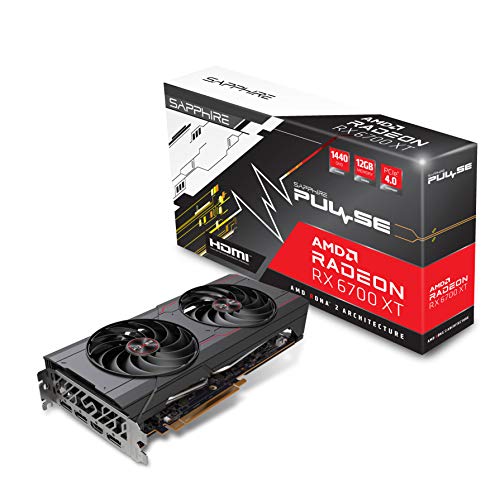
Sapphire Technology Pulse AMD Radeon RX 6700 XT Gaming Graphics Card with 12GB GDDR6, AMD RDNA 2 (11306-02-20G) (Renewed)
Chosen because it specifies AMD RDNA 2 (11306-02-20G) (Renewed).
View on Amazon
XFX Speedster SWFT309 AMD Radeon RX 6700 XT CORE Gaming Graphics Card with 12GB GDDR6 HDMI 3xDP, AMD RDNA 2 RX-67XTYJFDV (Renewed)
Chosen because it specifies AMD RDNA 2 RX-67XTYJFDV (Renewed).
View on AmazonSpec Sheet Side by Side
| Spec | RX 5700 | RX 6700 XT |
|---|---|---|
| Architecture | RDNA 1.0 | RDNA 2.0 |
| Release date | 7 July 2019 | 3 March 2021 |
| Launch MSRP | $349 | $479 |
| Stream processors | 2304 | 2560 |
| Boost clock | 1725 MHz | 2581 MHz |
| Process | 7 nm | 7 nm |
| TDP | 180 W | 230 W |
| Memory | 8 GB GDDR6 | 12 GB GDDR6 |
| Memory bus | 256-bit | 192-bit |
| Bandwidth | 448.0 GB/s | 384.0 GB/s |
| Cache | 4 MB L2 | 3 MB L2 + 96 MB L3 (Infinity Cache) |
| Interface | PCIe 4.0 x16 | PCIe 4.0 x16 |
| Power connectors | 1x 6-pin + 1x 8-pin | 1x 6-pin + 1x 8-pin |
| Length / width | 268 mm, 2-slot | 267 mm, 2-slot |
| Display outputs | 1x HDMI 2.0b, 3x DisplayPort 1.4a | 1x HDMI, 3x DisplayPort |
Two lines in that table explain most of the result. The boost clock jumps by roughly 850 MHz, and the 96 MB Infinity Cache lets the narrower 192-bit bus behave like a much wider one in games. Raw bandwidth actually goes down on paper, from 448 GB/s to 384 GB/s, yet the newer card is clearly faster because so many memory requests are served from the on-die cache instead of GDDR6.
How Much Faster Is the RX 6700 XT in Games?
Most launch reviews compared the RX 6700 XT with the RX 5700 XT rather than the plain RX 5700. Hardware Unboxed’s TechSpot comparison measured the 6700 XT about 30% ahead of the 5700 XT on average, and also showed that at identical clock speeds the two architectures perform similarly, which confirms that clocks and cache are doing the heavy lifting. Since the non-XT RX 5700 generally sits around 10-15% behind the 5700 XT in published relative-performance charts, the realistic gap between the two cards in this article is roughly 35-50% at 1440p, with single-game results such as Shadow of the Tomb Raider landing near the top of that range.
- 1080p: the lead is usually toward the lower end of the range because the CPU starts to set the frame rate in lighter games.
- 1440p: this is where the 6700 XT shines; it moves many modern games from the 45-60 FPS band an RX 5700 manages at High settings into the 60-80 FPS band, though exact figures vary with settings, CPU and game patch.
- 4K: both cards struggle without upscaling, and the 96 MB cache becomes less effective at this resolution, so the advantage narrows slightly in percentage terms.
The 12 GB frame buffer matters more than the averages show. Several recent releases at 1440p High already push past 8 GB, and when an 8 GB card runs out, the symptom is not a lower average but stutter, missing textures or sudden 1% low drops. The RX 6700 XT avoids that problem in most current games at 1440p.
Features: Ray Tracing, Upscaling and Games That Need DX12 Ultimate
This is the part of the upgrade that has aged into a bigger deal than it looked in 2021. The RX 5700 has no hardware ray tracing and does not support DirectX 12 Ultimate. A growing number of games treat ray tracing as mandatory rather than optional, and on an RX 5700 they either refuse to launch or rely on unsupported workarounds. The RX 6700 XT runs them natively. Its ray tracing performance is modest, so heavy path-traced settings are out of reach, but lighter RT effects and RT-required titles are playable at 1080p and 1440p with upscaling.
On upscaling and frame generation, both cards can use FSR 3.1 upscaling and FSR 3 frame generation in supported games. FSR 4, AMD’s machine-learning upscaler, is officially an RDNA 4 feature, so neither card gets it. The RX 6700 XT does gain access to AMD Fluid Motion Frames 2 at the driver level, which the RX 5700 does not support, giving a smoothness option in games without built-in frame generation. Intel XeSS also runs on both cards through its compatibility path.
Worked Example: Does the Upgrade Pay for Itself?
Using launch MSRP and the midpoint of the relative-performance range (call the RX 5700 100 and the RX 6700 XT about 142):
- RX 5700: $349 / 100 = about $3.49 per performance point.
- RX 6700 XT: $479 / 142 = about $3.37 per performance point.
At launch, the two cards offered nearly identical value per frame. Today, both are mostly bought and sold used, which changes the math. An RX 5700 usually sells for about $100-$140 used, while an RX 6700 XT is commonly $180-$240 used. If you sell the old card, the net cost of the upgrade is often in the $60-$130 range for a roughly 40% jump, which is strong value for a used-market move. The weaker case is buying a 6700 XT new at a price close to an RX 9060 XT 16GB, since the newer card adds FSR 4, much better ray tracing and 16 GB.
Power, PSU and Case Fit
The RX 6700 XT has a 230 W TDP versus 180 W for the RX 5700, so the PSU deserves a quick check. A simple sizing rule: GPU TDP plus CPU power plus about 150 W of headroom.
- RX 5700 with a 105-125 W gaming CPU: 180 + 125 + 150 = about 455 W, so a quality 500-550 W unit was enough.
- RX 6700 XT with the same CPU: 230 + 125 + 150 = about 505 W, which points to a quality 550-650 W unit; AMD’s own guidance for the reference card is 650 W.
Physically, the swap is close to a drop-in. Both reference designs are 2-slot, about 267-268 mm long, and use the same 6-pin plus 8-pin connector arrangement, so existing cables usually carry over. Partner cards with triple fans can run longer and thicker, so measure clearance before buying a specific model. Both use PCIe 4.0 x16, so even on an older PCIe 3.0 motherboard there is no meaningful bandwidth penalty.
Who Should Upgrade and Who Should Wait
| Your situation | Better move |
|---|---|
| 1440p, single-player games, RX 5700 dipping below 60 FPS | Upgrade to RX 6700 XT, especially used |
| Want to play games that require ray tracing hardware | Upgrade; the RX 5700 cannot run them properly |
| 1080p esports titles at high refresh rates | Keep the RX 5700; the CPU often matters more |
| Budget near a new RX 9060 XT 16GB | Skip the 6700 XT and buy the current-generation card |
| PSU under 500 W of uncertain quality | Budget for a PSU first, or stay put |
Buying used carries the usual risks for cards of this age: worn fans, dried thermal paste and occasional mining history. A card that holds stable clocks under a long gaming session and has quiet fans is a reasonable buy; repasting is an inexpensive fix if temperatures look high.
Bottom Line on RX 5700 vs RX 6700 XT
The RX 6700 XT turns an aging 1080p-to-1440p card into a comfortable 1440p card with enough VRAM for current releases and the hardware features needed for ray-tracing-required games. It is the most sensible used-market upgrade for an RX 5700 owner who keeps the same platform. The only reason to pass is if new RDNA 4 cards are priced close enough to make the extra features worth the jump straight to the current generation.
Frequently Asked Questions
Is the RX 6700 XT a big upgrade over the RX 5700?
Yes. Published review data places the RX 6700 XT roughly 35-50% ahead of the RX 5700 at 1440p. It also adds 4 GB of VRAM, hardware ray tracing and DirectX 12 Ultimate support, which the RX 5700 lacks.
Do I need a new power supply for the RX 6700 XT?
Often not, as long as the existing unit is a quality 550-650 W model. The 6700 XT has a 230 W TDP, 50 W more than the RX 5700, and uses the same 6-pin plus 8-pin connectors. Older or no-name units below 550 W are worth replacing.
Can the RX 5700 run games that require ray tracing?
Not properly. The RX 5700 has no hardware ray tracing and does not support DirectX 12 Ultimate, so games that make RT mandatory either fail to launch or are unsupported. The RX 6700 XT can run them, though with modest RT performance.
Does the RX 6700 XT support FSR 4?
FSR 4 is officially limited to RDNA 4 cards such as the RX 9060 XT and RX 9070 series. The RX 6700 XT uses FSR 3.1 upscaling and frame generation, plus AMD Fluid Motion Frames 2 at the driver level.
Is a used RX 6700 XT better value than a new RX 9060 XT?
It depends on the price gap. A used RX 6700 XT, commonly around $180-$240, offers strong raster value. If a new RX 9060 XT 16GB costs only a little more, the newer card is the safer pick for FSR 4, stronger ray tracing, 16 GB of VRAM and a warranty.