Key takeaways
- Cores and threads: The 9950X3D packs 16 cores and 32 threads across two CCDs; the 9800X3D has 8 cores and 16 threads on a single CCD.
- Cache layout: The 9800X3D’s 96MB of L3 sits on one unified die. The 9950X3D has 128MB total, but only one CCD carries the stacked cache — Windows and AMD’s chipset driver park games onto that die. The newer Ryzen 9 9950X3D2 Dual Edition addresses this by putting V-Cache on both CCDs.
- Clock speeds: The 9950X3D boosts higher on its frequency-optimized CCD, which helps in lightly threaded productivity work; the 9800X3D’s advantage is consistency, since every core is a cache core.
- Gaming performance: Realistically a wash. Across large test suites the two land within a few percent of each other, with the 9800X3D occasionally ahead in titles that scheduling gets wrong.
- Power and cooling: 120W TDP versus 170W. The 9800X3D is happy on a good air cooler; the 9950X3D wants a 280mm or 360mm AIO to hold peak boost.
- Platform cost: Both drop into any AM5 board with a BIOS update, but the 9950X3D justifies a stronger VRM — one reason bundles like the Micro Center 9950X3D with MSI PRO X870E-P combo are popular.
What's inside
The AM5 platform has aged remarkably well, and in 2026 the two chips that dominate every “what CPU should I buy for gaming” thread are still AMD’s 3D V-Cache parts: the 16-core Ryzen 9 9950X3D and the 8-core Ryzen 7 9800X3D. Both use the same second-generation stacked-cache design that put the L3 underneath the cores instead of on top, which is why both run cooler, clock higher, and overclock better than the older 7000X3D generation. Where they diverge is core count, price, and what you plan to do when you’re not gaming.
That distinction matters more than it used to. GPUs like the RTX 5080 and 5090 have pushed frame rates high enough that a weak CPU genuinely bottlenecks a 1440p high-refresh setup, while streaming, local AI workloads, and video export have crept into a lot of gamers’ routines. Choosing between these two isn’t about which is “faster” in a vacuum — in pure gaming they’re close enough that most people couldn’t tell them apart blind. It’s about whether you’re paying for eight cores you’ll actually use.
As an Amazon Associate we earn from qualifying purchases at no extra cost to you. Product prices and availability are accurate as of the date shown and are subject to change.


⚡ Save on Your Next PC — Amazon Prime
Prime members get fast free shipping on the systems above, plus early access to Prime Day & Black Friday PC deals. New members get a 30-day free trial.
Watch: Ryzen 9 9950X3D vs 9800X3D: 2026 Showdown — Video Review
Quick Verdict
Buy the Ryzen 7 9800X3D if gaming is 90% of what your PC does — it delivers essentially flagship frame rates for meaningfully less money, runs on cheaper boards, and is easier to cool. Buy the Ryzen 9 9950X3D if you also render, compile, stream on a single PC, or run heavy multitasking sessions, because it matches the 9800X3D in games while roughly doubling multithreaded throughput.
Key Differences
- Cores and threads: The 9950X3D packs 16 cores and 32 threads across two CCDs; the 9800X3D has 8 cores and 16 threads on a single CCD.
- Cache layout: The 9800X3D’s 96MB of L3 sits on one unified die. The 9950X3D has 128MB total, but only one CCD carries the stacked cache — Windows and AMD’s chipset driver park games onto that die. The newer Ryzen 9 9950X3D2 Dual Edition addresses this by putting V-Cache on both CCDs.
- Clock speeds: The 9950X3D boosts higher on its frequency-optimized CCD, which helps in lightly threaded productivity work; the 9800X3D’s advantage is consistency, since every core is a cache core.
- Gaming performance: Realistically a wash. Across large test suites the two land within a few percent of each other, with the 9800X3D occasionally ahead in titles that scheduling gets wrong.
- Power and cooling: 120W TDP versus 170W. The 9800X3D is happy on a good air cooler; the 9950X3D wants a 280mm or 360mm AIO to hold peak boost.
- Platform cost: Both drop into any AM5 board with a BIOS update, but the 9950X3D justifies a stronger VRM — one reason bundles like the Micro Center 9950X3D with MSI PRO X870E-P combo are popular.
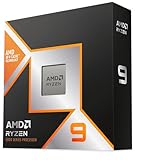
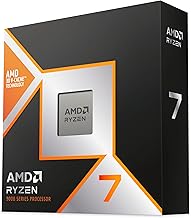
AMD Ryzen 9 9950X3D
The 9950X3D is the closest thing to a no-compromise desktop chip. It’s a genuine 16-core workstation processor that happens to also be a top-tier gaming CPU, and that dual identity is the entire pitch. In Blender, Handbrake, code compilation, and multi-instance workloads it’s close to twice as fast as the 9800X3D, and it holds that lead while giving up nothing measurable in games once the driver stack is current.
The caveat is that its performance depends on software doing the right thing. AMD’s scheduling has matured a lot since the 7950X3D era, but the occasional title still needs a manual nudge. If you’d rather sidestep the setup entirely, prebuilds such as the Panorama XL RTX 5080 with the 9950X3D arrive validated, and the Micro Center 9950X3D with GIGABYTE X870E AORUS Elite WIFI7 ICE combo is a clean route to a properly matched board with USB4 and Wi-Fi 7.
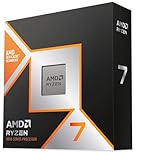
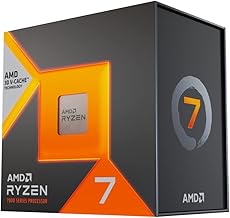
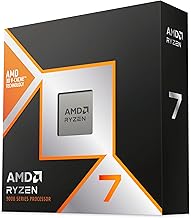
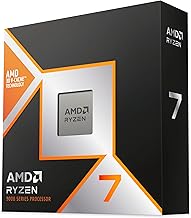
AMD Ryzen 7 9800X3D
The 9800X3D remains the smartest gaming purchase on the market, and that hasn’t changed in two years. Eight cores with a full slab of stacked cache is exactly what game engines want, and because there’s no second CCD, there’s no thread-scheduling variable to worry about — you install it and it just works at full speed in every title.
It’s also the easier build. Lower power draw means a mid-range B850 board and a quality air cooler are genuinely sufficient, and the money saved on CPU, board, and cooling can go straight into a better GPU, which will do far more for your frame rate. Its ceiling shows up only in heavily threaded work: if you regularly export long timelines or run big compiles, you’ll feel the missing eight cores.
Which Should You Buy?
- For pure 1440p/4K gaming: Pick the 9800X3D and spend the difference on your graphics card.
- For gaming plus content creation: Pick the 9950X3D — it’s the only one of the two that won’t hold back renders and exports.
- For single-PC streaming or heavy multitasking: Pick the 9950X3D, or step up to the 9950X3D2 Dual Edition if you want cache on both CCDs.
- For productivity-first builds where gaming is secondary: Consider the standard Ryzen 9 9950X, which offers the same 16 cores for less.
- For a fast, hassle-free build: A CPU-and-motherboard combo or a configured 9950X3D desktop removes compatibility guesswork.
Frequently Asked Questions
Is the 9950X3D actually faster than the 9800X3D in games?
Marginally, and not reliably. Averaged across a broad suite the two trade places within a few percent — well inside run-to-run variance. Don’t pay the premium for frame rate alone.
Do I need a new motherboard?
No. Both are AM5 and work in B650, X670, B850, and X870-series boards with an updated BIOS. Check your board vendor’s support page before buying.
What cooler should I use?
A high-end dual-tower air cooler is fine for the 9800X3D. For the 9950X3D’s 170W envelope, a 280mm or 360mm liquid cooler is the safer choice for sustained boost.
Can these CPUs be overclocked?
Yes. Unlike first-generation X3D parts, both support full multiplier overclocking and Precision Boost Overdrive, though Curve Optimizer undervolting usually delivers better results than raw clock chasing.