Key takeaways
- Frame pacing: 144Hz refreshes every 6.9ms; 240Hz every 4.2ms. That ~2.7ms saving is real but small — roughly a third of the improvement you got moving from 60Hz to 144Hz.
- Motion clarity: Higher refresh reduces sample-and-hold blur, so text on walls, enemy outlines, and flick-shot targets stay legible while you’re panning quickly.
- GPU demand: A 144Hz panel is satisfied by ~144fps; a 240Hz panel needs ~240fps to be fully utilized. In esports titles that’s easy, but in modern AAA games it usually isn’t.
- Resolution trade-off: At a given budget, 144Hz buys you 1440p; 240Hz generally keeps you at 1080p. Sharpness versus speed is the real decision for most buyers.
- Panel technology: 240Hz models increasingly ship with Fast IPS and sub-1ms grey-to-grey response, while budget 144Hz displays still often use slower VA or older IPS panels that smear in dark scenes.
- Connectivity: 240Hz at 1080p requires DisplayPort 1.2 or newer, or HDMI 2.0+. Older HDMI ports and cheap cables will silently cap you at 120Hz or 144Hz.
What's inside
For most of the last decade, 144Hz was the line that separated a “gaming monitor” from an ordinary desktop display. It delivered the single biggest perceptual jump most players ever experience — the leap from 60Hz — and it did so without demanding a top-tier graphics card. In 2026, though, that line has moved. Fast IPS panels running at 240Hz have collapsed into mainstream pricing, and a 240Hz display now costs roughly what a decent 144Hz model did two or three years ago.
That makes the 144Hz vs 240Hz decision less about affordability and more about fit. A higher refresh rate is only useful if your GPU can actually feed it, if you play the kind of games where motion clarity translates into results, and if you’re not sacrificing resolution or panel quality to get there. Below we break down what genuinely changes between the two tiers, and which 2026 displays make the strongest case at each level.
As an Amazon Associate we earn from qualifying purchases at no extra cost to you. Product prices and availability are accurate as of the date shown and are subject to change.



⚡ Save on Your Next PC — Amazon Prime
Prime members get fast free shipping on the systems above, plus early access to Prime Day & Black Friday PC deals. New members get a 30-day free trial.
Watch: 144Hz vs 240Hz Monitor: Worth It in 2026? — Video Review
Quick Verdict
Choose 144Hz if you play a broad mix of single-player, RPG, and story-driven titles, run a mid-range GPU, or want to put your budget toward higher resolution and better color instead of raw speed. Choose 240Hz if competitive shooters, fighting games, or racing sims make up the bulk of your playtime and you consistently push frame rates above roughly 180fps — at 1080p in 2026, that upgrade costs very little extra.
Key Differences
- Frame pacing: 144Hz refreshes every 6.9ms; 240Hz every 4.2ms. That ~2.7ms saving is real but small — roughly a third of the improvement you got moving from 60Hz to 144Hz.
- Motion clarity: Higher refresh reduces sample-and-hold blur, so text on walls, enemy outlines, and flick-shot targets stay legible while you’re panning quickly.
- GPU demand: A 144Hz panel is satisfied by ~144fps; a 240Hz panel needs ~240fps to be fully utilized. In esports titles that’s easy, but in modern AAA games it usually isn’t.
- Resolution trade-off: At a given budget, 144Hz buys you 1440p; 240Hz generally keeps you at 1080p. Sharpness versus speed is the real decision for most buyers.
- Panel technology: 240Hz models increasingly ship with Fast IPS and sub-1ms grey-to-grey response, while budget 144Hz displays still often use slower VA or older IPS panels that smear in dark scenes.
- Connectivity: 240Hz at 1080p requires DisplayPort 1.2 or newer, or HDMI 2.0+. Older HDMI ports and cheap cables will silently cap you at 120Hz or 144Hz.
144Hz Monitors: The Balanced Sweet Spot
144Hz remains the most sensible default for players who don’t live inside competitive shooters. It’s high enough that motion feels fluid and input lag largely disappears as a complaint, but low enough that a mid-range GPU can hold the frame rate in demanding games without dropping every setting to low. If you’re gaming on hardware in the RTX 4060 or RX 7600 class, 144Hz is far more likely to be a rate you actually hit than a number on the box.
The stronger argument for 144Hz in 2026 is what you can spend the savings on. At the same price as a fast 1080p/240Hz panel, you can usually step up to 1440p at 144Hz or 165Hz — a change you notice every second you use the display, not just during fast pans. For RPGs, strategy games, sim racing cockpits, and anything you also work in, extra pixels and better color coverage tend to matter more than the last 96Hz of refresh rate.
240Hz Monitors: Built for Competitive Play
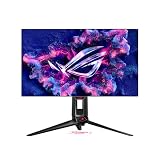
If your library is dominated by Valorant, CS2, Overwatch, Apex, or Rocket League, 240Hz is where the money should go. The clearest all-rounder here is the ASUS TUF Gaming VG279QM5A, a 27-inch Fast IPS panel with a 0.3ms rated response, G-SYNC compatibility, and Extreme Low Motion Blur Sync — the combination that actually delivers the crisp, low-smear motion 240Hz promises rather than just the refresh number. Its 99% sRGB coverage also means it doesn’t look washed out when you step away from ranked play.
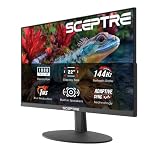
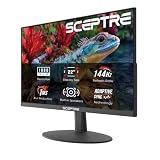
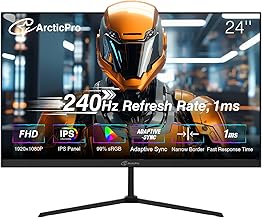
For tighter budgets, the value tier has become genuinely good. The Dell SE2426HG (23.8-inch) and Dell SE2726HG (27-inch) both pair 240Hz IPS panels with FreeSync Premium and DisplayPort 1.4, and they’re the safest picks if you want a flat, no-nonsense esports screen. If you’d rather have immersion, the Sceptre C255B-FWT240 adds a 24.5-inch 1500R curve and built-in speakers, while the SANSUI 27-inch curved model brings 130% sRGB and a 4000:1 contrast ratio. The SANSUI 32-inch curved 240Hz is the outlier — a big, cinematic panel, though 1080p stretched across 32 inches will look noticeably softer up close.
Which Should You Buy?
- For competitive FPS and ranked play: pick 240Hz — the ASUS TUF VG279QM5A is the best-balanced option thanks to its Fast IPS panel and ELMB Sync.
- For a mid-range GPU and mixed AAA gaming: pick 144Hz, ideally at 1440p, so your card renders frames you can actually see.
- For the best 240Hz on a budget: pick the Dell SE2426HG for a compact desk, or the SE2726HG if you want 27 inches for a similar outlay.
- For immersion and desk presence: pick a curved 240Hz panel — the Sceptre C255B-FWT240 for a tighter esports feel, or the SANSUI 32-inch for maximum screen size.
- For gaming plus creative or office work: pick 144Hz at higher resolution; sharpness and color accuracy will serve you better than refresh rate.
Frequently Asked Questions
Can you actually see the difference between 144Hz and 240Hz?
Yes, but it’s subtle. Most players notice smoother tracking and less blur during fast horizontal pans within a few minutes of side-by-side use. It is nowhere near as dramatic as the 60Hz to 144Hz jump, and casual players often can’t identify it blind.
Do I need an expensive GPU for a 240Hz monitor?
Not for esports titles — most modern mid-range cards clear 240fps in CS2, Valorant, or Rocket League at 1080p. For AAA games you’ll usually land between 90 and 150fps, in which case the extra refresh headroom simply sits unused rather than causing problems.
Is 240Hz worth it at 1080p, or should I go 1440p at 144Hz?
It depends on genre. Competitive players almost always prefer 1080p/240Hz for clarity in motion and lower system load. Everyone else generally gets more day-to-day satisfaction from 1440p at 144Hz.
What cable do I need to hit 240Hz?
Use DisplayPort 1.2 or higher, or HDMI 2.0 or higher. Displays like the Dell SE2426HG and Sceptre C255B include DisplayPort 1.4 inputs, and some bundles ship the cable — but you may still need to enable the full refresh rate manually in Windows display settings.
Final Verdict
In 2026 the honest answer is that 240Hz has become the default for competitive 1080p gaming, and the ASUS TUF VG279QM5A or either Dell SE-series panel will