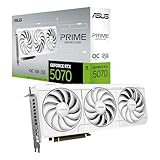
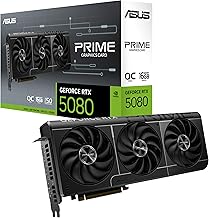
Key takeaways
- Shader hardware: The RTX 5080 ships with 10,752 CUDA cores against the 5070 Ti’s 8,960 — roughly 20% more raw shading, RT, and Tensor throughput.
- Memory: Both use 16GB of GDDR7 on a 256-bit bus, but the 5080 runs faster modules for around 960GB/s of bandwidth versus roughly 896GB/s. Capacity is identical, so neither card has a VRAM advantage.
- Real-world performance: Expect a 15–20% lead for the 5080 at 4K, shrinking to closer to 10–15% at 1440p where CPU limits start to intrude.
- Power draw: The 5080 is rated near 360W and generally wants an 850W PSU; the 5070 Ti sits around 300W and is comfortable on a quality 750W unit.
- Physical footprint: RTX 5080 partner cards are typically larger and heavier, with premium models reaching 3.8 slots. The 5070 Ti has a wider selection of compact, two-and-a-half-slot designs.
- Value per frame: The 5070 Ti almost always wins on cost per frame; the 5080 wins on peak capability and long-term headroom.
What's inside
Two years into the Blackwell generation, the GeForce RTX 5080 and RTX 5070 Ti have settled into clearly defined roles. One is the near-flagship built to push 4K at high refresh rates; the other is the value champion that quietly handles almost everything for meaningfully less money. What complicates the choice is how much they share: both are built on the same GB203 silicon, both carry 16GB of GDDR7 on a 256-bit bus, and both support the full DLSS 4 feature set including Multi Frame Generation.
That overlap is exactly why this decision deserves a closer look in 2026. With current releases leaning harder on path tracing and neural rendering, the gap between these two cards appears in specific scenarios rather than uniformly across your library. Below we break down the measurable performance difference, the board partner designs worth your money, and which card actually suits your monitor, your case, and your budget.
As an Amazon Associate we earn from qualifying purchases at no extra cost to you. Product prices and availability are accurate as of the date shown and are subject to change.



⚡ Save on Your Next PC — Amazon Prime
Prime members get fast free shipping on the systems above, plus early access to Prime Day & Black Friday PC deals. New members get a 30-day free trial.
Watch: RTX 5080 vs 5070 Ti: Worth It in 2026? — Video Review
Quick Verdict
Buy the RTX 5080 if you game at 4K on a 120Hz-or-faster display, run path-traced titles at native-ish settings, or lean on your GPU for rendering, AI work, and video encoding — it’s the card with headroom to spare. Buy the RTX 5070 Ti if you’re primarily a 1440p high-refresh gamer, an entry-level 4K player comfortable using DLSS, or building within a tighter budget where the money saved is better spent on a stronger CPU, faster storage, or a better monitor.
Key Differences
- Shader hardware: The RTX 5080 ships with 10,752 CUDA cores against the 5070 Ti’s 8,960 — roughly 20% more raw shading, RT, and Tensor throughput.
- Memory: Both use 16GB of GDDR7 on a 256-bit bus, but the 5080 runs faster modules for around 960GB/s of bandwidth versus roughly 896GB/s. Capacity is identical, so neither card has a VRAM advantage.
- Real-world performance: Expect a 15–20% lead for the 5080 at 4K, shrinking to closer to 10–15% at 1440p where CPU limits start to intrude.
- Power draw: The 5080 is rated near 360W and generally wants an 850W PSU; the 5070 Ti sits around 300W and is comfortable on a quality 750W unit.
- Physical footprint: RTX 5080 partner cards are typically larger and heavier, with premium models reaching 3.8 slots. The 5070 Ti has a wider selection of compact, two-and-a-half-slot designs.
- Value per frame: The 5070 Ti almost always wins on cost per frame; the 5080 wins on peak capability and long-term headroom.
GeForce RTX 5080: The 4K Performance Pick
The RTX 5080 is the card to buy when you want 4K without compromise. In demanding path-traced titles it’s the difference between dialing settings back and leaving them alone, and its extra Tensor throughput means DLSS 4 upscaling and frame generation have more overhead to work with. It’s also the better creative tool, with dual encoders and additional bandwidth that pay off in Blender, DaVinci Resolve, and local AI workloads.
Board partner choice matters more here than at any other tier. The ASUS ROG Astral RTX 5080 sits at the top with its four-fan, 3.8-slot cooler, vapor chamber, and three-year warranty — excellent thermals and acoustics, but it demands a genuinely large case. The ASUS TUF Gaming RTX 5080 OC and GIGABYTE RTX 5080 Gaming OC with WINDFORCE cooling are the sensible mainstream picks, while the MSI Ventus 3X OC White is the obvious fit for a light-themed build. The PNY Epic-X RGB Triple-Fan is the value-oriented entry, and if you’re working in a small form factor chassis, the GIGABYTE RTX 5080 WINDFORCE OC SFF is the rare 5080 designed to actually fit.
GeForce RTX 5070 Ti: The Smart Money
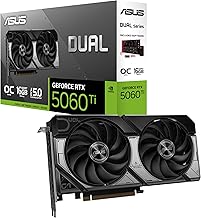
The RTX 5070 Ti remains the enthusiast sweet spot. At 1440p it delivers well past 144fps in the vast majority of modern titles, and with DLSS 4 quality upscaling it’s a thoroughly capable 4K/60–100fps card. Crucially, it carries the same 16GB frame buffer as the 5080, so it won’t run out of memory before it runs out of shading power — the failure mode that shortens the useful life of lesser cards.
It’s also the easier card to build around. Lower power draw means less heat dumped into your case, quieter operation under sustained load, and compatibility with mid-range power supplies you may already own. For anyone upgrading from a 3070, 3080, or 4070, the 5070 Ti represents a substantial generational jump without forcing a platform-wide overhaul.
Which Should You Buy?
- For 4K 120Hz-plus gaming: Pick the RTX 5080 — the extra bandwidth and shader count matter most exactly where you’re playing.
- For 1440p high-refresh: Pick the RTX 5070 Ti; you’ll be CPU-limited long before the GPU becomes the bottleneck.
- For content creation and AI work: Pick the RTX 5080 for its stronger Tensor performance and encode throughput.
- For SFF and compact builds: The 5070 Ti has more options, though the GIGABYTE RTX 5080 WINDFORCE OC SFF is a legitimate alternative if your case allows.
- For best overall value: The RTX 5070 Ti, every time — put the savings toward a faster CPU or a better display.
Frequently Asked Questions
Is the RTX 5080 worth the extra cost over the 5070 Ti?
Only if you’re gaming at 4K or running GPU-accelerated professional workloads. At 1440p the performance delta rarely justifies the premium, and the 5070 Ti’s identical VRAM capacity removes the usual longevity argument for stepping up.