Key takeaways
- GPU load: 4K renders roughly 2.25× the pixels of 1440p, so expect a 40–55% frame-rate drop in native rendering — the single biggest practical difference between the two.
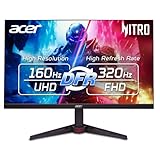
- Refresh ceiling: 1440p panels routinely hit 240–360Hz, while most 4K displays top out around 160Hz unless they use dual-mode, like the LG UltraGear’s 165Hz/330Hz switch or the Acer Nitro’s 320Hz DFR mode.
- Pixel density: At 27 inches, 4K delivers roughly 163 PPI versus 109 PPI at 1440p — text, UI elements and distant textures are visibly cleaner without anti-aliasing crutches.
- Upscaling reliance: 4K depends heavily on DLSS, FSR and frame generation to stay above 100fps in modern titles; 1440p often runs native, avoiding upscaling artifacts entirely.
- Screen size scaling: 1440p starts to look soft past 27 inches, whereas 4K stays crisp at 32 inches and beyond — one reason the Sceptre and LG 32-inch panels make sense at that size.
- Consoles and value: PS5 Pro and Xbox Series X output 4K/120 natively over HDMI 2.1, while 1440p buyers get more panel quality — OLED, higher refresh, better HDR — for the same spend.
What's inside
The 1440p versus 4K debate used to be simple: 1440p was the sweet spot for frame rates, and 4K was a luxury that punished all but the most expensive graphics cards. In 2026 that line has blurred considerably. High-refresh 4K panels have collapsed in price, HDMI 2.1 is standard on virtually every new display, and dual-mode technology now lets a single monitor behave like two — a sharp 4K panel for single-player games and a blisteringly fast lower-resolution display for competitive shooters.
That makes the decision less about raw resolution and more about how you actually play. If your library is dominated by esports titles and you want every frame your GPU can produce, 1440p (or a dual-mode panel running in its high-refresh state) still wins on responsiveness. If you play cinematic, graphically demanding games, do creative work between sessions, or sit close to a 32-inch screen, 4K’s pixel density is genuinely transformative. Below we break down where each resolution earns its keep, and which monitors are worth your money right now.
As an Amazon Associate we earn from qualifying purchases at no extra cost to you. Product prices and availability are accurate as of the date shown and are subject to change.


⚡ Save on Your Next PC — Amazon Prime
Prime members get fast free shipping on the systems above, plus early access to Prime Day & Black Friday PC deals. New members get a 30-day free trial.
Watch: 1440p vs 4K Gaming Monitor: 2026 Guide — Video Review
Quick Verdict
Choose 1440p — or a dual-mode display like the LG 32GX850A-B UltraGear OLED that switches to 330Hz — if competitive frame rates, a mid-range GPU, or an ultrawide field of view matter most; the INNOCN 49C1G 49-inch 32:9 panel is the immersion-first alternative for sim racers and flight fans. Choose 4K if you want maximum detail on a 27–32 inch screen and own an upper-tier GPU: the Acer Nitro VG270K V4 and KTC H27P22S deliver 160Hz 4K IPS at sane prices, the ASUS TUF VG27UQ1A adds broad G-SYNC/FreeSync certification and a three-year warranty, and the Sceptre U325W-UPT is the budget route to a large 32-inch 4K desktop.
Key Differences
- GPU load: 4K renders roughly 2.25× the pixels of 1440p, so expect a 40–55% frame-rate drop in native rendering — the single biggest practical difference between the two.
- Refresh ceiling: 1440p panels routinely hit 240–360Hz, while most 4K displays top out around 160Hz unless they use dual-mode, like the LG UltraGear’s 165Hz/330Hz switch or the Acer Nitro’s 320Hz DFR mode.
- Pixel density: At 27 inches, 4K delivers roughly 163 PPI versus 109 PPI at 1440p — text, UI elements and distant textures are visibly cleaner without anti-aliasing crutches.
- Upscaling reliance: 4K depends heavily on DLSS, FSR and frame generation to stay above 100fps in modern titles; 1440p often runs native, avoiding upscaling artifacts entirely.
- Screen size scaling: 1440p starts to look soft past 27 inches, whereas 4K stays crisp at 32 inches and beyond — one reason the Sceptre and LG 32-inch panels make sense at that size.
- Consoles and value: PS5 Pro and Xbox Series X output 4K/120 natively over HDMI 2.1, while 1440p buyers get more panel quality — OLED, higher refresh, better HDR — for the same spend.
1440p and High-Refresh Gaming: Frames First
The argument for 1440p in 2026 is unchanged in principle but stronger in execution. A mid-range card can drive 1440p at well over 144fps in most competitive titles without leaning on upscaling, and the resolution scales beautifully as GPUs age — you simply gain headroom instead of losing playability. For CS2, Valorant, Apex or Marvel Rivals players, the motion clarity of 240Hz-plus at a lower resolution is worth far more than extra pixels you never notice mid-firefight.
Two products here serve that philosophy differently. The LG 32GX850A-B UltraGear is arguably the best of both worlds: a glossy 4K OLED with a 0.03ms response time that drops to 1080p at 330Hz on demand, plus G-SYNC and FreeSync Premium Pro. The INNOCN 49C1G takes the opposite approach, spending its pixels horizontally — a 3840×1080 32:9 curved canvas at 144Hz with 99% sRGB, HDR400, USB-C and an R1800 curve. It is far easier to drive than 4K while feeling more immersive in racing sims and open-world games.
4K Gaming Monitors: Detail and Desktop Space
Native 4K is the visual upgrade you can’t unsee. Foliage stops shimmering, distant text becomes legible, and HDR highlights have more room to breathe. The 27-inch class is where value peaks: the Acer Nitro VG270K V4 pairs a 160Hz IPS panel with 0.5ms response, dual HDMI 2.1, FreeSync Premium and a 320Hz dual-frame-rate mode, while the KTC H27P22S counters with a fast IPS panel, 1ms GTG, HDR400, 132% sRGB coverage and a full tilt/swivel/pivot/height stand.
If you want certified adaptive sync and after-sales support, the ASUS TUF VG27UQ1A is the safe pick — 160Hz, 1ms, ELMB Sync, NVIDIA G-SYNC Compatible, 95% DCI-P3 and a three-year warranty. For those who prioritise size and screen real estate over refresh rate, the Sceptre U325W-UPT offers a 32-inch 4K panel with dual DisplayPort, dual HDMI and 99% sRGB, making it a strong dual-purpose display for gaming and content work.
Which Should You Buy?
- For competitive esports: pick a high-refresh setup — the LG 32GX850A-B in 330Hz dual mode gives you OLED response times without giving up 4K for single-player games.
- For best all-round 4K value: pick the Acer Nitro VG270K V4 or KTC H27P22S; both hit 160Hz at 27 inches with HDMI 2.1-class connectivity.
- For immersion and sim racing: pick the INNOCN 49C1G — a 49-inch 32:9 curve does more for presence than extra vertical pixels.
- For a large productivity-plus-gaming screen: pick the Sceptre U325W-UPT at 32 inches, where 4K density genuinely pays off.
- For warranty and colour accuracy: pick the ASUS TUF VG27UQ1A with its 95% DCI-P3 coverage and three-year cover.
Frequently Asked Questions
Do I need a high-end GPU for 4K gaming in 2026?
For native 4K above 100fps in demanding titles, yes. With DLSS or FSR quality upscaling, however, upper-mid-range cards handle 4K/160Hz comfortably in most games, especially with frame generation enabled.
Is 1440p still worth buying?
Absolutely — for competitive players and anyone on a mid-range GPU, 1440p delivers the highest frames per dollar. Dual-mode 4K panels now offer a compelling middle path if your budget stretches.
Does 4K look better at 27 inches or 32 inches?
27-inch 4K is exceptionally sharp but may require display scaling for desktop text. 32-inch 4K balances density with usable screen space and is generally the more comfortable everyday choice.
What is dual-mode and does it matter?
Dual-mode lets one panel run at native 4K/high-detail settings or switch to a lower resolution with a much higher refresh rate. It effectively removes the need to choose between resolutions.
Final Verdict
If your priority is competitive performance or you’re pairing a mid-range GPU, high-refresh 1440p-class gaming remains the smart buy — and the INNOCN 49C