Key takeaways
- Contrast and black level: OLED delivers per-pixel illumination and effectively infinite contrast; IPS blacks look dark grey by comparison, and even good mini-LED backlights show some blooming around bright objects.
- Motion clarity: OLED response times of 0.03ms virtually eliminate smearing behind moving objects. Fast IPS panels are quick at 1ms GtG but still show mild ghosting in dark transitions.
- Brightness: IPS sustains high full-screen brightness indefinitely. OLED hits enormous peak highlights in small windows but dims full-field white via automatic brightness limiting.
- HDR performance: DisplayHDR TrueBlack 400/500 certifications on OLED describe a genuinely different HDR experience than the same nominal numbers on an edge-lit IPS.
- Longevity and burn-in: IPS has no burn-in risk. OLED mitigates it with pixel shifting, logo dimming, and panel refresh cycles, plus warranties that now cover it explicitly.
- Price per refresh hertz: IPS wins on raw specs for the money; OLED charges a premium for image quality rather than for numbers on a box.
What's inside
- Watch: OLED vs IPS Gaming Monitor: 2026 Comparison — Video Review
- Quick Verdict
- Key Differences
- OLED Gaming Monitors: Best Image Quality and Motion Clarity
- IPS Gaming Monitors: Brightness, Value and Peace of Mind
- Which Should You Buy?
- Related Guides
- Frequently Asked Questions
- Final Verdict
- Related Articles
- Related Guides
Walk into any 2026 gaming build discussion and the same fork in the road appears: OLED or IPS. Both panel types can now hit triple-digit refresh rates, both support adaptive sync, and both come in sizes from compact 27-inch QHD screens to sprawling ultrawides. The difference is in how they make light. OLED pixels emit their own light and switch off completely for true black, while IPS panels rely on a backlight shining through a liquid crystal layer. That single distinction cascades into contrast, motion clarity, brightness, price, and long-term durability.
- Watch: OLED vs IPS Gaming Monitor: 2026 Comparison — Video Review
- Quick Verdict
- Key Differences
- OLED Gaming Monitors: Best Image Quality and Motion Clarity
- IPS Gaming Monitors: Brightness, Value and Peace of Mind
- Which Should You Buy?
- Related Guides
- Frequently Asked Questions
- Final Verdict
- Related Articles
- Related Guides
The choice matters more in 2026 than it did even two years ago, because both technologies finally got good at their weaknesses. QD-OLED and WOLED panels now ship with meaningful burn-in protection and multi-year warranties that explicitly cover it, and their prices have fallen into territory that used to be premium IPS money. Meanwhile IPS has pushed past 500Hz at 1080p, adopted mini-LED backlights with hundreds of dimming zones, and remains the brightness king for sunlit rooms. Neither is a bad buy — but one of them is clearly better for how you play.
As an Amazon Associate we earn from qualifying purchases at no extra cost to you. Product prices and availability are accurate as of the date shown and are subject to change.


⚡ Save on Your Next PC — Amazon Prime
Prime members get fast free shipping on the systems above, plus early access to Prime Day & Black Friday PC deals. New members get a 30-day free trial.
Watch: OLED vs IPS Gaming Monitor: 2026 Comparison — Video Review
Quick Verdict
Choose OLED if you play story-driven, visually rich games, watch a lot of content on the same screen, and want the best-looking image money can buy at a given size — the near-instant pixel response also makes it the sharpest-moving panel type available. Choose IPS if you play in a bright room, leave static HUDs or spreadsheets on screen for hours a day, want the highest refresh rate per dollar, or simply want a monitor you never have to think about maintaining.
Key Differences
- Contrast and black level: OLED delivers per-pixel illumination and effectively infinite contrast; IPS blacks look dark grey by comparison, and even good mini-LED backlights show some blooming around bright objects.
- Motion clarity: OLED response times of 0.03ms virtually eliminate smearing behind moving objects. Fast IPS panels are quick at 1ms GtG but still show mild ghosting in dark transitions.
- Brightness: IPS sustains high full-screen brightness indefinitely. OLED hits enormous peak highlights in small windows but dims full-field white via automatic brightness limiting.
- HDR performance: DisplayHDR TrueBlack 400/500 certifications on OLED describe a genuinely different HDR experience than the same nominal numbers on an edge-lit IPS.
- Longevity and burn-in: IPS has no burn-in risk. OLED mitigates it with pixel shifting, logo dimming, and panel refresh cycles, plus warranties that now cover it explicitly.
- Price per refresh hertz: IPS wins on raw specs for the money; OLED charges a premium for image quality rather than for numbers on a box.
OLED Gaming Monitors: Best Image Quality and Motion Clarity
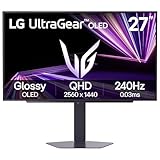
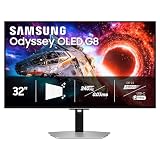
The 27-inch QHD OLED has become the default enthusiast pick, and the field is deep. The Samsung Odyssey OLED G6 (G61SH) pairs a QD-OLED panel with 240Hz, a glare-free matte coating that tames reflections better than most, Pantone validation, and a three-year warranty alongside Samsung’s OLED Safeguard protection suite. LG’s UltraGear 27GX700A-B pushes to 280Hz with DisplayHDR TrueBlack 500 and up to 99.5% DCI-P3 coverage, while the UltraGear 27GX704A-B covers the same ground at 240Hz and TrueBlack 400 for buyers who don’t need the extra headroom. The AOC Agon Pro AG276QZD2 rounds out the group with up to 280Hz, built-in speakers, and a four-year warranty.
If you want scale, OLED goes big. The Alienware AW3425DW brings QD-OLED to a 34.2-inch WQHD ultrawide with an 1800R curve at 240Hz — the sweet spot for sim racing, flight, and RPGs. The Samsung 49″ Odyssey G93SC doubles down with a DQHD super-ultrawide that replaces a dual-monitor setup entirely, still at 240Hz with 0.03ms response and G-Sync Compatible plus FreeSync Premium Pro support. All of these share HDMI 2.1 or DisplayPort connectivity suitable for modern GPUs and consoles.
IPS Gaming Monitors: Brightness, Value and Peace of Mind
IPS earns its place through practicality. A good IPS panel holds 400–600 nits across the entire screen without dimming, which matters enormously if your desk faces a window or you game during the day. Colours stay consistent from wide viewing angles, text rendering is conventional with no subpixel fringing, and there is no automatic brightness limiter making the image shift as scene content changes. For streamers, content creators, and anyone doing colour-critical work between matches, that stability is worth a lot.
IPS is also the value play. For the price of a mid-range OLED you can get a higher refresh rate, a larger screen, or a 4K resolution — and you can leave a static Discord window, stream deck overlay, or trading dashboard on screen for eight hours a day without a second thought. Mini-LED IPS models narrow the contrast gap considerably, though they never fully close it. If your monitor doubles as your work display and you keep hardware for five-plus years, IPS remains the low-risk choice.
Which Should You Buy?
- For single-player and visual showcase games: pick OLED — the contrast advantage in dark scenes is transformative and cannot be replicated by any backlight.
- For competitive FPS on a budget: pick IPS, where the same money buys a higher refresh rate; step up to a 280Hz OLED like the LG 27GX700A-B if budget allows.
- For bright rooms and daytime gaming: pick IPS, or choose a matte OLED such as the Samsung Odyssey OLED G6 if you want the best of both.
- For immersion and multitasking: pick a large OLED — the Alienware AW3425DW for a curved ultrawide, or the Samsung 49″ Odyssey G93SC to replace two monitors.
- For a mixed work-and-play machine: pick IPS if static UI dominates your screen time; otherwise the AOC Agon Pro AG276QZD2’s four-year warranty makes OLED a safe compromise.
Frequently Asked Questions
Is OLED burn-in still a real risk in 2026?
It is a manageable one. Modern panels use pixel shifting, logo and taskbar dimming, and scheduled panel refresh cycles, and manufacturers back them with multi-year warranties that specifically cover burn-in. Typical mixed gaming and media use is very unlikely to cause visible retention within the warranty period.
Does 240Hz OLED feel faster than 240Hz IPS?
Yes, noticeably. Refresh rate is identical, but OLED’s near-instantaneous pixel transitions remove the smearing that IPS still shows in dark-to-dark changes, so moving objects hold more detail at the same frame rate.
Are these monitors suitable for PS5 and Xbox Series X?
The models with HDMI 2.1, including the LG UltraGear 27GX700A-B and 27GX704A-B, support high-refresh console output with VRR. Check that your chosen panel’s resolution matches what your console outputs natively for the cleanest result.
Is a matte or glossy OLED coating better?
Glossy produces slightly deeper-looking blacks in a dark room; matte, as used on the glare-free Samsung Odyssey OLED G6, is far more usable under overhead lighting or near a window. Pick based on your room, not on spec sheets.
Final Verdict
In 2026 the honest answer is that OLED has won on image quality and motion, and IPS has won on brightness, value, and durability — so buy for your room and your habits rather than for the technology label. If you game mostly in controlled lighting and want the most striking picture available, a QD-OLED like the Samsung Odyssey OLED G6, LG UltraGear 27GX700A-B, or Alienware AW3425DW is the upgrade you’ll notice every single session. If your screen lives in daylight and doubles as an all-day workstation, a quality IPS panel will serve you longer and cost you less.