Key takeaways
- Memory: The RX 9070 XT ships with 16GB of GDDR6 on a 256-bit bus; the RTX 5070 has 12GB of faster GDDR7 on a narrower 192-bit bus. Bandwidth is roughly comparable, but capacity is not — and 12GB is the tighter constraint at 4K in 2026.
- Raster performance: Across a broad game suite at 1440p, the 9070 XT typically leads by a mid-double-digit percentage. The gap widens at 4K and narrows at 1080p, where CPU limits flatten both cards.
- Ray tracing: RDNA 4 closed most of the historic gap, and the 9070 XT trades blows with the 5070 in standard RT titles. In heavy path-traced games, NVIDIA still pulls ahead.
- Upscaling and frame generation: FSR 4 is a genuine leap for AMD and looks excellent, but DLSS 4 has broader game support and Multi Frame Generation, which NVIDIA uses to multiply frame rates on high-refresh displays.
- Power and thermals: The 9070 XT draws around 300W under load and wants a quality 750W supply; the 5070 sits near 250W and is comfortable on 650W. That difference shows up in case temperatures and fan noise.
- Non-gaming work: NVENC, CUDA, and broad AI framework support still make the RTX 5070 the default for streamers, editors, and hobbyist ML users.
What's inside
Two years into the RDNA 4 and Blackwell generation, the mid-to-upper mainstream GPU bracket has settled into a genuine two-horse race. AMD’s Radeon RX 9070 XT and NVIDIA’s GeForce RTX 5070 sit close enough in street price that most builders shopping for a 1440p-first card will end up comparing exactly these two — and the decision is less obvious than it looks on a spec sheet.
The short version: one card leans on raw shader throughput and a generous 16GB frame buffer, the other on a more mature software stack and the best frame generation technology on the market. Which matters more depends entirely on the games you play, the resolution you target, and whether your GPU does anything besides game. Below, we break down the real differences in 2026, then match each card to the buyer it actually suits.
As an Amazon Associate we earn from qualifying purchases.





⚡ Save on Your Next PC — Amazon Prime
Prime members get fast free shipping on the systems above, plus early access to Prime Day & Black Friday PC deals. New members get a 30-day free trial.
Watch: RX 9070 XT vs RTX 5070: 2026 Comparison — Video Review
Quick Verdict
The Radeon RX 9070 XT is the better buy for pure rasterized performance at 1440p and 4K, and its 16GB of VRAM gives it far more headroom for texture-heavy modern titles and high-resolution modding. The GeForce RTX 5070 is the smarter pick if you lean on DLSS 4 Multi Frame Generation, play path-traced showcase titles, stream or edit video, or run CUDA-dependent creative and AI workloads — and it does all that on noticeably less power.
Key Differences
- Memory: The RX 9070 XT ships with 16GB of GDDR6 on a 256-bit bus; the RTX 5070 has 12GB of faster GDDR7 on a narrower 192-bit bus. Bandwidth is roughly comparable, but capacity is not — and 12GB is the tighter constraint at 4K in 2026.
- Raster performance: Across a broad game suite at 1440p, the 9070 XT typically leads by a mid-double-digit percentage. The gap widens at 4K and narrows at 1080p, where CPU limits flatten both cards.
- Ray tracing: RDNA 4 closed most of the historic gap, and the 9070 XT trades blows with the 5070 in standard RT titles. In heavy path-traced games, NVIDIA still pulls ahead.
- Upscaling and frame generation: FSR 4 is a genuine leap for AMD and looks excellent, but DLSS 4 has broader game support and Multi Frame Generation, which NVIDIA uses to multiply frame rates on high-refresh displays.
- Power and thermals: The 9070 XT draws around 300W under load and wants a quality 750W supply; the 5070 sits near 250W and is comfortable on 650W. That difference shows up in case temperatures and fan noise.
- Non-gaming work: NVENC, CUDA, and broad AI framework support still make the RTX 5070 the default for streamers, editors, and hobbyist ML users.
Radeon RX 9070 XT: Maximum Frames Per Dollar
The 9070 XT is the enthusiast’s value play. Sixty-four RDNA 4 compute units and a 16GB frame buffer mean it rarely stumbles: you can run ultra textures, high-resolution shadow maps, and aggressive mod packs without the sudden frame-time hitching that a 12GB card can develop late in a generation. For anyone driving a 1440p high-refresh panel or a 4K display with upscaling enabled, it is the more consistently fast option of the two.
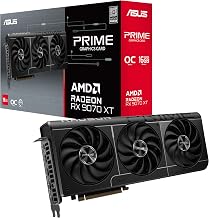
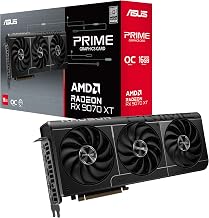
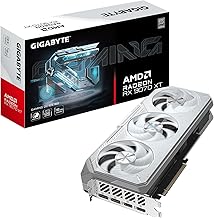
Board partner choice matters more here than on the NVIDIA side, because the higher power draw needs real cooling. The GIGABYTE RX 9070 XT Gaming OC 16G and its white Gaming OC ICE sibling are the heavyweight picks, with 2.7-slot coolers and server-grade thermal gel. The ASUS Prime RX 9070 XT OC is the best fit for compact builds thanks to its 2.5-slot Axial-tech design and dual BIOS. The ASRock Challenger OC and XFX Swift are strong triple-fan options at the sensible end of the range, while the PowerColor Reaper is the one to grab if airflow clearance is tight. All six carry PCIe 5.0 and DisplayPort 2.1, so display connectivity is a wash.
GeForce RTX 5070: The Smarter Software Stack
The RTX 5070 wins on polish rather than brute force. DLSS 4’s transformer-based upscaler remains the reference standard for image quality, and Multi Frame Generation can turn a 60fps baseline into something that genuinely saturates a 240Hz monitor. In titles that implement it well — and support is extensive in 2026 — the perceived smoothness advantage can outweigh the 9070 XT’s native rendering lead.
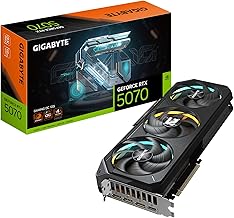
It is also the easier card to live with. Lower power draw means less heat dumped into your case, quieter fans, and compatibility with modest power supplies, which matters if you’re upgrading an existing prebuilt rather than starting fresh. Add NVENC for streaming and recording, plus CUDA support that no AMD alternative fully replaces, and the 5070 becomes hard to argue against for anyone whose PC pulls double duty. The 12GB frame buffer is the one real reservation — it’s adequate today, but it is the spec most likely to age poorly.
Which Should You Buy?
- For 1440p high-refresh gaming: Pick the RX 9070 XT. It delivers more native frames in the widest range of titles.
- For 4K on a budget: Pick the RX 9070 XT. The 16GB buffer is the deciding factor at this resolution.
- For path-traced showcase titles: Pick the RTX 5070, which handles the heaviest ray tracing workloads more gracefully.
- For streaming, editing, or AI work: Pick the RTX 5070 for NVENC and CUDA.
- For small-form-factor or low-wattage builds: Pick the RTX 5070, or the compact ASUS Prime 9070 XT if raster performance is the priority.
Frequently Asked Questions
Is 12GB of VRAM still enough in 2026?
For 1080p and most 1440p gaming, yes. At 4K with ultra textures, or in heavily modded games, 12GB is increasingly the limiting factor — which is where the 9070 XT’s 16GB pulls ahead.
How much power supply do I need?
Plan on a quality 750W unit for the RX 9070 XT and 650W for the RTX 5070, assuming a mainstream CPU. Both use standard connectors from reputable board partners.
Is FSR 4 competitive with DLSS 4?
In image quality, FSR 4 is close enough that most players won’t notice a difference in motion. DLSS 4 still wins on game support breadth and Multi Frame Generation.
Which RX 9070 XT model should I choose?
Cooling and clearance should drive the decision. The GIGABYTE Gaming OC models run coolest, the ASUS Prime fits tighter cases, and the PowerColor Reaper, ASRock Challenger, and XFX Swift all perform within a few percent of one another.
Final Verdict
If you want the most rendering performance per dollar and expect to keep the card for several years, the Radeon RX 9070 XT is the stronger buy — the extra VRAM alone justifies it for 1440p and 4K gamers. If your priorities include path tracing, DLSS 4 frame generation, streaming, or creative and AI workloads, the RTX 5070’s software ecosystem and lower power draw make it the more versatile machine. Both are good cards; the right one is simply the one that matches how you actually use your PC.